|


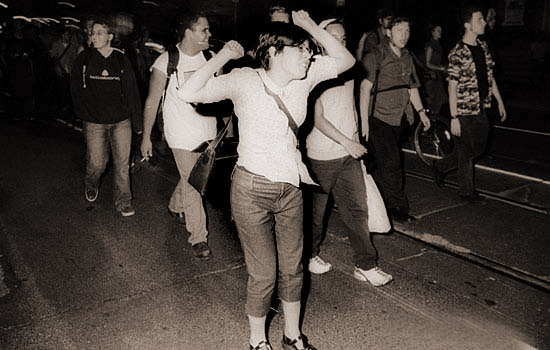
reclaim the streets : : : : : : : Reclaim the Streets manifests itself as a non-violent, direct action “reclaiming” of major roadways in order to have a party and political uprising. RTS events are spectacular and colourful and allow, for a brief period of time, a new and innovative use of a public space. The RTS movement was born out of a combination of the rave party and anti-car movements in the UK. In 1991 the first RTS group partied to support ‘walking, cycling and cheap or free public transport and against cars, roads and the system that pushes them.’ This simple mandate has sparked international support and the idea of simultaneous street parties has spread to cities all over Europe, Australia, North America and Africa. In 1998 Reclaim the Streets hit the concrete of Toronto. The action brought together the visions of many communities including artists wanting to infuse creativity into public space, anti-car bike enthusiasts, “pro-partiers”, and anti-poverty activists. Although many arguments erupted in those early planning stages all agreed that citizen interaction with public space needed to be challenged and recreated. As an organizer and faithful attendee, I witnessed moments of pure magic -- which renewed my faith in the power of activism and people coming together around a common goal. These creative interludes have included: make out sessions in front of police lines, stilt walkers in bikini briefs, sod being laid in the financial district, cotton candy eating, costumes, merriment and of course dancing. Yet, whenever we attempt to dismantle the status quo there is resistance. A fundamental disagreement that raged amongst organizers and participants over the years has been how do we negotiate with the intense police presence, how far do we push the boundaries and how do we support those amongst us that are inevitably arrested and scapegoated? These are questions we all face when confronting the tumultuous dance that is direct action. Some argued in favor of negotiation with the police. They believed violence and targeting would increase if we did not compromise and tailor our behavior according to police demands. Others felt this negotiation was futile as the police act as agents to further the rights and privileges of the middle class, and it is a mistake to treat them as responsible moral individuals. How have these debates been resolved in the year 2004? Last year I attended Reclaim the Streets no longer having any organizational ties but still sharing an affinity for the power that can erupt when art and activism intersect. While previously I had spent many hours discussing how to mobilize around those arrested, I myself was arrested for simply crossing the street off of Dundas Square. While attempting to set foot on the road at a busy downtown intersection one of Toronto's finest forcefully grabbed my arm. My reaction was immediately colured by my frustration with the intense and volatile presence of the police at this RTS event. Not only were we aggressively manhandled while attempting to take over the streets, the coppers also divided and conquered the mischief-makers by forcing them to use crosswalks at different times. Thus, when this burly man grabbed me, I told him with anger in my voice to ' let me go.’ Soon after I found myself being hauled away by three men-of-the-law. Being a girl that weighs less than a hundred pounds and is barely over five feet tall it is safe to say that this was an excessive use of police force. Adding to the absurdity is the fact that I was simply trying to join my friends on the other side of the road. My charge was “Obstruction of Justice”: I had interfered with the police in their line of duty. A mockery of my rights, perhaps? One should be allowed and encouraged to cross their fair city streets with out fear that they will be put in jail. Could the reality be that the true notion of public space may be turning into a folktale as corporate interest’s loom bigger and brighter? As I sat in the paddy wagon, handcuffs digging into my wrists, not knowing how long I would sit there or where I was being taken I caught a glimpse of Dundas Square through the window. There were my fellow reclaimer's dancing in the Mecca of glowy-corporate-propaganda. This offered me little comfort as I wondered if our point was being made to the general public? Hours later I was released from my cold cell into the rainy night. A few faithful supporters were waiting for me with encouraging cheers yet none of the organizers were present, unlike two years previously when the entire march swung over to the cop shop to hold a vigil for the three arrested. Things change. Over the proceeding months, while I sat in the crowded court house for hours, was denied legal aid and received legal bills, the purpose of my arrest became less and less clear. Is this the price one is expected to pay when they participate in direct action? As activists, community members, front line workers and artists we should not accept our rights being arbitrarily revoked. I was one of three arrested last year for equally absurd reasons, one a bike kicker another a horse slapper. When did it become the norm that when we exercise our right to dissent a few will go down? That a few will be arrested harassed or physically hurt? These consistent arrests only prove that we should be more outraged and push harder. If all those in attendance this year at Reclaim the Streets believe that we live in a time and space where corporate interests overrule public need then when some are arrested supporting these beliefs it should be considered unacceptable. Our power lies in unity and not the fragmentation that comes from squabbles over political tactics. Reclaim the Streets can and has been a site of much inspiring action. It addresses the concerns of the homeless, pedestrians, cyclists and that we want and need more ownership of their public space. We should be allowed to sleep, eat, dance, create, recreate, build, dance and scream to our hearts content in this concrete jungle. When we start to look at sidewalks and streets as more than spaces to pass through, community inevitably starts to form, and we begin to look one another in the eye as we pass and maybe start to view ourselves as creative agents of change rather than consumers.
|
spacing.ca || contact || subscribe || in this issue || stores (c) 2004 Spacing Publishing |
