
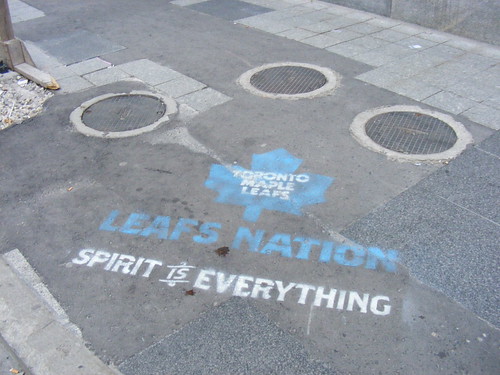
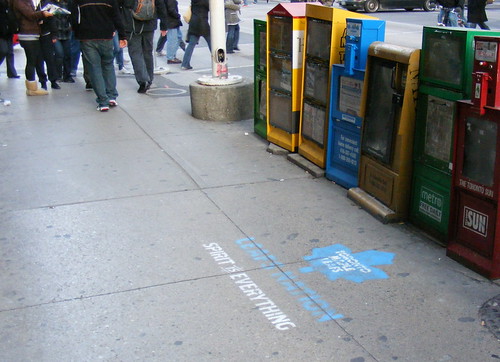
 On Friday, I noticed that the sidewalks around the Yonge-Queen intersection have been painted with stenciled ad messages promoting the Toronto Maple Leafs.
This is certainly not the first time we have seen ads painted beneath our feet on public sidewalks here in Toronto. Bike lanes were also taken over for ads last year. Indeed, there is even a company, Futuro Marketing, that openly makes a profit from selling public spaces for a limited time.
The company that commissioned this ad, Maple Leaf Sports and Entertainment, has the money and resources to purchase loads of conventional advertising – its namesake product, the Toronto Maple Leafs NHL team, is the highest valued in that league – and is the most expensive to go see. With other very lucrative sports and property assets, it begs to wonder why the company would resort to relatively inexpensive, and illegal, forms of advertising to promote its product.
Not to go into much of a Maple Leafs rant – there’s plenty of other places that will offer you one – but the slogan is somewhat interesting. Has MLSE gone with “Spirit is Everything” because that is all the team has? Or a message to its disappointed fans? In any case, I don’t even think that these illegal ads will help team spirit.
As an aside, one may note that the above picture shows the sidewalk in rather poor condition, with asphalt covering holes and trenches for utility work, common in Downtown Toronto. I am hopeful that the Downtown-Yonge BIA work, including the installation of new light standards, will fix the rather pitiful condition of the sidewalks between Dundas and Richmond.
19 comments
Looks like my dog will be finding a new target to poop on.
Out of curiosity, for one who doesn’t live in the city, Where does it say that sidewalk advertising is illegal in Toronto? your use of the phrase “openly making a profit” as well as your interspersing of the word “illegal” imply that.
There’s one of these stencils at College & Bathurst as well.
Typo: ashfalt should be asphalt.
When I first saw that motto last year I thought it should be:
Spirit is Everything
Results are Nothing
Certainly the people doing and authorizing this should be criminally charged and treated far more harshly then some mixed-up teenage tagger.
“ashfalt”? Is that the same as asphalt?
I think this ad campaign was dreamed up precisely because it’s “unconventional” – it’s an attempt to give the Leafs “street cred” and make them feel cool, like the urban fabric of the city. There is probably the hope that less critical minds will think that this is spontaneous fan art, and that it will nestle into their hearts all warm and fuzzy.
So you’re allowed to deface public property and insert your marketing message into our collective space if you’re a corporation with oodles of money, but if you’re an artist trying to get people to think, you’re a criminal? Typical.
There’s also one outside of Bathurst station.
Abraham: It says its illegal in the city bylaws. We’ve been through this type of thing a hundred times in Toronto.
I spit on this public space ad every time I see it.
The Leafs, at the core, have no soul. There are
interested only in making money. They have consistently vetoed an NHL team coming to Hamilton
Here they are abusing public space for their own monetary purposes. I hope the City gives them a huge fine.
Hockey mythology is so tired. What does “spirit is everything” mean anyway?
As I tweeted a couple weeks ago: Least necessary brand-awareness campaign ever.
Interesting … the city goes after “graffiti” and makes building owners remove it at their own expense, because it’s a blight on the neighbourhood. Why don’t they go after these “graffiti artists” and make them remove everything they put down on our sidewalks? that too is a blight.
So are the sidewalks around AirCanada Centre open to free expression. Can we apply to city hall to get a permit to paint “our message” …doubt it! This is elitism at it’s finest.
The city doesn’t do a very good job going after graffiti — I think every single storefront on Spadina between College and Queen has at least a dozen ugly tags.
I also wonder if the City will turn a blind eye to all of this considering the deal made between MLSE and the City about BMO Field’s turf/grass replacement.
While its clearly 100% illegal to do what they’ve done, there should be a tad grey area in this: if they did it around the ACC I really wouldn’t blink an eye at it. But at King and Dufferin? King and Bathurst? Why? Its only the richest sports franchise in Canada and doesn’t need any more promo.
And, if you look up around the city you’ll find Raptors/TFC banners on light poles. So they know how to go thru the City’s proper channels to get their promotional material on City property.
I like this campaign alot. It gets you thinking when you see them as you walk down the street; “Oh yeah, the Leafs are playing tonight…” and I think it works
P.S. There is also one outside Wellesley Station.
One on University Avenue had a similar looking stencil by it saying “Raptors: We prefer winning”
Guerilla Marketing gone wrong. The purpose was only for the Ad agency to make a buck or gain fame piggy backing on real street artists and smaller innovating compamies. They’re just biting other peoples style and cashing in to make a buck, after all, what was the purpose? I could sell these leafs in Ottawa with nothing more than a pencil. The bottom line is to innovate, captivate and motivate the MIND!, not to copy, that’s weak wack!
Did city hall seek permission from the taxpayers and citizens regarding this? After all the city asstes belong to all of it’s inhabitants. A few politicians and employees have no business sanctioning this free advertising.
If they must then let’s begin with United Way, Salvation Army, Sick Children’s hospital, Womens Hospital, Heart and Stroke, Breast Cancer Foundation etc. etc.
Giving free advertising space to a sub standard sports club which is making the city a laughing stock of Canada/US is outrageous!
Sorry about the Freudian slip. I meant “city assets”.