Architecture
March 1st, 2010
Brantford city council recently voted to demolish three blocks of heritage buildings in the city’s downtown. Guest columnist Nigel Terpstra, of Urban Toronto, sent us this post about the situation.
Recently, the city of Brantford, Ontario announced its plans to demolish and remove forty-one structures from the south side of Colborne Street, in the heart of its historic downtown. The structures themselves date from 1850 to 1915 with the section stretching from 115 to 139 Colborne comprising one of the longest surviving collections of pre-confederation buildings in Canada. They represent a wide variety of architectural styles from the Beaux Arts of The Right House (1870), to the Georgian of The Shannon Building (1867), to the Edwardian of the Dominion House Furnishings Company (1915). Within that range are also included a number of Renaissance Revival, Second Empire and even Art Deco structures, all of which were created at different times, for different clients with different needs. They could very soon all be reduced to rubble.
February 11th, 2010
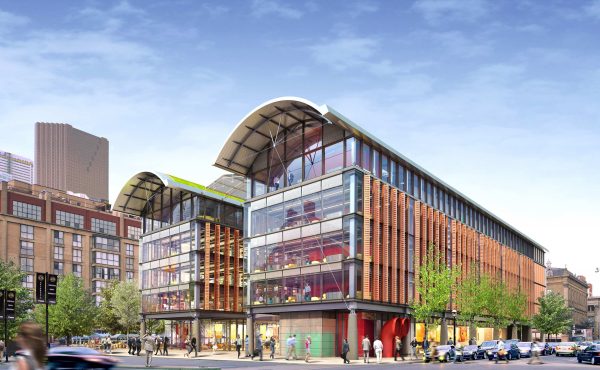
Ryerson University announced Wednesday that architectural firms Zeidler Partnership Group of Toronto and Snohetta of Oslo, Norway have been hired to design the school’s new Student Learning Centre at the corner of Yonge and Gould. The hiring represents a significant step forward in the university’s marquee plans to redevelop the Sam the Record Man site.
While a complete plan for the site is still at least a year away, the architects were on hand to talk about their previous experiences and their initial ideas around the project. Their collective resumes are very impressive. Snohetta’s CV includes the new Library of Alexandria and Oslo’s National Opera. The firm is currently working on the September 11th memorial museum in lower Manhattan, the King Abdulaziz Centre for Knowledge and Culture in Mecca and new university libraries in Ohio and North Carolina. Toronto’s Zeidler architects have been involved in international projects in Tel-Aviv, London’s Canary Wharf and Seoul. Right now, they’re working on the revitalization of the Union Station rail shed.
It is clear from this selection that Ryerson views the site as an opportunity to do something special both for the school and for the city as a whole. Lead architects Tarek El-Khatib and Craig Dykers made clear that they too understand the potential for the site and the intricate role it will play in linking the campus with the city, while further enhancing the vibrancy of Yonge Street. To this end, the architects acknowledged that the building will have retail along Yonge Street and will attempt to keep up with the round-the-clock liveliness of the area. “The context is extremely important…there’s a great movement to create this public environment around Dundas and the whole force of it is creeping up the street,” said El Khatib. “There has been also some great efforts at changing the character of Gould Street so that is going to become a very important players in how the ground floor works.”
The architects created a video of a visit to the site and their consultation with students on what the new centre should be:
February 2nd, 2010
In this episode of Spacing Radio, we tackle the obstacles facing pedestrians and explore the forgotten, abandoned places in our midst. We begin with Spacing Magazine senior editor and co-chair …
January 22nd, 2010
Spacing readers are probably aware of the controversy surrounding the historic wartime era hangars at Downsview Airport. Relics from the abandoned Forces base that once occupied the site, the hangars have heritage status but are not subject to normal heritage review because of their ownership by the Department of National Defence. When crews were spotted last November preparing for demolition, a coalition of Torontonians that included developers, politicians and the Architectural Conservancy of Ontario (ACO) successfully pressured National Defence into staying the demolition.
The issue arose again however on Christmas Eve when National Defence sent the ACO a letter stating that, unless someone could come up with $20,000 weekly payments very quickly, the demolition would have to commence; another letter writing campaign ensued. Demolition was again stayed and the issue returned to the back burner when a Lieutenant General wrote the ACO demanding an end to the barrage of distracting emails that were preventing him carrying on the business of administering a war.
January 16th, 2010
Last week Spacing received word that there was a unique chance for a beautiful view of the city available from the top of the new RBC Dexia tower at Simcoe and Wellington (see photos of the building on Flickr). Always intrigued by new perspectives on Toronto, we decided to investigate. Confused as to whether we would find an open air viewing area, an intended observation deck, or active office space we didn’t know what to expect. We were pleasantly surprised.
Owing to its grand spanking newness, the top floor of the tower remains completely vacant with no impediment to its breathtaking views. From 41 stories up, the 360-degree view of the city includes a lot of interesting sites. On the south you can look down on to the top of Simcoe Place. To the east you can observe the busy crossroads of York and Front, and of course an unimpeded view of the financial district. Westward, the viewer is rewarded with and eye level view of construction on the Ritz-Carleton building. Perhaps most striking is the presence of the CN Tower. As you exit the elevators you immediately notice the tower authoritatively occupying a piece of the view to the lake. Without the full context of its pods, the structure looms like a monolith.
January 15th, 2010
A little after midnight we were walking south on Bathurst, rounded the Bloor Pizza Pizza corner and saw a glow from the window of Honest Ed’s. My first thought (for a split second) was “art installation” because it was calm and quiet (and Ed’s has given their windows over to art before) but it was quickly evident it was real and inside the window display. Walking over, people were already on the phone to 911, so I took photos. The pictures that follow occur over only about 3 minutes. That time frame includes: when the fire was small and a handful of people were around -> a police car showing up telling them to move back -> the the glass popping, exploding and shattering (Mike Smith, who writes for Now Magazine, was also walking by and just suggested to me via Facebook it may have been the sound of exploding wine bottles from the Wine Rack store inside) -> the fire licking up at the vernacular signage (…ONCE IN A LIFETIME SOMETIMES NEVER!!! and HONEST ED’S A FREAK HE HAS BARGAINS COMING OUT OF HIS EARS were affected) -> to the first fire truck arriving and dousing it (the1st picture with the thick black smoke). Both the speed at which the fire grew and Toronto Fire’s arrival were remarkable. Or maybe it was just routine, but seeing TOFD in action like this, from beginning to end makes Toronto seem safe and that its various systems, when they need to, will work like clockwork. Eventually at least 8 pumpers showed up, Bloor was shut down, and we walked east to try to find a nightcap but as has been widely reported, you can’t find a reasonably civilized drink in the Annex anymore.
Though there were many “oh no” responses to my tweeting of the event at the thought of losing a Toronto landmark, the rumour around town (up until the recession, that is) is that Honest Ed’s, the only big box store one could call lovable, will become a condo complex one day soon now that the late Ed himself isn’t around to fuss over his D.I.Y. K-mart retail creation. As unique as it is, intensification of this site seems inevitable (even if those rumours have quieted down), and it makes those signs telling you to get inside seem even more urgent because one of these days it’ll disappear in much less dramatic fashion than it almost did tonight.
January 12th, 2010
The Twitterverse recently led me to an interesting blog post that pointed out how, in the Bourne movies, the Jason Bourne character “uses public infrastructure as a superpower.”
A battered watch and an accurate U-Bahn time-table are all he needs for a perfectly-timed, death-defying evasion of the authorities. … Bourne wraps cities, autobahns, ferries and train terminuses around him as the ultimate body-armour.
The writer contrasts this with a character like James Bond who is backed by plentiful resources and so uses powerful, private high-tech gadgets to pursue his ends.
It makes sense — Bourne is a man with almost no resources, and public infrastructure is built to give those who have few resources a range of potential activity comparable to those whose resources are plentiful.
January 12th, 2010
How can Toronto’s design community contribute to making Toronto a better city for walking? To help get the City’s new Walking Strategy off the ground, the City has teamed up with designers of all stripes to hold a …
December 18th, 2009
As we wrote two weeks ago, the For York Visitor’s Centre design competition included four detailed schemes. “Submission A” was chosen for the …
December 10th, 2009
High on my long list of Spacing posts I’ve not yet had time to make is one on Richard Serra’s “Shift” sculpture. It sits in a field near King City, north of Toronto. As of today I no longer have to make the post because Derek over at BlogTO wrote an excellent piece on it. When Spacing Review’s editor Jessica Duffin Wolfe and I went out to see Shift on a sub-zero Sunday afternoon last February, the future of this crazy-wonderful piece of art was unclear. However, as the Globe reported a few days ago, it’s future may be secure. Derek at BlogTO writes:
“Shift” is challenging in the way that almost all good modern art is. It doesn’t reveal its meaning or its beauty quickly. But given the chance to dwell upon it for a while, it’s impossible not to acknowledge the seamlessness by which it’s incorporated into the landscape. In speaking of his intentions for the installation, Serra reveals that what he “wanted was a dialectic between one’s perception of the place in its totality and one’s relation to the field as walked. The result is a way of measuring oneself against the indeterminacy of the land.”
Though Serra’s work has at times been termed monolithic, nothing could be further from the truth here. Not only is the boundary of “Shift” defined by the “maximum distance two people [can] occupy and still keep each other in view,” but the structure also emphasizes the natural curvature of the terrain, rising and falling in direct proportion to the land itself. Its scale is thus determined by a sort of parallax effect, whereby the most distant reaches of the sculpture blur with the land.
“Shift” is also a profoundly human structure. The maximum height of each shifting wall is five feet and hence at eye-level. At no point does it ever disregard the viewer or the land. But this human quality also extends beyond the formal elements of the sculpture.
Read the rest of his post. We were also in a bit of a daze when we finally found the sculpture. We knew what to expect but when you see it in person it overwhelms and we visited it for an hour or so before walking back to the car. What follows are photos of our journey to see a snow-covered Shift (part of the motivation of this mini-post is that our fingers froze to the point of pain while taking pictures, so they need a full public viewing to make it worthwhile). One question some of our readers may be able to answer: where is Roger Davidson now, the wealthy art collector who first commissioned Shift in 1970? Google searches only pick up mention of him in stories about Shift (proving the only way to hide from Google is to have done things before, say, 1993). Beyond checking the links in BlogTO’s post, pick up a copy of Coach House’s 2007 book Concrete Toronto and read a short essay on Shift by Toronto artist and architect Adrian Blackwell.