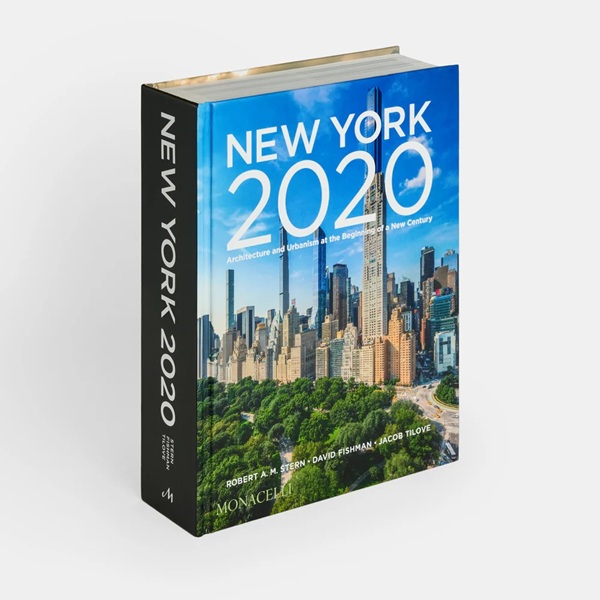
The much-anticipated final volume in the critically acclaimed series, New York 2020 explores the planning and politics of building the city in the first decades of the 21st century. More than 2,000 buildings are described and illustrated, giving details of their planning and design, and the critical reception. Among the milestones featured are the rebuilding of the World Trade Center site, the creation of the High Line and Hudson Yards, the jagged line of Supertalls on the skyline, and the transformation of derelict waterfront and parkland.
- From the press release
Authors: Robert A.M. Stern, David Fishman, & Jacob Tilove (Monacelli Press, 2025)

At the end of 2025, architecture lost two juggernauts: Frank Gehry and Robert A.M. Stern. To say we lost two titans is a vast understatement, as collectively the two architects represented in many ways our architecture culture for the last several decades. One, the true formalist and the other, the historicist, their influence was felt in schools and the public realm, in boardrooms and on the city streets, by both seasoned professionals and the laity public alike.
But as yin to the other’s yang, while Gehry was a true design practitioner realizing such projects as the Guggenheim in Bilbao and LA Disney Concert Hall, Stern ran a successful practice and was Dean of the Yale School of Architecture from 1998 to 2016. During this time, his academic acumen included documenting the architectural history of New York City, and before his passing this past November, released this 10-pound, 3-inch thick tome of NYC’s five boroughs, containing 2,000 illustrations and accompanied by essays on current events that occurred between 2000 and 2020.
This, of course, means the book begins with 9/11 and closes with Covid 19, which understandably provides a staggering amount of subtext for the buildings that were designed and built at this time. After a 100 page introduction, which concludes with the effects of Covid on the nine million inhabitants of the city that never sleeps, the book’s contents include a chapter on each of the smaller boroughs—Brooklyn, Queens, the Bronx, and Staten Island—with Manhattan divided into six chapters, including one devoted entirely to the rebuilding of the World Trade Centre. One imagines that the single-page Afterword on page 1,295 is perhaps Stern’s singular voice, a closing comment on the city he loved very much, as attested to by the six volumes he has produced on it over the decades, including New York 1880, 1900, 1930, 1960, and 2000.
And as the book points out, a lot has happened in the past twenty years…
In the first chapter, the editors recount the September 11 event itself, followed by the immediate aftermath to rebuild and the visions that were pursued, right up to its current form, including the architects and developers that made it happen. There is a section on the memorial for the victims, and the competition process that yielded the two fountains occupying the site now. There is also a section on the architecture of Santiago Calatrava, including the PATH station, great hall, and new St. Nicholas church he has contributed to the site, as well as the new Perelman Performing Arts Centre by REX, the most recent addition to the site. And of course, there is a section on the new WTC tower itself, starting with Daniel Libeskind’s Freedom Tower and proceeding to the final WTC One by David Childs and SOM.
The next chapter – Lower Manhattan – includes some of New York’s most notable recent additions, including Little Island by Heatherwick, a curious private-public park development that is accessible from the newest section of the High Line along the Hudson. SANAA’s New Museum of Art, accompanied by its recent addition by OMA is also here. As is the new Whitney Museum, along with 8 Spruce Street by Frank Gehry, the late architect’s last contribution to the New York skyline, in addition to his IAC building in Chelsea, both featured here.
The next chapter, entitled Midtown, also features some formidable recent additions, including the High Line by Diller Scofidio + Renfro, joined by all the new buildings around it. A section on the massive development at Hudson Yards, home to the Vessel and Shed, is also here as one would expect it to be. This is joined by the new Moniyahan train hall next to Madison Square Gardens, representing a throwback to the days of grand transit halls, and perhaps what the original Penn Station might’ve been like. The chapter closes out with the new Supertall high-rises along the south edge of Central Park, with the three tallest by Rafael Vinoly (432 Park Avenue), SHoP (111 West Fifty-seventh Street), and Smith and Gill (Central Park Tower), topping out at 85, 84, and 98 storeys respectively.
Other highlights in the Midtown chapter include updates on such favourites as MoMA, the New York Public Library, and Lincoln Center, which includes the recent renovation of the NY Philharmonic’s home, David Geffen Hall, by Diamond Schmitt Architects.
The Upper East Side chapter also includes a section on Roosevelt Island, where Louis Kahn’s long ago commissioned design of the south point known as FDR Four Freedoms Park, was finally realized and opened in 2012. The chapters that follow on Brooklyn, Queens, the Bronx, and Staten Island also feature some wonderful new public spaces for the boroughs, including Brooklyn’s Atlantic Yards and Barclays Centre, and Queens’ wonderful Hunter’s Point Park by Weiss/Manfredi, including a new Steven Holl-designed library.
Of the book’s 1,488 pages, over 200 are reference notes, a testament to the immeasurable research Robert Stern, David Fishman, and Jacob Tilove undertook for this magnificent tome. One can only hope that with Stern shaking off this mortal coil that its legacy will continue—perhaps New York 2050 when the city has become 100% renewable! If it makes it there, it will make it everywhere, so perhaps its microcosm of New Yorker’s can solve traffic congestion, affordable housing, and climate change all in one false swoop—such would be what Robert Stern would want to see and hear in the next iteration.
And though you may need to buy a new bookshelf to store it in our post-Covid micro-dwellings, it will be, in this architect’s opinion, worth the real estate. Stern and his cohort here have provided what could be one of the last great architectural surveys of its kind, as it will remain to be seen if the next generation prefers to have this kind of information made available in analog paper form or as a digital archive, spoon-fed by AI algorithms. Both Robert Stern and Frank Gehry departed at what is shaping up to be a most interesting time, certainly as along with AI we take the next step into our brave new world, ChatGPT and all.
It is for precisely this reason that we need guidebooks like New York 2020, reminding us that as there are surely nine million stories in the naked city, the way we share and inhabit our communities will always say the most about just how civilized a society we are.
***
For more information on New York 2020, visit the Phaidon website.
**
Sean Ruthen is a Metro-Vancouver based architect.