
“To redesign the environment we really have to redesign our whole value system – question the sacred cows – and ask ourselves what we really want, what has priority. For each project in my office we define our goals and set up a priority system. As we work with the client and begin to absorb the pressures to compromise we have a yardstick to measure our changing course. This makes it possible to intelligently evaluate the pressure in terms of our goals and decide whether or not to accept the change and if not, having completely identified the pressure we can at least attempt to reason with it. In practice, we find the system forces a greater depth of involvement between architect and client in the programming and the whole design process ultimately leading to the solving of more aspects of a project than is usually possible.”
- Frank Gehry, from Chapter Nine, ‘Easing the Edges‘
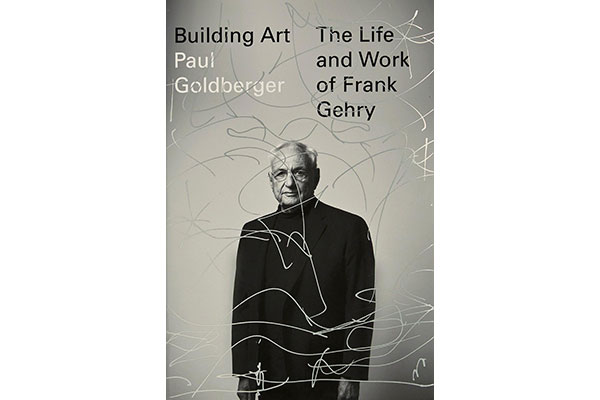
Written by Paul Goldberger, Knopf Publishing (2017)
With Frank Gehry having passed away in December, in memoriam I undertook reading Paul Goldberger’s massive opus on the late architect. Representing some five years of research by the Pulitzer Prize-winning author, Goldberger must be commended for succinctly capturing both the man and his work in its detail-laced 450+ pages. Providing an inside look at the deal-making behind some of our age’s most famous buildings, and populated with several smaller black and white photos of his personal life, the book’s only shortcoming is its all-too-brief colour insert—providing the requisite images of the Guggenheim in Bilbao. the Disney Concert Hall in his hometown Los Angeles, and one of his last projects, the Louis Vuitton Foundation in Paris, along with a picture of himself aboard his sailboat, Foggy.
Many architects may already be familiar with some of his early history, including his childhood in Toronto. Goldberg devotes several early chapters to this period, recounting his father’s struggles to maintain steady employment at the same time his mother was taking him to the Art Gallery of Ontario and to hear the symphony at Massey Hall, opening his eyes to both culture and art.
Along with working as a young boy in his grandparent’s hardware store, Goldberger describes Gehry’s early architectural education, including his introduction to the Los Angeles-based teachers and practitioners who would shape his thinking and provide ongoing mentorship. Most importantly, he describes Gehry’s immersion into the LA art scene and the enduring friendships with artists that would influence his work throughout his career.
Half the book is devoted to his early career, including his time working for a large commercial firm specializing in shopping mall design, where the two senior partners embodied the poles he navigated between throughout his career—one the business-minded dealmaker, the other driven by architectural form-making. If Goldberger has one central task here, it is demonstrating Gehry’s working philosophy—revealing how his buildings were not simply formal flights of fancy, but the result of a rigourous method, one that demanded active participation of the client.
The narrative arc of the book mirrors his professional career, with the pivotal moment being the unveiling of his redesigned Santa Monica home in 1978. Literally breaking the box of the stereotypical suburban home—using cheap materials like chain link and plywood—it ushered in a decade of important milestones, including the Pritzker Prize in 1989, shortly after winning the competition to design the Disney Concert Hall.
The book does not shy away from the challenges Gehry faced over the years, describing both personal and professional setbacks, including the delay of the much coveted LA concert hall through the 1990s, with its complexity to construct becoming one of its main criticisms (with another architect selected as Architect of Record, much to Gehry’s dismay).
Of course, the end of the 1990s brought his crowning achievement in Bilbao (1997), which demonstrated—to the Disney board and the world—that using sophisticated computer software (in his case CATIA) one could translate the architect’s vision into built form for the now unbelievable cost of $100M USD. This breakthrough enabled the concert hall project to resume—and despite having started before Bilbao—it was completed and opened in 2004 to great civic and critical fanfare. Goldberger adeptly captures all the wheeling and dealings between the architect, various clients, and civic authorities for both projects—storytelling that alone justifies the book’s price of admission.
Among many stories and anecdotes, a few stood out, particularly from Gehry’s early foray into architecture in schools in the late sixties, where he and his sister Doreen—herself a teacher and sociologist—worked for one term with a fifth grade class to design a new city. As Goldberger notes, a short film documenting the event may still exist and perhaps could now see the light of day. Another nugget the book daylights is the moment when Gehry shelved his Easy Edges cardboard furniture line—despite its potential to be a huge commercial success—for fear of becoming known as a furniture designer rather than an architect.
Having written about architecture for decades—and counting among his contemporaries such greats as Herbert Muschamp and the late, great Ada Louise Huxtable—Goldberger reflects in the afterword on the challenges of becoming a biographer for this book, a fundamentally different beast from writing about buildings alone. In addition to the several biographers he acknowledges as inspiration for Building Art, he surely owes a debt to Brendan Gill’s Many Masks (1987) about the other Frank, and whose author had a personal friendship with his subject. With Goldberg and Gehry, one senses a comparable camaraderie: a relationship formed before Gehry became a household name, lending the narrative a light, conversational tone, reminiscent of the easy banter Gehry shared with his friend Sydney Pollack in the 2006 film Sketches of Frank Gehry.
Published in 2017, the book’s final hundred pages candidly discuss Gehry’s status as a brand, questioning whether his firm could survive without him, with discussion of a partner’s attempt to buy him out—an offer Gehry declined. Several Gehry Partners projects were surely still underway at the time of his passing in December—and the office will most certainly carry on without him to finish those projects—including the high profile Guggenheim in Abu Dhabi.
With Building Art closing out at the occasion of the architect’s 85th birthday—a lavish 400-person affair in the great hall of the Bilbao Guggenheim—one can imagine given his good health at that time he would’ve continued to work right up to his final days. For as the book makes clear, the work was all-encompassing and central to his life—alongside his wife Berta, his friends, and his family.
For Gehry, professional success mattered deeply but so too did living well—and in both respects, he seems to have succeeded.
***
For more information on Building Art, go to the publisher’s website.
***
Sean Ruthen is a Metro Vancouver-based architect.