
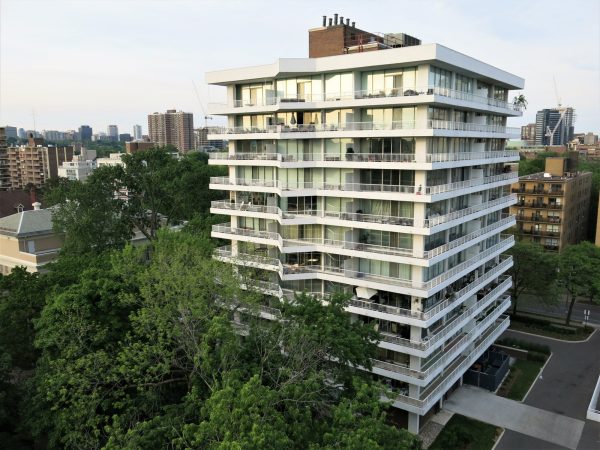
Location, location, location is the old saying about what matters in real estate. But what if you combined location, with architecture, and terrific views, as Joseph (Joe) Medwecki did at 190 St. George St.?
The building, at the corner with Lowther Ave. in Midtown Toronto (yes, it’s the one with the pointy balconies), has been featured in architectural books and was No. 7 on a National Post list of top ten condominiums in Toronto. Jack Batten, in his book The Annex, called it “one of the winners in elegant appearance” among towers that from the 1950s onward marched up St. George St. from Bloor St. W.
I once wrote that it is rare for the public to know the names of designers of apartment buildings (or condos, I’ll now add). “How many apartment-house architects, anywhere, can this be said of? Gaudi in Barcelona; maybe Friedensreich Hundertwasser?” Perhaps Uno Prii, in Toronto?
Like many Spacing readers, I like multiple-unit dwellings and think some are very good as architecture and as homes, including 190, which is why I live there. Its distinctive look may be familiar but it’s not likely you have heard of Joe Medwecki, who died in Toronto on Nov. 10, 2025, at age 98.
Shy and reserved, Medwecki once told an interviewer, about 190, “The building speaks for itself,” insisting, “I have nothing more to contribute.” However, tempted to tea and cookies in an upper-floor suite by a group of residents, Medwecki told them all about their 12-storey, 70-unit “home,” erected 1970-1972 on the site of one or two Annex mansions.
From the second floor up, balconies wrap around, with the apartments enclosed in double-pane floor-to-ceiling glass. The end posts are placed outside, letting window extend into the corners. See-through metal railings allow air, light and views through while giving privacy from below.
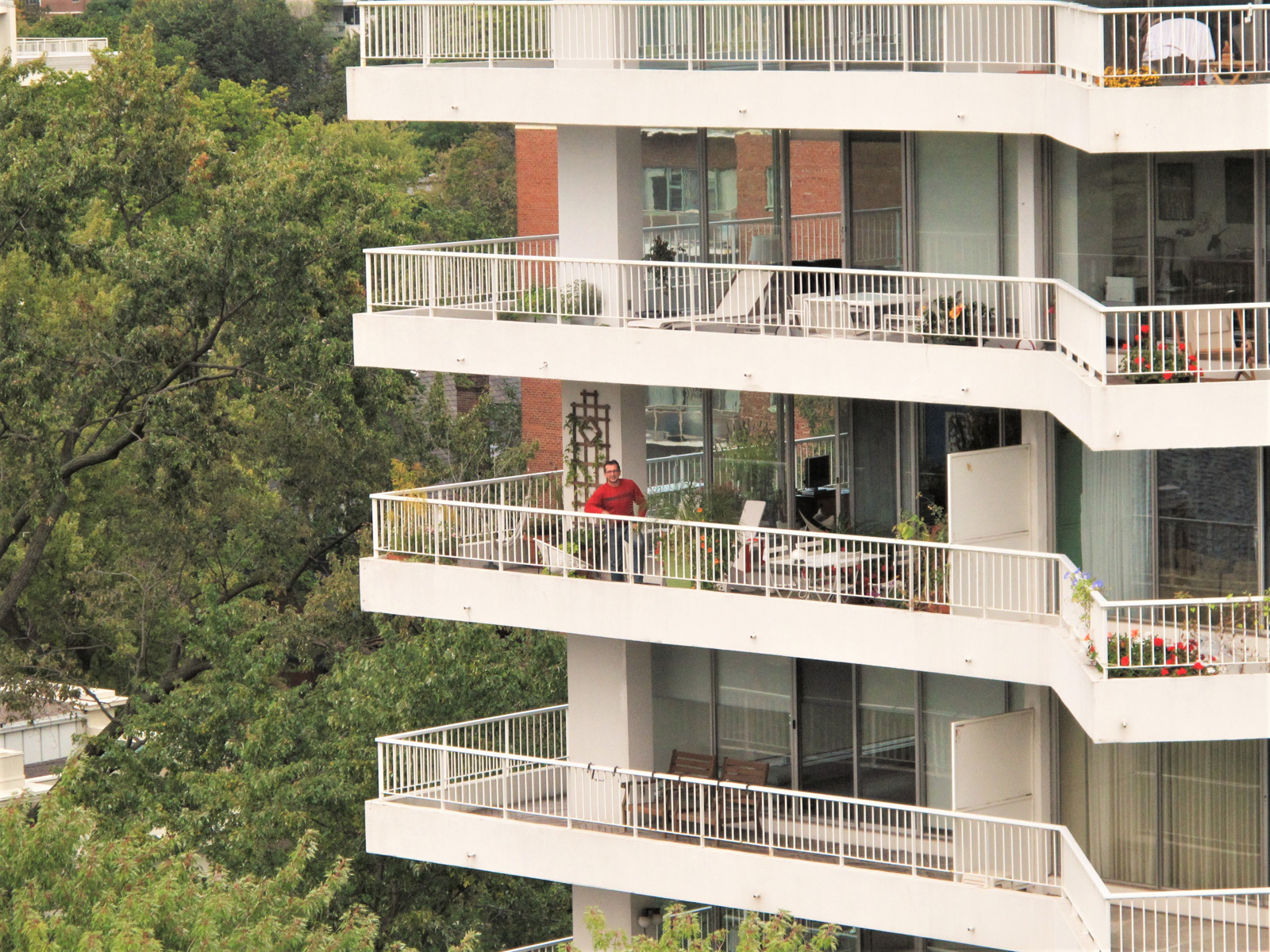
The design added appeal, said Medwecki, while “simplifying construction considerably,” eliminating bricklaying and heavy masonry. The famously pointed balconies on the east and west sides gave middle units patios, with “a view towards the lake.”
“Once you are in a high-rise building, you should take advantage of the view toward the city,” he said. At 190 — and I can vouch he’s right — “you can enjoy that view even if you are quite deep in the living room.”
My well-thumbed copy of Patrica McHugh’s Toronto Architecture: A City Guide calls 190 “A distinguished essay in Late-Modernism.” In East/West: A Guide to Where People Live in Downtown Toronto, Joe Panabaker suggested Medwecki one-upped Mies Van der Rohe by making the glass house private and habitable even in the big city, using “the great late-Modern trick of the continuous balcony.”
Set back on its corner by the day’s zoning rules, and now sitting discreetly among mature trees, it also pulls off Le Corbusier’s “tower in the park” idea successfully.
The architect told me the building was conceived in an extended “exchange of thoughts” about architecture with his fellow Polish emigré, the developer Tadeusz (Ted) Lempicki. At that time, the late 1960s, Medwecki was studying for a Master’s in urban design under the younger architect Jack Diamond, at the University of Toronto.
“I was talking [to Lempecki] about what I was doing, a small sort of presentation of my thesis,” Medwecki recalled. “And he said, ‘you know what? I think I would like you to do that building for me.’”
It was originally to be rental, like Lempicki’s earlier Irving Grossman-designed 50 Prince Arthur (look for a statue, “Rosalyn,” out front), but 190 was finally offered to the public as one of Toronto’s early condos.
Medwecki was born in Poznan, Poland in 1927. He studied at Warsaw University of Technology and worked under the celebrated Bohdan Pniewski on the postwar rebuilding of the National Opera, whose mosaic floor of exotic woods is Joseph Medwecki’s design.
Cold-war Poland mostly blocked emigration but, finding a loophole, the young architect came to Canada in 1956, joining his father, an aircraft designer who had been evacuated here in 1939. Accompanying him was his wife, Antonia “Tosia” Kajetanowicz, whom he married in 1953. Later, her Toronto dental practice became known for its background music of soothing Mozart symphonies.
Medwecki’s practice was small, “the most I ever had in the office was five people,” adding “I did all the working drawings [for 190 St. George St.] myself.” He focused on commercial buildings, factories, and warehouses in greater Toronto but did some in the United States, plus an occasional house, “primarily for my industrial clients.”
Among his other projects are the medical arts building at 600 Sherbourne St., also for Lempicki, and a mansion at 937 Whitter Cres. in Mississauga, recently on the market.
Teaching at Humber College in the 1970s, the architect “always had a carnation on his lapel, that was his signature,” said Stan Kedzierski, a former student, now a resident in Medwecki’s building.
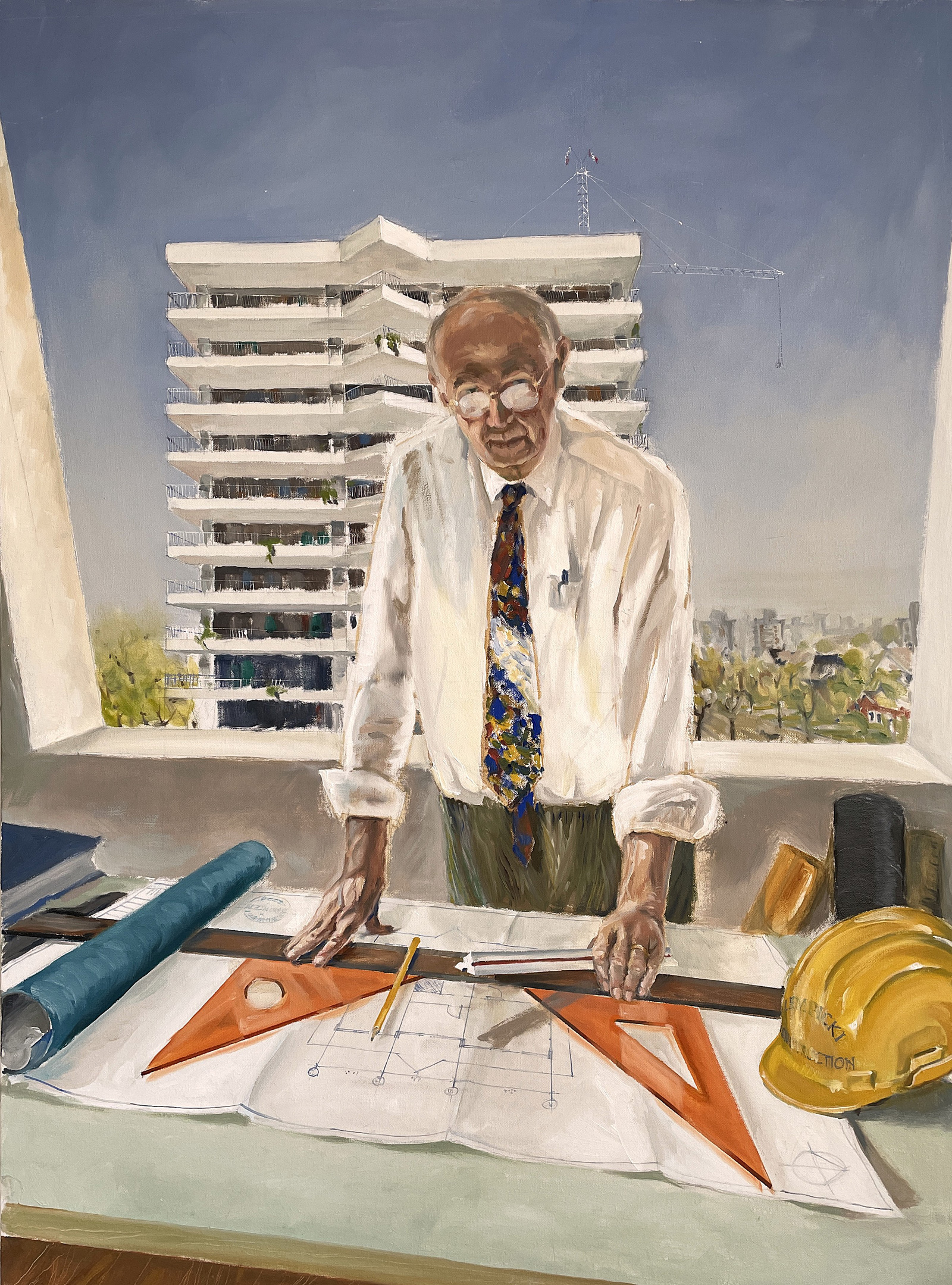
During the 2000s the architect attended the Ontario College of Art and Design as a mature student, earning another diploma and creating a self-portrait featuring 190 St. George and the tools of his trade.
Pedestrians walking by can often be seen looking up at the building, and that is how many of us who live there came to know of it. My spouse and I moved in during 1999, but the building “was cherished basically from the very beginning,” said resident Hanna Bartel.
In the oft-times (but not always) tower-anxious Annex, opinions have evolved.
The erection of 190 marked the end of tower-building on St. George street for quite some time. More recently, a member of the district’s famous residents association was heard to say, when visiting an 8th floor apartment, “THIS is where you move, when you sell your home in the Annex.”
“You can’t beat the terraces, the windows,” said Royal LePage realtor David Fenster, who has sold countless units, and lives there too.
Medwecki himself never resided at 190 St. George, but he could see it from his own condo at 284 Bloor W.
A shorter version of this story appeared in the e-newsletter of the Annex Residents Association.
2 comments
Balconies glass widow walls are environmental disasters !!!!
Balconies to condos are the same as radiators are to cars. In the winter they suck warmth out of the interior and in the summer heat moves from the outside in. And what can you say about R2 window walls except they transfer heat out in the winter and in during the summer.
We worry about climate change and build these cute energy sucking monsters. This apartment gets an F for climate destruction.
It would be interesting to compare this 56-year-old building’s energy footprint to later ones of different designs, I could ask our management company to do so. We have had energy audits in the past, without setting off alarms. Before losing our heads it is good to ask, “how do we know?” what we think (or decide) we know.