

As Astral’s wretched street furniture deal limps towards its inevitable conclusion, Toronto’s litter bins are back in the news, although they’ve been living rent free in our urban consciousness for years — a gross and ubiquitous reminder of how the city managed to, uh, make a mess of one of any municipality’s most basic responsibilities.
According to the Toronto Star this week, Mayor Olivia Chow wants to hive off trash cans from whatever street furniture deal follows the Astral contract, which expires in 2027. She and Toronto Danforth councillor Paula Fletcher have a motion on next week’s executive committee agenda calling for the “decoupling” of the litter bins from the rest of the street furniture policy.
To re-cap: that Triple-P provided the city with 25,000 pieces of apparently free street furniture, plus a kickback of several hundred million dollars in exchange for outdoor advertising revenues from bus shelters and other fixtures. While the contract included benches, public maps, and community message boards, it didn’t deliver the promised heated bus shelters or coin-operated bathroom stalls, and offloaded responsibility for fixing broken bins to Astral.
Everyone’s familiar with the busted R2D2 bins, and their more angular successors, all of which suffered from incessant vandalism, perpetrated, city officials told Spacing two years ago, by people looking to scavenge the aluminum cigarette butt holders inside. The foot pedals didn’t survive winter, the disgusting orifices on the first two generations were absurdly small, and the city’s garbage collectors didn’t actually source separate, notwithstanding the presence of holes for both waste and recycling.
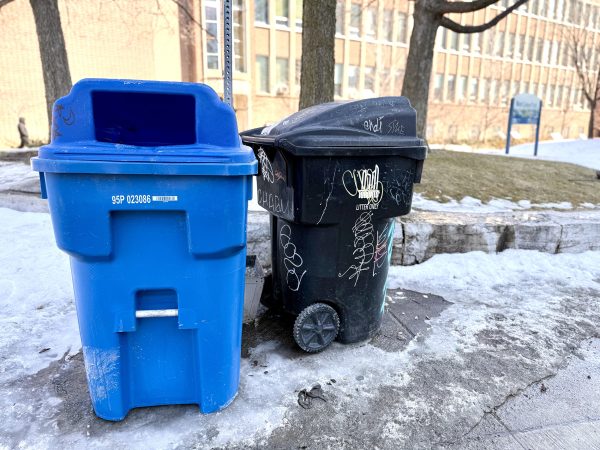
In the past decade or so, the parks department, which is rarely a source of innovation, glommed on to an approach to waste management that actually works: it deployed thousands of those black, blue and green extruded plastic bins across Toronto’s extensive park network. They’re big, homely, plentiful and chained to posts so they don’t go strolling. But for the occasional summer park picnic, they tend not to belch up their contents, which is typical of their street-side cousins.
Yet they’ve become a target of some local politicians, residents, and commentators who find them ugly and therefore unbefitting of Toronto’s public spaces. “They look awful plopped amid the green lawns, gardens and playgrounds of Toronto’s typical public park,” observed Globe and Mail columnist Marcus Gee, who canvassed several other cities’ superior bins.
It’s not obvious yet whether these receptacles will be caught up in the city’s latest efforts, spurred on by Josh Matlow, to bring design harmony to its public spaces. Nor is it clear if parks bins will be folded into Chow’s campaign to solve the street-side trash container crisis.
There is, however, an important and quintessentially Toronto lesson to be learned here, which is that objects in public space that break due to heavy use invariably go begging for routine maintenance, as happens with benches and picnic tables. The reason, of course, is money, or the lack thereof. Unless said objects are located in high visibility, tourist-oriented locations, they’ll be neglected until they’re impossible to ignore.
Neither council nor city officials have formally stated that the thousands of plastic park bins will be replaced with more attractive containers. But, if that idea is on the table, we should be clear-eyed about the implications.
First, toggling back to pre-Astral days, the city attempted to make a big deal of involving residents in the design competition for new street trash bins, with open houses and prototypes on display at City Hall, opportunities for feedback, etc. The R2D2 bin that emerged from the pack evokes the old joke about how a camel is a horse designed by committee. It was a classic example of over-thinking — too many features (the pedals, the hole for cigarette butts, the labeled openings, etc.) and an aesthetic that fell far short of expectations.
We know the Astral deal militated against proper maintenance, but if we swap out the contractual limits of that Triple-P for the fiscal constraints of the city budget, it’s possible to imagine what might befall a new generation of beautified trash/recycling bins situated in Toronto parks. After all, the funding associated with deploying and then taking care of sturdier and more aesthetically pleasing bins will have to come from somewhere. My concern is that the additional expense will lead to a backlog of broken bins that don’t get repaired in a timely way, with the predictable mess that results.
The current plastic ones, which do their job, are all but indestructible and inexpensive, so the city hasn’t scrimped in deploying them. The trade off, then, will be aesthetics for effectiveness. And we’ll have to choose.
In my view, I’d rather the city spend its resources on better park design, better benches, and improved maintenance of all the other elements that will elevate Toronto’s public spaces.
The big plastic bins are unquestionably ugly, but they do what they’re supposed to do, which is a whole lot more than we can say about the Astral-era trash cans. If council wants to extract them from the next street furniture deal and further refine their design, have at it. But let’s make sure the city focuses on what ultimately matters with these objects, which is their capacity to actually contain our garbage until it gets taken away.


One comment
The same thought has crossed my mind as I drop my dog’s waste in the ugly bin, the cheap ugly ones work, and don’t force me to put my hand near a filthy surface. I do notice people putting their bags of home trash in them, but the frequency of garbage pick up is a column for another day.