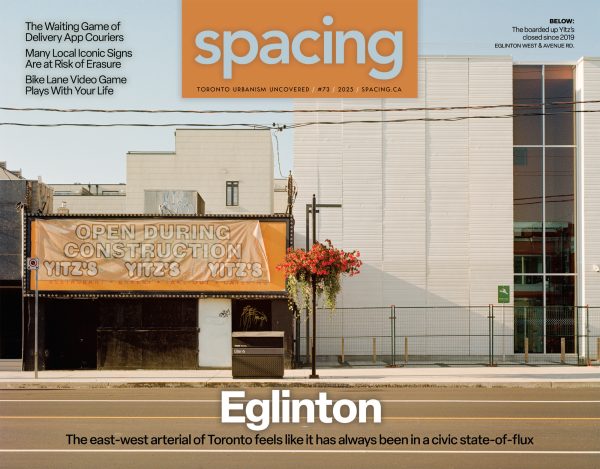

We still don’t know when the Eglinton Crosstown LRT will open. It could be any day – the testing is all done. Or it could be many weeks away, given its history – there are still processes to go through, apparently, and still no-one wants to commit to a specific date. We can only hope that the first passengers will be able to hop on one of the once-new, now quite old trains while our new issue about Eglinton Avenue is still on store shelves.
To prepare for the coming of the LRT, in our cover section we invite readers travel along Eglinton more or less from east to west, exploring different neighbourhoods and the changes that have happened and will happen along the route and even beyond it, reaching to each edge of the city. In some ways, this issue is a complement to our Yonge Street issue (#69) last year, exploring Toronto’s iconic east-west artery after doing its north-south one. If Yonge is Toronto’s spine, then Eglinton could be considered its prime rib.
The decade and a half of Crosstown construction has been difficult for Eglinton. There is no doubt that many businesses had to close as a result of the disruption. In exchange, it promises big changes, and not just in terms of faster — at least in the underground sections — and more comfortable transit. It is supposed to generate new housing and economic activity – although how quickly that will happen is now in question as the housing market slumps. And that new construction itself brings challenges, potentially displacing existing communities and services.
But the Crosstown also brings opportunities for new communities and services, ideally extending the vibrant main street vibe that already exists in a few stretches into more of the city, while creating housing for many more people. Whether that goal is realized will depend a lot on decisions made by the City, developers, businesses, and non-profits.
A change I am particularly interested in lies right at the heart of the street. Yonge and Eglinton is, by some measures, the intersection in Toronto most heavily used by pedestrians – far more people cross on foot than in private vehicles, and that number will only increase as new towers get completed around this transit node. Unlike Yonge at Dundas and at Bloor, it didn’t get a pedestrian-only scramble intersection phase in part because of the volume of TTC buses along Eglinton. But now that the transit is about to be underground, it has become a strong candidate for a walking-friendly transformation. In the fall, City staff inexplicably opposed the idea, citing objections that would apply just as much to the existing scrambles, but City Council will revisit the proposal once the LRT is fully functioning.
The scramble would complement another change that the Crosstown is supposed to bring to Eglinton – cycle tracks along a significant length of the street. Again, there is frustrating uncertainty about when they will be implemented, although the City insists that they are not affected by the Provincial bike lane legislation because they were set in motion before that was in place. The scramble intersection and the bike lanes together would signal that Toronto realizes walking and cycling aren’t just an eccentric downtown thing, but ways of getting around that apply across the city. Together with the LRT, they would create what is termed a “complete street,” realizing the vision of developing a true people-friendly main street. They would affirm that Toronto aspires to be a city that looks to the future.
Meanwhile, our front section resolved into a few themes. An extended photo essay by Sophie Bouquillon looks at the situation of bike delivery couriers, relegated by apps to waiting in public spaces for work, while Emily Macrae digs into an online game that highlights the dangers to cyclists created by Premier Doug Ford’s assault on bike lanes. Joe Wilson looks at how teachers use Spacing’s subway quiz to engage neurodiverse students, while Lisa Ditchun proposes ways to get kids engaged with civic issues. In the wake of the closure of the Imperial Pub, Kurt Kraler asks how to preserve Toronto’s sign legacy, while Elianna Lev explores the poetry of a different kind of sign, personalized licence plates. Kevin Kitchen and Chris Harrison, meanwhile, each ponder some of the lesser-known public spaces in the city.
There are so many ways to explore the city, and we are keeping our fingers crossed that, before this issue leaves the shelves, the Eglinton Crosstown LRT is one of them.
This issue is available now at the Spacing Store at 401 Richmond St. W., and soon at fine book and magazine stores, as well as arriving soon in subscribers’ mailboxes.