
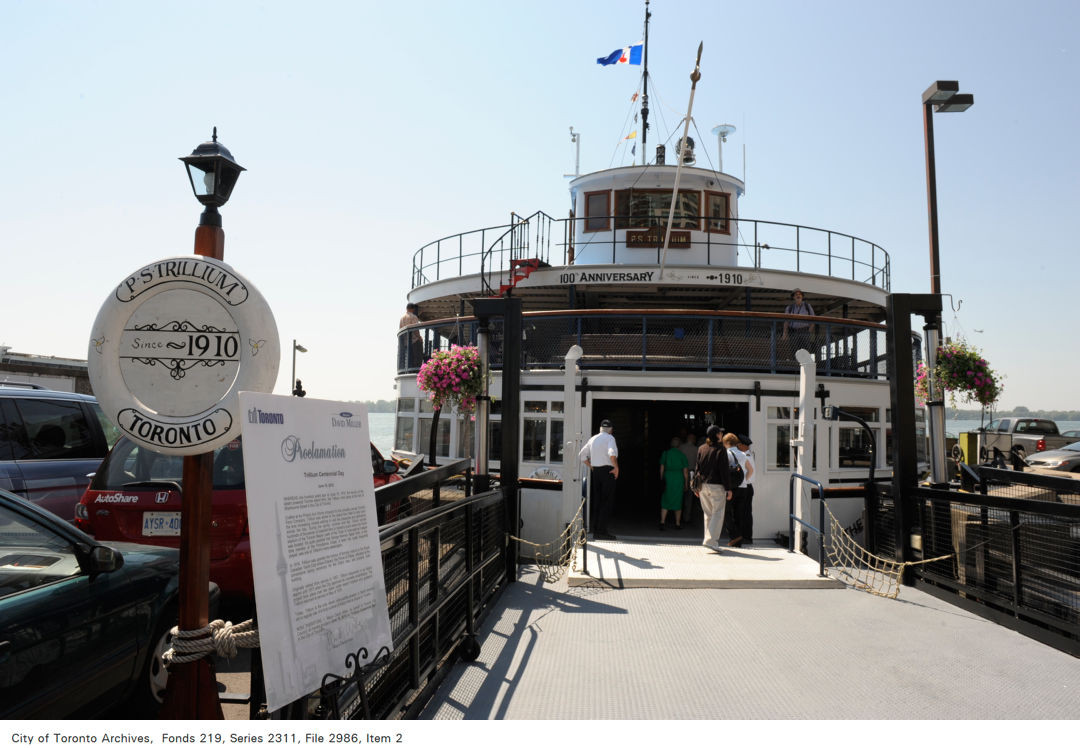
By Toronto standards, it is a borderline miracle that the Trillium ferry is still operational.
Built in 1910, two years before the Titanic, the city’s famous side-wheeler ferry is the last of its kind on the Great Lakes. With a new electrified ferry fleet on the horizon, the question needs to be asked: what do we do to celebrate this old piece of floating nostalgia before it becomes an afterthought?
We can rule out the classic Toronto approach of preserving the façade, building a towering condo out of its deck and calling it heritage. But if the Trillium is going to become a museum of Toronto, a floating restaurant, a spa, or something else entirely, the bigger question that comes first is: where will it live in a way that actually honours the ship’s history?
Not hidden and not stranded. A boat as nostalgia-evoking and essential to the Islands experience should be featured in a way that provides what our city often forgets to give its heritage pieces: exposition with context and nearby activity.
My pitch: the Portland Street slip at Bathurst Quay, beside the Canadian Malting Silos – a location where the waterfront, the skyline and the islands converge, anchored in what will soon be a cluster of past, present and near future destinations. A place, in other words, where the ferry won’t just sit, but would be visited.
First, let’s talk about where the Trillium shouldn’t go. When it was retired in 1957, it was left to rot in a lagoon near the Island Water Filtration Plant. Restored back into service in 1975, in part due to advocacy from Mike Filey and Tommy Thompson, we should hope the `do nothing’ option is off the table for good.
And while a location for the Trillium somewhere off of the Toronto Islands is a decent idea and worthy of consideration, the highly seasonal and ticketed traffic across the harbour would make a visit to this much beloved ferry restrictive to many. In a way, a location at the Island would hide this extraordinary piece of our city’s history.
Another cautionary tale is HMCS Haida. As a high schooler, I biked past the Haida when it was moored on an innocuous stretch of the western waterfront. The ship wasn’t really a destination in and of itself, but rather a landmark you passed on your way to somewhere else. Later, when I lived in Hamilton after university, my friends and I used the dockwall beside Haida’s new home, in the Hamilton harbour, as a quiet smoke spot, a low-traffic place where we could hang out without bothering anyone. HMCS Haida is an impressive ship, but her mooring locations were not.
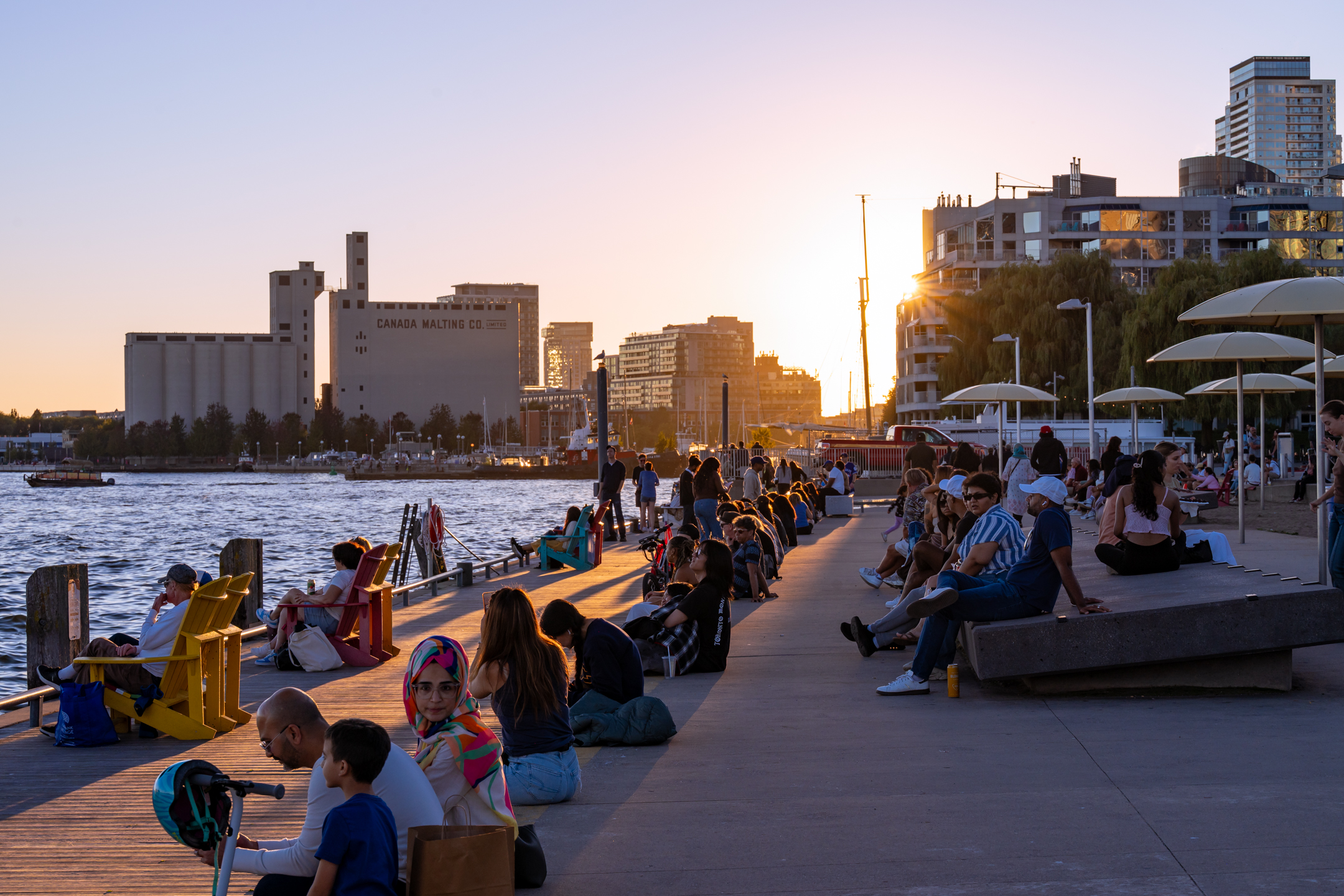
A better idea for the Trillium is to retire her the way we all hope to: into a vibrant neighbourhood, surrounded by complementary activities. At the Waterfront BIA, we talk about building hubs where attractions work together so that destinations, like the Trillium, aren’t standalone museum pieces, but part of a circuit visitors can easily build into a half- or full-day outing. Our 2024 Waterfront Retail Review, a critique of the waterfront’s retail and destination infrastructure, underscored that by co-locating destinations and complementary businesses into clusters, we can encourage visitors trips to be longer and richer experiences.
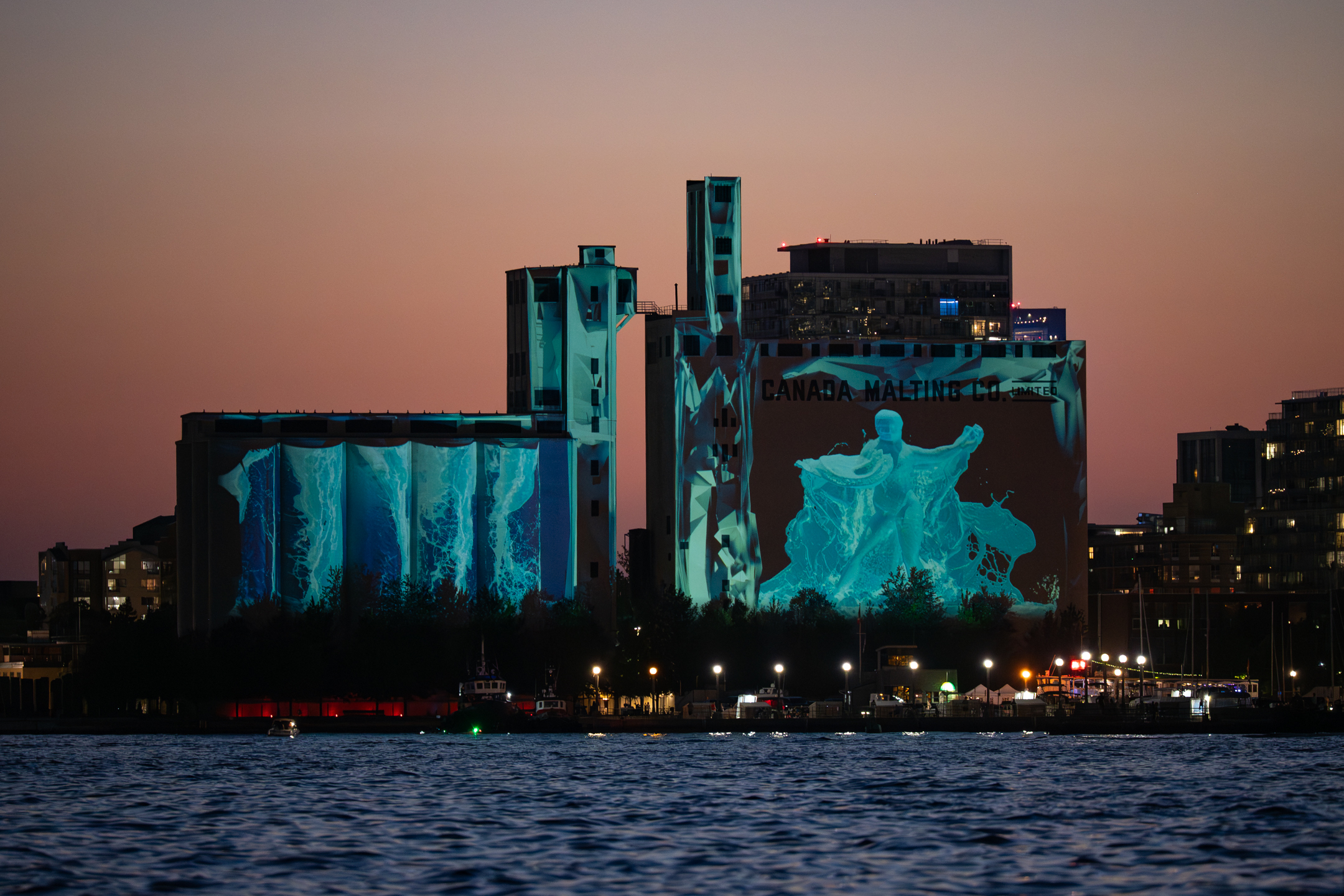
So what’s so exciting about Bathurst Quay? Most Torontonians don’t yet realize how much work is going on in this corner of the waterfront. The quay’s anchor, the Canadian Malting Silos, dates to 1928 and stands as a reminder of Toronto’s industrial past, bookending the downtown portion of the waterfront. Its restoration is one of the most striking and enabling projects in the area. Where the silos once looked like something soon to be demolished, they now feel deliberate, with the repaired concrete newly tinted to look like it did originally. A newly restored “Canada Malting Co.” sign extends proudly across them.
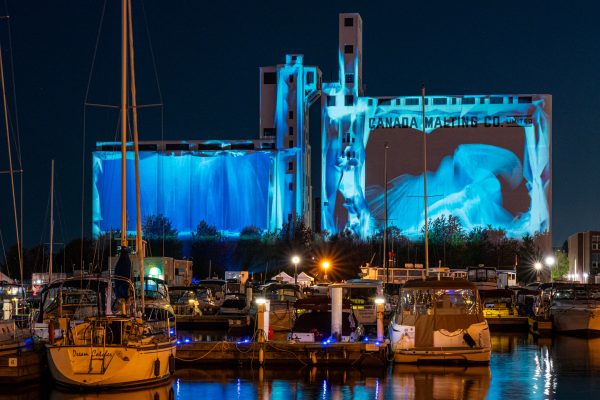
A few years ago, the Waterfront BIA commissioned Quebec-based Moment Factory to explore permanent projection mapping on the silos, and we were thrilled to learn the projections could be seen not only around the harbour, but also from the CN Tower, turning the silos into a true civic canvas.
While a permanent vision for projections hasn’t been realized yet, OCAD University has purchased equipment for temporary installations, including stunning projections recently in partnership with the city as part of Nuit Blanche and New Year’s Eve. OCAD’s role goes beyond lighting the facade: the silos are also slated to house OCAD’s Global Centre for Climate Action, with ground-floor exhibition space within the silos.
By situating the Trillium beside the silos, a story of Toronto’s waterfront’s industrial past and recreational present quickly emerges alongside narratives of culture, climate and public space come together.
The silos don’t just stand alone at Bathurst Quay. Just to the south and west sits Ireland Park, Bathurst Quay Common, and the soon-to-be-completed Corleck Building – the former Canadian Malting administration office, which is being repurposed into the home of the Canada Ireland Foundation. The site will be a cultural and community destination rooted in migration stories, including those of the approximately 30,000 Irish immigrants who arrived in Toronto during the 1847 potato famine.
Excitingly, the Corleck plans to open a rooftop patio for special occasions. There are few things more attractive than a place to have a proper pint on a sunny rooftop with one of the best views on the waterfront!
The high-quality park space in the area also helps make the case for Bathurst Quay as a destination hub. The Bathurst Quay Common is a beautiful programmable plaza and waters-edge promenade that could become an incredible place to program, bustling with activity that may be of interest to visitors arriving at the Billy Bishop Toronto City Airport.
A short walk east from the Bathurst Quay is the Toronto Music Garden, one of the city’s best-maintained park spaces and home to Harbourfront Centre’s much-loved Summer Music in the Garden series. Nearby is the Terry Fox Legacy Art Project, featuring some cool visuals carved out of the rocks’ silhouette.
Finally, across from the silos is the next big piece of the puzzle: Spadina Pier – sometimes referred to as “Bathurst Quay Waterfront Park.” Envisioned to be a future signature park for the city, with the potential for a new wave deck across the head of the Portland Street Slip, the vision for this space has narrowed for budgetary reasons. But the potential remains as the city looks at how to re-purpose the former industrial site and now-closed underwater parking garage into a flexibly programmable pier – a “meanwhile park,” such as exist in cities like Seattle and New York, used for activities like public performances, markets, installations, casual gatherings, sports and recreation.
Which brings us back to the Trillium. Whatever her future use turns out to be, the decision to place the vessel here would do more than preserve it. The Trillium would become a centrepiece within an interconnected network of destinations with transit access, local life, and enough programming to drive repeat visits, even when the weather isn’t cooperating.
I hope Toronto has learned that standalone destinations struggle because they don’t hold the public’s attention or drive repeat visits. If the Trillium was retired into a dense cluster of parks, cultural destinations, community infrastructure, and a pier-in-progress, she wouldn’t be hidden away as a relic, but rather situated where this chapter of Toronto’s past can be met, re-visited and celebrated as a gem of the waterfront.
photos by Romain Garcia/WBIA; Archives image: fonds 219, series 2311, file 2986, item 2
Oliver Hierlihy, LPM, is Director of Operations for the Waterfront BIA, where he leads urban activation & placemaking, data, and policy initiatives. Follow him on LinkedIn at www.linkedin.com/in/ohierlihy

5 comments
A nicely written and informative article that makes a convincing case for the Trillium’s future home.
Good suggestion, but I don’t think it necessarily needs to be moored in the water. I actually think it would be better protected on a dry dock—similar to how London’s Cuddy Shark is displayed. Positioning it at eye level with visitors could make it an even more engaging and memorable attraction.
Spadina Pier (539 Queens Quay W) on the east side of the Portland/Dan Leckie Slip) had a lower deck of parking that was closed because it flooded.
The City of Toronto has approved a park for this slip, and the remainder of the parking was closed in 2023.
It seems like it could be an ideal site for an off-water dry dock of the Trillium, in the centre of a park.
https://www.toronto.ca/city-government/planning-development/construction-new-facilities/park-facility-projects/new-park-at-spadina-pier/
Thanks for the article, Oliver. The conversation reminds me of the HMCS Sackville and the CSS Arcadia, destinations on the Halifax waterfront, close to each other but each managed under different governance structures. Governance is often the boring but critical question.
In my opinion there are better things to be done with a unique piece of history than add it to the flotilla of boats lining the cities shores. The city has only purchased 2 new vessels, when 4 are currently in operation. Rather than waste more money on new boats I say we leave it at 2. The Ongiara, the newest in the fleet, should be retained, but re-engined and modernized electrically to bring it up to spec. And for the tourist riddled summer only Centre Island route? Modernize the Trillium. The Swiss have proven that antique steam ships can reliably provide public transportation, with modern upgrades to the controls, electrical generation, navigation, and communication. The Trillium, with it’s 1970s electronics replaced, it’s boiler made even more automated than it already is (a nice bonus being it can already theoretically handle alternative fuels), and it’s Edwardian components refreshed, would be the perfect complement to the new Electric vessel. The Trillium already has the highest passenger capacity of the fleet, meaning it’s future proofed. The best thing to do with any historical piece of machinery is to run it, the worst thing in preservation is to let it sit.