

Does the City of Toronto see its network of sidewalks as transportation infrastructure?
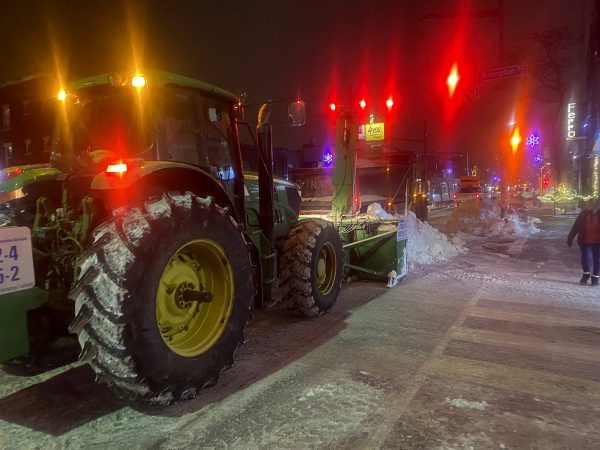
Officially, the answer is yes. Transportation services, the sprawling department tasked with planning, maintaining and enforcing rules on Toronto’s public rights-of-way, is notionally responsible for the care and feeding of our sidewalks. But the record-setting snow-dump that hit us a week ago Sunday reveals (and not for the first time) that sidewalks are the second-class citizens of our transportation infrastructure, and not considered, in practical terms, to contribute to the way people and goods move through the city.
After days of complaints that flooded into 311, city manager Paul Johnson conceded the point. “[O]perationally, we realized that sidewalks have become an issue where we’re just not doing enough and we need to improve,” he told reporters on January 28, three days after the storm, alongside an announcement that crews would be sent out to inspect sidewalks across the city. “Clearly there’s a gap in our performance around sidewalks and we’re hoping to improve that over the next 24-hour cycle.”
Did they? I’ll resist the temptation to insert the shrugging emoji here, but that’s my take.
I walk a lot, and I’ve tried to make sense of the city’s sidewalk snow-clearing process, but to no avail.
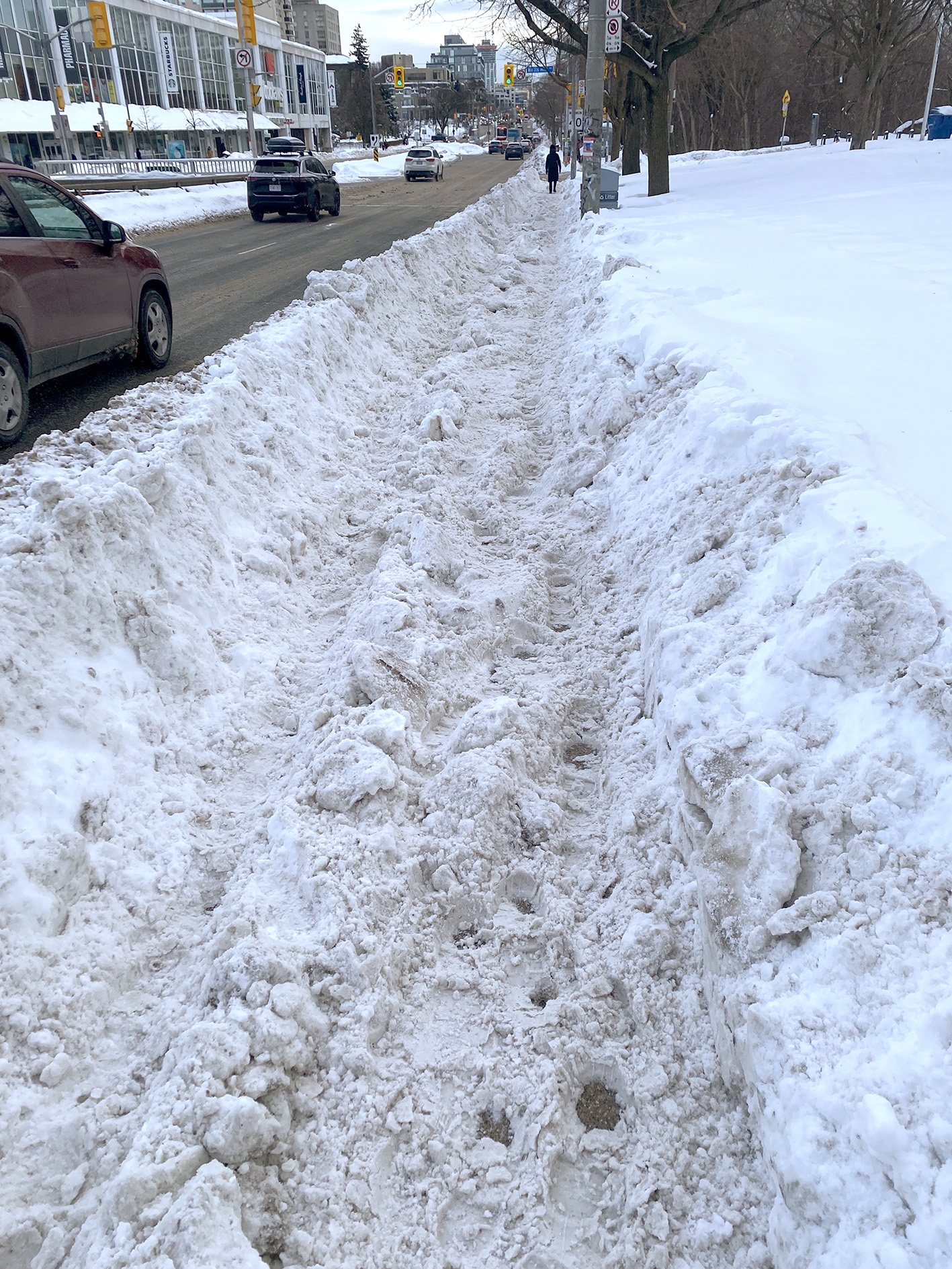
Some sidewalks show evidence that the little snow-plows have done the rounds. But there are also plenty of stretches where the plows have cleared in some places while in others they had their shovels up, leaving behind deep tire grooves that make those sidewalks even less walkable.
There’s no rhyme or reason to the way the City clears corners. Some are shovelled, others are not, even if one of the aforementioned plows has been by, as evidenced by their tire tracks.
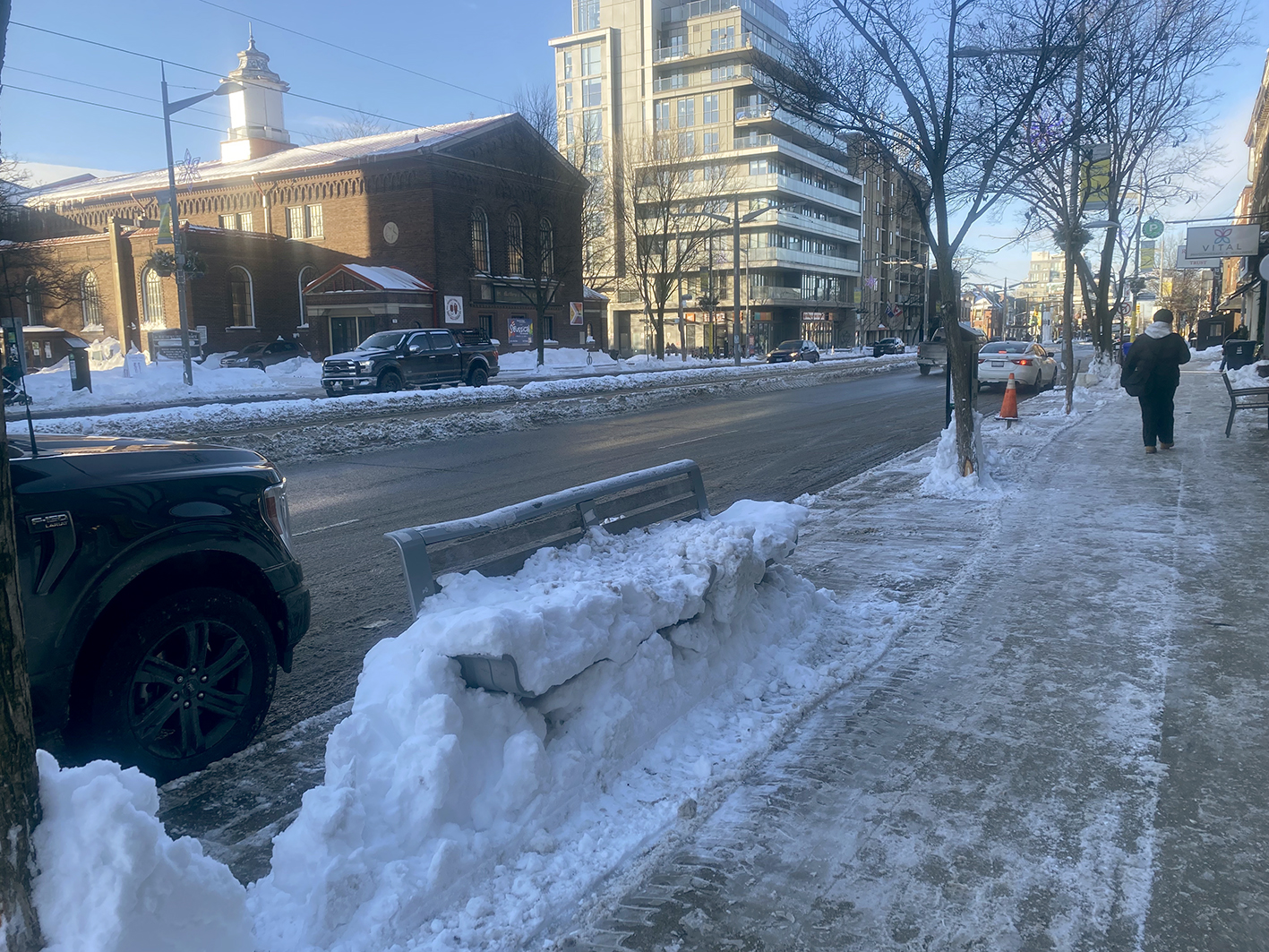
Even on arterials and main streets, you can see that the city has cleared the sidewalk for a certain distance, but then something mysterious happens and the next stretch remains clotted and impassable, although the clearing activity resumes some distance further along.
Why? Who knows.
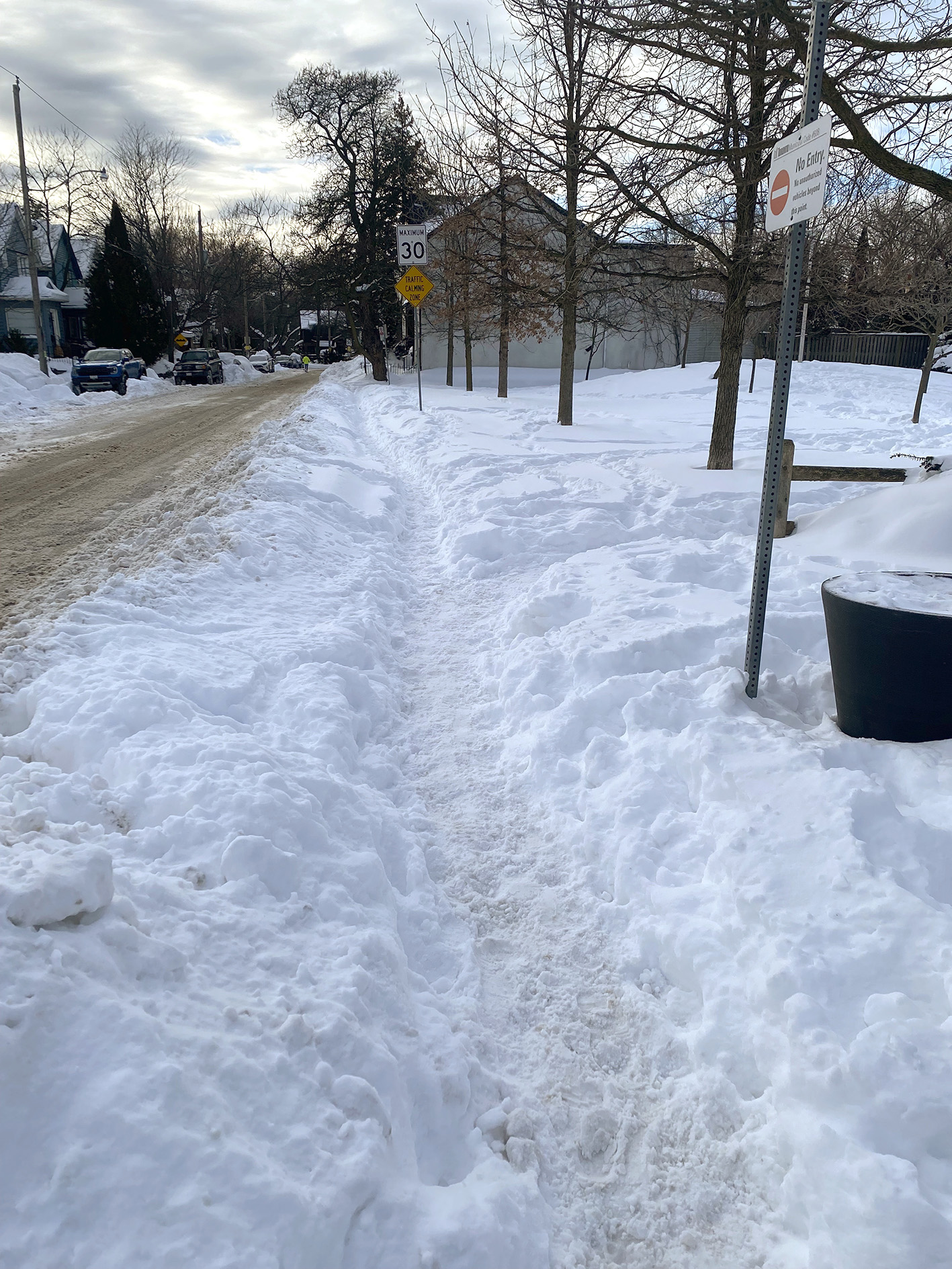
Last, there’s the old and apparently still active turf war between transportation services and other city agencies or public institutions. The sidewalks surrounding parks are almost never cleared, in my experience, which suggests that transportation services and parks and recreation have an unresolved feud over which entity is responsible — a ludicrous fight, given that the stumbling public doesn’t care who clears the path, as long as it is done.
Same deal with school sites, which reflects poorly on both the boards and the city, given that these are especially busy sidewalks populated by kids, parents with strollers, and so on.
I get that the guys driving the little plows aren’t using maps fitted out with bespoke instructions. Nor can the city’s crews and contractors be everywhere at once. But I don’t think it’s too much to ask that long-standing issues of who is responsible for what be resolved by the warring bureaucratic factions during the off-season. Similarly, as a matter of operational policy, if the city is going to go to the trouble of plowing sidewalks, those vehicle operators should be instructed to clear a pedestrian path at every corner they pass.
The sidewalk patchiness we’ve all had to navigate in the past week stands in stark contrast to the way the city handled the roads this year (quite well), and hints at an absurd counter-factual. Imagine if the road clearing crews skipped a block of an arterial here and there, for no apparent reason.
Yet that’s precisely what the sidewalks are like. The contrasting treatment provides clear evidence that the city doesn’t see them as integral to Toronto’s transportation network, but rather more like a concrete buffer between the important bits and the private bits. Feet, strollers, scooters, walkers — these are all elements of the transportation system. It shouldn’t have taken a tsunami of calls to 311 for the city to recognize this basic fact of urban life.
Final rant: it’s worth asking whether the city’s pledge to plow in front of all private dwellings is working. After years of complaints about the unfairness of suburban areas receiving windrow clearing while downtown neighbourhoods get nothing, council a few years ago voted to establish sidewalk plowing, with the following performance standards: when there’s more than two centimetres of snow, the city will “clear all public sidewalks.”
“Sidewalk clearing after a snowfall takes approximately 12 hours to complete and, depending on the storm severity, may occur more than once,” according to the city’s website, which goes on to claim that 98% of all sidewalks receive mechanical clearing and the remaining stretches are “manually cleared by city crews.”
Nothing of the sort happened following the storm, and, in this instance, I understand why — the city was stretched to the limit in dealing with the sheer volume of snow.
But I want to raise a question about the unintended consequences of this new policy, which is a snowy variation on the tragedy of the commons. Now, some homeowners (in my observation, at any rate) have just stopped clearing their sidewalks altogether, on the assumption that the city will do it for them.
Some, but not all, because, well, old habits, etc. But also because a lot of people — the majority, really — recognized that the sidewalks in front of their properties would be impossible to navigate with so much snow, especially since the little plows did not come by, in lots of places, during those first twelve hours. So they cleared a path.
The result with the plowing pledge has been a hard-to-navigate patchwork, which, in the case of a very heavy snowfall, only gets worse with the passage of time due to the accumulation of packed-down snow on those un-cleared segments of sidewalk and the rough mess left when the sidewalk plows go by without attempting to clear (often because the sidewalk is just too narrow).
Is the current system better or worse than what existed previously? The old approach had lots of flaws, of course — not just the equity issue, but also the reality that it put older residents or those with health/mobility conditions at a disadvantage. As well, in the pre-sidewalk plowing era, some homeowners simply couldn’t be bothered shovelling, and correctly recognized that the city’s threat of a fine was largely empty.
Yet I’m not persuaded the new system has been an improvement. At the minimum, the city, now seized of the shortcomings of its sidewalk clearing operation, should investigate ways to confront this problem, which is real, aggravating, and impedes accessibility for a wide range of residents.
The city doesn’t treat road clearing as a nice-to-have, for all the obvious reasons. For a municipality that pays so much lip service to walkability, climate and equity of access, sidewalk snow clearing shouldn’t be one, either.
2 comments
Don’t hold your breath and expect this city to change its archaic ways. Pedestrians are treated like an impediment to the automobile. If you don’t believe this, aside from the failure to clear sidewalks, just look at the exponential growth in people driving pickup trucks and SUVs. Toronto will never be a real modern city. In fact it’s not really a city, just an appendage of Queen’s Park.
In our neighbourhood we’ve never seen such issues. Our street wasn’t plowed for five days. Driving was nearly impossible, even with great snow tires.
The sidewalks were even worse. I walk everyday: to the gym, grocery store, taking out our dog. But it wasn’t homeowners that caused the worst problems. Sure, there were some slowpokes, but mostly elderly people who couldn’t do it themselves and neighbours helped out. After a week in the residential areas, the city came by with a sidewalk machine which was too wide and pushed the snow back onto the sidewalk, creating ridges and narrow channels. It was hard to walk and dangerous since it was hard and soon icy.
On Bathurst, the streets were clean but sidewalks were completely ignored. Even now, some areas have not been cleared. I saw parents with strollers trying to traverse these walkways with great difficulty, many days after the storm.