
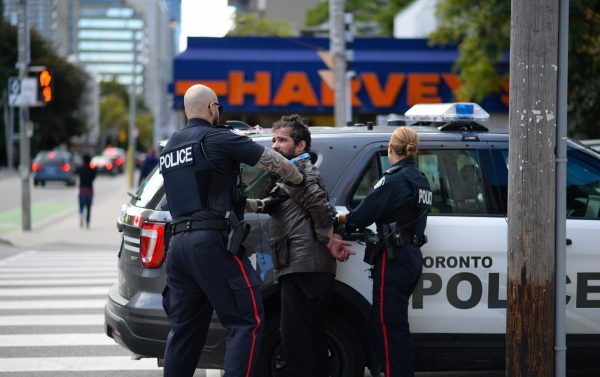

Following last week’s revelations about “Project South” — a far-ranging probe into police corruption that netted indictments against seven Toronto cops, one retired officer and three other suspensions in Peel Region, as well as 24 civilians — a media-fuelled narrative quickly hardened into received wisdom. According to various pundits, this bust, which allegedly involved organized crime, extortion and attempted hit jobs, with links to drug dealers, car theft rings and the always nefarious tow truck industry, had shaken public confidence in the Toronto Police Service.
The news “struck at the heart of the public’s faith in the police,” opined Ian Scott, the former head of the Special Investigations Unit in an op-ed entitled, “How can Toronto’s police regain public confidence?”
As if to project an image of resolve in the face of adversity, Toronto police chief Myron Demkiw and two senior cops from York Region appeared, oddly, in bullet proof vests in their first press briefing following initial news reports.
Queen’s Park promptly jumped into the fray, with the Ford government ordering up a review, to be conducted by the provincial inspector general of policing, of all 45 Ontario police services — an exercise in performative accountability that makes little sense, given the location of the criminal activity (the GTA). What’s more, it will take forever to produce findings (although that may have been the intention all along).
Not to be outdone, Demkiw pledged to establish an internal “working group” that will probe “our internal processes, practices and everything that we do.” “The integrity of this investigation is the first step in helping Torontonians feel confident in the trust they place in us.”
Et voila, public confidence, which seemed to waver precariously through a news cycle or two, is being restored. Or at least the engine is running.
None of the stories positing a loss in public confidence in the Toronto police offered proof that the public had reacted to this intriguing set of arrests by withholding its faith in an institution that only sporadically basks in the glow of civic approval.
I suppose we could interpret confidence to mean confidence in the most public manifestations of the city’s policing infrastructure. Demkiw, for example, didn’t fall on his sword, nor was he really expected to, which suggests that his own reserves of public confidence are holding up. Nor did Mayor Olivia Chow threaten to withhold or claw back the TPS’ $90 million-plus annual budget hike, so the fact that we’re in business-as-usual territory when it comes to the ever-rising cost of policing strongly implies that Toronto council’s confidence wasn’t rattled.
As for the rest of us, if you’re in a bar when a fight breaks out, or if you come home one evening and discover that someone’s broken in, or if your shop has been ransacked, will you hesitate to call 911 because your confidence has been at least stirred if not shaken?
Unlikely.
I can, however, imagine that confidence (and therefore morale) within the affected police services may be a bit wobbly these days. After all, it’s only human nature for the people working inside a huge organization that’s been exposed in this way to wonder about co-workers with weird habits or those who create a slip stream of rumours. But that phenomenon isn’t a public confidence crisis, is it? It is about something else entirely.
Public institutions do experience crises in confidence. Take the Toronto Transit Commission: the agency’s chronic post-pandemic problems with service frequency and scheduling have helped prevent ridership from returning to pre-pandemic levels, which, I’d argue, is evidence of a loss of confidence. But in the case of transit, large swaths of the commuting public have options for getting around the city. There’s no such alternative to the police, unless you live or work in the rarified confines of private spaces and can afford private security.
I’d also question the underlying assumption behind the hyper-ventilating media warnings, i.e., that public confidence in the police was intact prior to the Project South bust.
Yes, the city last year saw a nearly record low in the homicides, which suggests that the TPS is doing something to improve public safety by preventing violence. But, as former chief Bill Blair once told me, he never takes credit for declining crime rates because he doesn’t think the police should be held solely responsible for rising crime.
Then there’s the related question about which public we are talking about when we assert the existence of public confidence. Lots of people have almost no direct encounters with the police besides seeing cruisers on the street or cops working at public events or directing traffic near construction sites.
Yet, as is well recognized, many lower-income, racialized communities have experienced chronic over-policing or a profusion of not especially random street checks. We’ve seen some reform in recent years in carding procedures, as well as efforts by the TPS to diversify its labour force. But a 2023 report on anti-Black racism in the TPS by the Ontario Human Rights Commission found, among other things, that “Black people remain disproportionately over-represented in all instances of use of force by the TPS.” In other words, if you are young and brown and male, you probably didn’t have water-tight confidence in the TPS on the day before the Project South arrests, and you likely won’t have much more after all the investigations and working groups and audits are complete.
As for the wider public, in whose name the extensive provincial review is being carried out, I’m not at all clear why the Ford government reached for an exercise that is so wide-ranging and complex. After all, the Project South investigators fingered cops and their accomplices in the GTA, not Sudbury or Ottawa or Windsor.
If this spider’s web of corruption does, in fact, extend to Ontario’s nether regions, we’re looking at something far worse than Serpico, at which point public confidence, or the lack thereof, is the least of our problems.
One comment
I am a white, middle class, middle-aged woman and I have little confidence in the Toronto Police Service. The results of the Project South investigation do not surprise me at all.
If the TPS does not have the confidence of someone like myself, then they have a serious problem indeed.