
Blair Scorgie is a Toronto-based Registered Professional Planner and Urban Designer. He is the Managing Principal of Scorgie Planning, and a Sessional Lecturer at Toronto Metropolitan University.
Toronto’s housing debate often focuses on permissions — where new housing is allowed, how tall buildings can be, and which neighbourhoods should absorb growth. Over the past several years, City Council has taken deliberate steps to expand those permissions through initiatives such as Expanding Housing Options in Neighbourhoods (EHON).
But permission on paper does not automatically translate into housing on the ground. The systems used to implement those policies — zoning rules, approval pathways, and delegated decision-making bodies — play an equally important role in determining whether policy intent ultimately becomes built form. At a time when cities are under pressure to address housing affordability, accommodate population growth, tackle climate change, and support more compact, transit-oriented urban form, the reliability of those implementation systems matters more than ever.
Toronto’s Committee of Adjustment was designed for a planning environment that was more stable and less internally complex than the one it now operates within. Its purpose was straightforward: address modest deviations from the zoning by-law without requiring every small change to return to City Council. For many years, that structure functioned reasonably well.
What is now emerging at the Committee is not primarily the result of any single decision or decision-maker. Rather, it reflects a growing lag between the City’s land use planning policy reforms and the regulatory and procedural machinery used to implement them. Specifically, over the past several years, council has deliberately expanded permissions through the EHON initiative — including the Major Streets framework, which is intended to support small apartment buildings of up to six storeys (19 metres) along designated corridors.
In policy terms, the direction is relatively clear. In implementation terms, the system remains uneven.
Many applications now arrive carrying multiple layers of planning signals: Official Plan direction that anticipates incremental intensification, EHON-based zoning permissions along Major Streets, and legacy zoning standards that were never updated to reflect these newer policies. The statutory test under Section 45 of the Planning Act – whether a variance is minor, desirable for the appropriate development or use of the land, maintains the general intent of the Zoning By-law, and maintains the general intent of the Official Plan – has not changed. The context in which it is being applied has.
A recent Scarborough case illustrates how this tension is surfacing. The proposal — a six-storey, 10-unit rental building on Pharmacy Avenue — sat on a corridor where council has expressly encouraged this form of intensification through EHON and the Major Streets framework. Height and density were permitted. The application nevertheless required a small number minor variances tied largely to legacy performance standards. (Full disclosure: I am the developer’s planning consultant.)
The builder sought minor variances for the front yard setback, building length (to allow for a functional layout), and front yard parking (there is no alternative location available), along with other technical adjustments. The city’s community planning, transportation services, and urban forestry divisions all provided supportive comments. Community planning explicitly concluded that the requested variances met the Planning Act’s four tests that determine whether the project warrants approval despite the minor variances. Nonetheless, the Committee of Adjustment unanimously refused the application.
During the hearing, discussion focused heavily on “neighbourhood character” and the appropriateness of the building type. The written refusal ultimately cited failure to meet the four tests, as required by statute, but — as is typical — did not provide detailed reasoning. The divergence between the policy context, the technical planning evidence, and the hearing discussion is what has drawn wider attention to the file in recent weeks.
It is important to be precise about what this example does and does not show. The Committee of Adjustment is not setting Official Plan policy. Nor is every hearing exhibiting this pattern. But cases like this do illustrate the increasing interpretive burden being placed on a body originally mandated to deal with relatively modest and contained zoning adjustments.
Major Streets files make this gap particularly visible. Council has made a deliberate policy choice through EHON to allow small apartment buildings along identified corridors. Yet many properties along those same corridors remain subject to Chapter 900 site-specific exceptions and other legacy zoning provisions that predate this policy change. The result is a growing class of proposals that are clearly policy-aligned but technically non-conforming.
In the absence of a calibrated implementation pathway, these files are pushed toward the Committee of Adjustment. What appears on paper as modest relief can end up carrying the practical weight of reconciling older zoning bylaws with newer policy directions. That is a structural condition, not a commentary on any individual panel.
At the same time, the Committee itself is showing signs of institutional strain. Members are increasingly being asked to navigate layered policy frameworks, legacy zoning history, and evolving Council direction all within the confines of a quasi-judicial volunteer body. Variation in interpretation is an inevitable by-product of that structure. Concerns about consistency, predictability, and mandate clarity are beginning to surface more frequently as a result.
There is also a governance dimension that cannot be ignored. City Council has delegated minor variance authority to the Committee. Yet in practice, councillors continue to comment on individual applications in ways that can be perceived — fairly or not — as attempts to influence the quasi-judicial panels. That dynamic adds another layer of pressure to a process that already operates in a highly compressed decision environment.
City Hall has begun to acknowledge the need for review. Recent directions to examine the Committee of Adjustment, including Planning and Housing Committee item PH28.14, which calls for a review of the Committee of Adjustment Process, and the Mayor’s broader interest in reform, point to growing institutional awareness that the current model is under stress. An amendment to PH28.14 moved by Councillor Frances Nunziata, which focused narrowly on coordination between tree injury or removal permits and minor variance approvals, is another signal that the approvals ecosystem is becoming increasingly tangled at the project level.
If Toronto were designing its approvals system from scratch today, it is unlikely the city and council would rely so heavily on a single discretionary forum to absorb these overlapping pressures. A more coherent architecture would better match decision-making tools to the scale and nature of the planning question being asked. Truly minor deviations from clear and contemporary standards should continue to be handled by the Committee of Adjustment. That pressure-valve function remains important and, in many cases, still works well.
The strain is most visible in middle tier proposals that implement Council’s adopted direction but require targeted departures from legacy zoning. These are neither classic minor variances nor full policy questions requiring a zoning bylaw change. Treating them as stretched minor variances forces the Committee to perform policy reconciliation work that the process was never designed to carry at scale.
Toronto would benefit from a distinct, criteria-based pathway for these policy-aligned but technically non-conforming cases, potentially through delegated authority tied directly to Official Plan intent and contemporary zoning objectives. Such a screening / triage mechanism would not remove scrutiny or public participation. It would simply ensure that the body making the decision is proportionate to the nature of the issue being resolved.
At the same time, reform cannot stop at process design. There is a real and immediate need to modernize the governance framework of the Committee itself. Minimum qualifications, clearer articulation of mandate, enhanced training expectations, and defined recourse where decisions consistently stray from the statutory framework all warrant serious consideration before the next Council appointment cycle.
This is not about second-guessing individual members. It is about institutional fit. A volunteer, rotating body exercising quasi-judicial authority over increasingly technical planning matters requires a governance approach that matches the responsibilities placed on the Committee.
Toronto’s planning framework has always evolved in stages. Policy moves first. Zoning and procedures follow. Institutional roles adjust more slowly. The Committee of Adjustment is where that lag is currently most visible, because it sits at the intersection of legacy zoning, contemporary policy direction, and site-specific conflict.
The question now facing council is not whether reform is needed. It is whether the next phase of reform will be sufficiently comprehensive — aligning zoning, approval pathways, and Committee governance with the policy direction Council has already set. Finishing that work is not deregulation. It is governance catching up to policy.
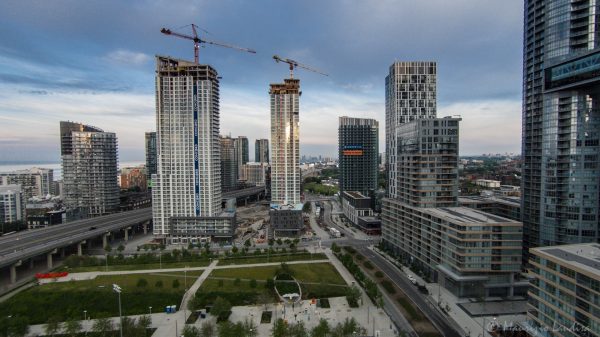
photo by Maurizio Laudisa (cc)

One comment
I find the lack of reasons in CoA decisions (and minutes) a disturbing lack of transparency that undermines the credibility of and pubic trust in the CoA. All the CoA panels in the City use the same boilerplate text as “reasons”: one set for an approval; another for a refusal. This does not meet the requirements of Section 44 of The Planning Act.
With Bill 23 stripping residents of access to Third Party appeals, CoAs can now operate with impunity, in the knowledge that the only way residents can appeal a decision is through a costly Judicial Review.
I served on the board of the Long Branch Neighbourhood Association and we fought developers mostly at TLAB and mostly on severance applications. We won 18 straight cases despite us all being lay people. So I have attended many CoA hearings and analyzed decisions across the City.
My recommendation is to remove consent (severance) applications from the CoA and instead direct these to TLAB. At TLAB, there is more rigor in the process, more time to present and analyze data, the opportunity to challenge evidence through cross-examination and, in the end, a decision that clearly lays out the reasons behind the decision.
Given the uneven playing field imposed by the Province, a 5-minute deputation to a CoA panel is a woefully inadequate and inconsiderate way to allow for meaningful debate of a consent application, arguably much more complex than a minor variance.
I have had experience with CoA panels that made decisions that were not supported by the evidence presented to them or where Panel members “revised the Official Plan” to support a decision they had made in advance.
There is no question in my mind the CoA is a process grossly in need of reform.