
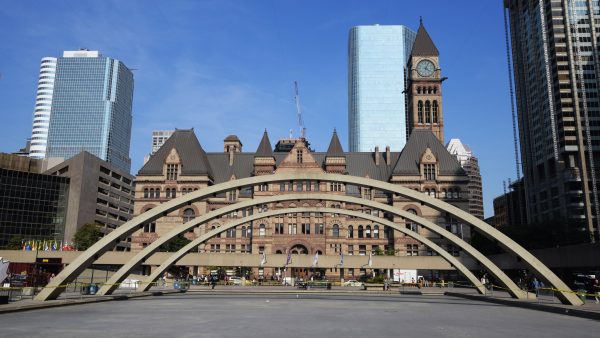

It sometimes seems that the endless civic debate over the second life of Old City Hall began not long after E.J. Lennox completed his sandstone monument to municipal government. But the earlier bursts of largely theoretical discourse — from the mid-2000s and then the 2010s, much of which centred around a Toronto museum — have given way to a much more immediate conversation now that the courts have finally moved out.
The city is bringing private tours into the building, and there were efforts to animate the central courtyard last summer. All these moves are encouraging, but at the heart of this formidable exercise in adaptive re-use is a daunting question: given the building’s condition, should the city undertake an extremely costly and time-consuming back-to-the-studs type overhaul to address issues such as accessibility, internal infrastructure, and so on? Or is there a way to chip away at this project, with the goal of bringing bits of the building back into public use, crowd-sourcing ideas for new occupants, cultural activity and so on?
Top down versus bottom up. Not letting the perfect become the enemy, etc.
In a recent Globe and Mail column, architecture critic Alex Bozikovic made a compelling case for the latter. “Mayor Olivia Chow should bypass the glacial municipal machine and establish a separate body, a non-profit sitting outside the bureaucratic walls, to run the site as a 10-year urban laboratory.” He asked the design studio PUBLIC WORK to conjure up ideas for drawing people into the courtyard and even opening it up to the main entrance on Queen Street. Heritage expert Michael McClelland, of ERA Architects, argues that old City Hall should be made available to artists.
These are all great ideas, and I’d add one other layer: transforming the two small streets that abut Old City Hall, Albert and James, into pedestrian-only or pedestrian-mostly spaces that could serve as highly accessible transition zones between this monumental structure and the heavily trafficked precincts — the Eaton’s Centre, Bell Trinity Place, Nathan Phillips Square, across Bay — that surround it.
James will be out of commission for years because it is a staging ground for the Ontario Line station construction. But Albert has enormous immediate potential as a car-free street now that the only vehicular users — cops, parked there for a court date, and prisoner transfer vans — have vacated the premises. (There’s an underground parking entrance and a loading bay at the rear of Bell Trinity Place that are accessible via James and Albert, but this large corporate complex has other entrances on Bay for both parking and deliveries into the Eaton Centre.)
With the city advancing a beautification strategy and looking for opportunities to make a mark, there’s no reason why Albert couldn’t be closed off once the weather warms up. The city could fit it out with several dozen moveable tables and folding chairs as an act of experimental urban acupuncture, no traffic studies needed. It’s not just about seeing what might happen on that cozy little block. This whole space, once animated, will signal passersby that they can now poke their noses into the amazing courtyard, which will become the key for unlocking the entire building.
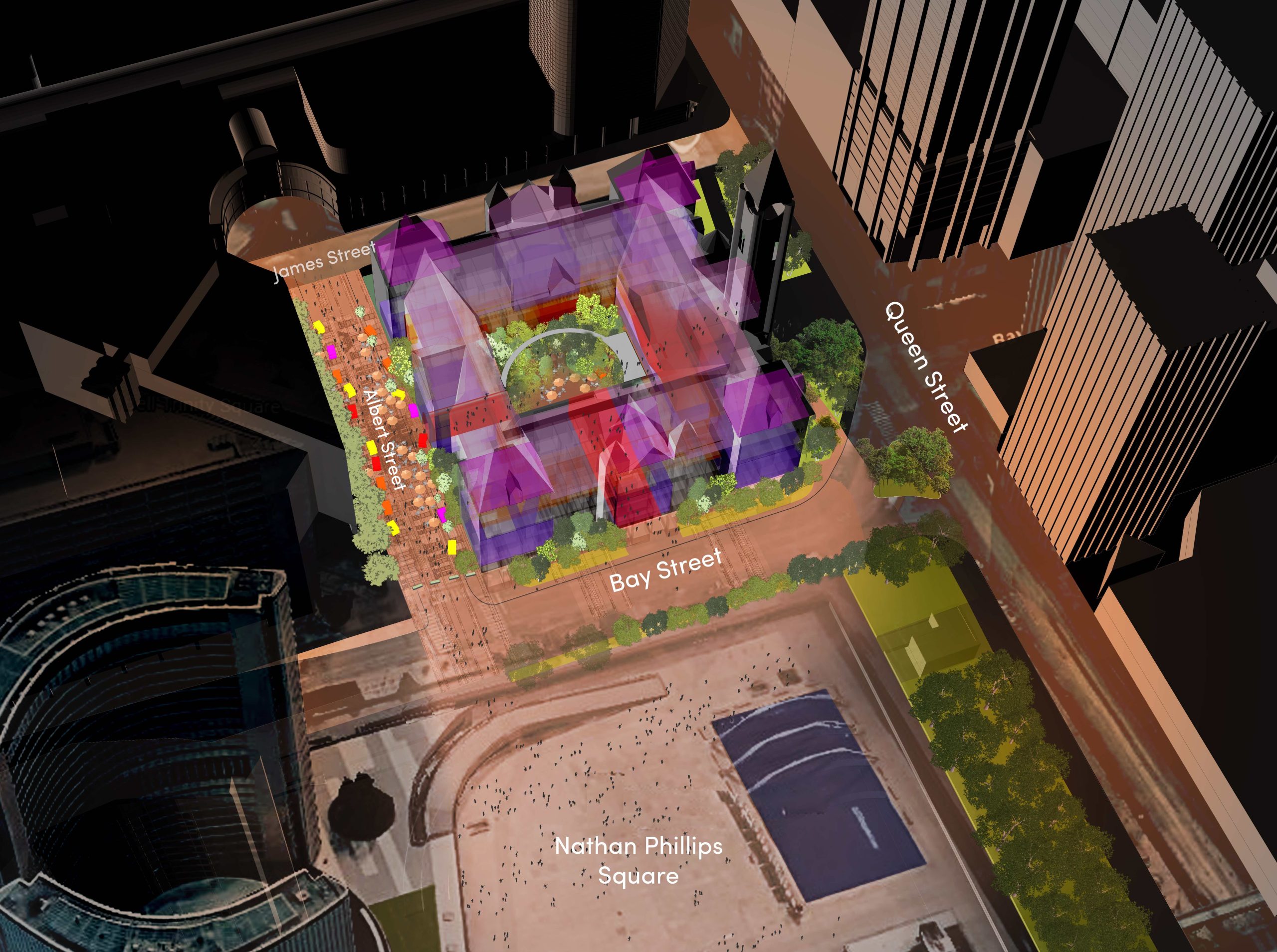
I asked PUBLIC WORK co-founder Marc Ryan about the potential of these spaces around Old City Hall. “You could have regular closures on Albert,” he says, “and nobody would mind, right?” In the renderings he prepared for The Globe, Ryan included a couple that considered these exterior zones. “That, to me, was really exciting, because then you could start saying, whatever you activate in the courtyard is linked to something that’s equally active and maybe more urban.”
Ryan points to the traffic light on Bay that connects the City Hall precinct to a block that, until now, was mainly an interstitial space leading to the Eaton’s Centre’s side entrance. He envisions programming and perhaps some landscaping, all in the service of enhancing what McClelland calls the “civic precinct.”
The James Street block, in fact, has even more open space than Albert because a wide apron of grass and trees. I’d also argue James, currently filled with construction trailers, is now axiomatically surplus to the city’s downtown grid: keeping it closed after the Ontario Line construction circus has moved on won’t disrupt anything. The city — and indeed Cadillac Fairview, which owns the Eaton Centre — should be thinking of this modest block as a huge public space opportunity, not as a service lane good for little more than a few deliveries and some street parking.
Ryan says that to fully integrate Old City Hall — isolated for so long as a castle full of dreary court rooms protected by security gantries — with its surroundings depends on opening up what he calls its four “cardinal entries,” thus making the building and its courtyard porous, a kind of crossroads. Pedestrianizing Albert and eventually James will augment this goal by inviting people into the building’s ambit. And unlike the many capital improvements awaiting old City Hall, closing Albert can be done right away, even as a pilot project, without significant financial outlays or disruption.
“Centering [old City Hall] as an address would just help you see it freshly,” muses Ryan. “I mean, to me, that’s just about seeing it again for the first time.”
3 comments
The current state of the pedestrian pathways in the nearby area, including the long pedestrianized section of James Street north of Albert, is the strongest single argument against new car-free streets in the area.
Maintenance is dismal. Trinity Square is a beat-up patchwork of pavers and asphalt patches, filled with massive puddles thanks to poor drainage. The area is filthy and often inundated with open drug consumption, favored by those who enjoy the secluded, low-traffic nature of the space. It is one of the least attractive areas in the core, and one that no one I know enjoys spending time in.
New pedestrian zones on Albert and James would likely be subsumed by the existing “users” of Trinity Square, as a drop in traffic further lessens eyes on the street. The City has completely failed to make the existing space anything but a blight, and CF has logically taken the cue by showing no interest in the area. I see no reason why any expansion would be treated differently, and to fail to acknowledge that is a major blind spot. For a publication that seeks to address the intimate matters of our city’s physical fabric, much of the writing has the detached familiarity of a satellite snapping photos from high orbit.
I fully support pedestrianizing these smaller streets. That said, it also raises a bigger question: should we be making bolder, more systemic moves?
With the Ontario Line set to reshape transit patterns downtown, it may be worth reconsidering whether the 510 should return to its historic routing at all. Keeping the current Adelaide/Richmond detour permanently—and pedestrianizing Victoria from Queen to York—could unlock something much more ambitious.
Done right, this could create a true ceremonial heart for the city: a continuous, people-first civic space where movement isn’t dictated by cars or streetcars, but by the experience of the place itself.
It’s exciting to be having this conversation about finally revitalizing Old City Hall and the cheap and dreary public realm around it! Old City Hall is one of the best civic landmarks in Canada. Even as a courthouse, it shouldn’t have had worn out lawns, excessively wide side streets around it, or a grand courtyard turned into an ugly parking lot.
I like this grassroots approach to adaptive reuse, but you can’t be too modest either with these projects. This building could be thriving with culture and tourists. The architecture is world class. It’s a designated National Historic Site of Canada. It’s such a low-hanging fruit when it comes to cultural and tourism investment.
All three levels of government should be prepared to spend the money to make the building and the public realm around it spectacular, as would be done in Quebec or most European countries. I feel that Quebecers are better at advocating for funding for these kinds of historic cultural revitalization projects than we are with the federal government. They seem to get more of these kinds of projects done and faster.