
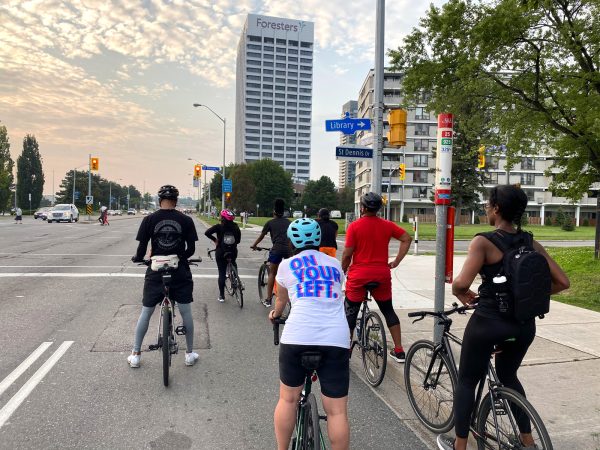
Under Ontario’s Highway Traffic Act, people riding bikes are required to have a few basic pieces of safety equipment: a white front light, a red rear light, and a bell or horn.
That last requirement is the one that sparked this reflection.
What happens when someone riding a bike doesn’t ring the bell while approaching pedestrians or slower users on a path? What if instead they simply use their voice and say, “On your left”?
Is that rude?
That question came to mind after reading a recent piece in Canadian Cycling Magazine by Terry McKall titled “On your left’ is cycling’s worst habit.” His argument is that shouting the phrase startles pedestrians, annoys people on shared trails, and contributes to the perception that cyclists are inconsiderate users of public space.
I read the piece with interest. But I also read it with a fair amount of skepticism.
We are people first, riders second
Before getting too deep into the debate about bells versus voices, it’s probably worth saying something about identity.
I’ve never really thought of myself as a cyclist. If that’s how you identify, that’s great. But I’ve always thought of myself simply as a person who rides a bike.
That distinction might seem small, but I think it can shape how you move through public space.
When you see yourself primarily as a cyclist, it’s easy to frame interactions with others as a conflict between user groups. Cyclists versus pedestrians. Cyclists versus drivers. Cyclists versus everyone.
But when you think of yourself as a person who rides a bike, the lens shifts.
You’re not a category of road user defending your turf. You’re simply another person moving through shared space. Sometimes faster, sometimes slower, but always responsible for how your movement affects the people around you.
Most people moving through these spaces are not trying to upset anyone. People are commuting. Exercising. Walking a dog. Teaching a child how to balance. Getting a bit of fresh air after a long day. The vast majority of interactions on paths and lanes happen without incident.
As Andrew Cuthbert observes in his reflection on everyday riding etiquette in Bike Manners:
“Cyclists are not a uniform group, people get out for all kinds of reasons, but in general, people are out to have a good time. Be mindful of your surroundings and the people around you, be courteous and polite and we can all have a good time.”
That reminder helps keep small moments of friction in perspective.
Because the goal isn’t perfect behaviour, the goal is behaviour that is legible and comfortable for others sharing the same space.
From that perspective, the question stops being whether “on your left” is rude.
The more useful question becomes:
how do we move around each other safely and respectfully?
How we signal matters less than why we signal
The Highway Traffic Act requires a bell or horn so that someone riding a bike can signal their presence. That requirement makes sense. People moving faster than others need a way to communicate that they are approaching.
But nowhere does the law say communication must only happen through a bell.
On most of the paths and lanes I travel, you’ll hear a mix of signals:
- a quick ring of a bell
- Saying “on your left” or “passing”
- or sometimes simply slowing down and waiting for space
Each communicates the same basic message: someone is approaching and intends to pass.
Where interactions break down is rarely because of the specific words or sounds used. More often, it’s because the person approaching is moving too quickly for the situation.
A bell rung at speed can startle. A shouted warning at speed can feel abrupt. Even the clearest signal can feel inconsiderate when paired with a close or hurried pass.
Slowing down changes the interaction.
It gives the person ahead time to process what they’ve heard. It allows space for unexpected movement. It signals patience rather than urgency.
Communication helps people anticipate what will happen next.
Speed determines whether that interaction feels safe.
When space is constrained, reducing pace becomes the clearest form of communication.
Speed changes the equation
Disagreements about etiquette can sometimes take on outsized importance, as though the central issue is whether one group is more considerate than another.
As Eben Weiss has observed in writing about pedestrian–cyclist tensions, “Cyclists and pedestrians are natural allies.”
Both groups are navigating environments largely shaped by motor vehicle movement.
That shared vulnerability should encourage cooperation, not competition.
The concern raised in McKall’s article is that saying “on your left” frustrates pedestrians and contributes to tension on shared trails.
In some situations, that’s absolutely true.
But the problem isn’t the phrase itself.
The problem is when someone rides past another person at speed, within inches, and treats the warning like a clearance notice rather than a courtesy.
People who ride bikes are sometimes described as though they are uniquely prone to inconsiderate behaviour. But impatience and distraction are not transportation-specific traits. They show up in every mode.
The difference is that when you are moving faster than the person ahead of you, the margin for error becomes smaller.
Which makes attentiveness more important.
And that dynamic isn’t limited to multi-use trails. It shows up anywhere people share space with someone riding a bike. Cycle tracks. Painted bike lanes. Sharrows. Even the roadway itself.
When people share space, risk is not distributed evenly.
Some people have less protection, less mobility, or less ability to quickly respond to sudden movement around them.
That includes:
- people walking
- people using wheelchairs or other mobility devices
- people who are blind or have low vision
- children
- older adults
- people pushing strollers
- people walking dogs
- joggers
- people riding bikes
Whenever you approach someone moving slower than you are, the same principle applies: The faster user carries greater responsibility.
That responsibility doesn’t just mean signaling your presence. It means adjusting your speed, giving space, and recognizing that not everyone experiences public space in the same way.
Some people rely more heavily on predictability and auditory cues. Others may not hear a bell at all. Others may require additional time to orient themselves.
In Ontario, accessibility is not simply a matter of courtesy; it is part of a broader commitment to reducing barriers in public life. The Accessibility for Ontarians with Disabilities Act (AODA) recognizes that people experience public space differently depending on mobility, vision, hearing, cognition, and other factors that may not always be visible to others.
Someone walking ahead may not hear a bell. Someone moving steadily along a path may not be able to see an approaching rider. Someone may require more time or more space to interpret what is happening around them.
In shared environments, we rarely know who is navigating these circumstances. Creating a bit more time and space helps ensure that the interaction remains safe even when we cannot immediately see the full context of another person’s experience.
Recognizing that people move through public space with different sensory and mobility needs helps interactions unfold more safely.
Courtesy is a practice
Shared spaces function best when people extend small acts of patience toward one another.
Most people are not looking for conflict on a path or lane. They are trying to move through their day with a sense of ease, whether that means getting somewhere efficiently or simply enjoying time outside. These environments work because they allow different needs and different speeds to coexist without constant friction.
Moments of adjustment are part of that process. People interpret their surroundings differently and respond with varying levels of confidence and experience.
What keeps these environments comfortable is not perfect coordination, but a willingness to accommodate small unpredictabilities without urgency.
A brief reduction in pace can communicate attentiveness more effectively than any sound or phrase on its own. It signals that the interaction is not a demand for immediate clearance, but a recognition that moving around one another requires ongoing negotiation.
These negotiations rarely register consciously, yet they shape whether public environments feel tense or welcoming. They influence whether someone feels at ease returning to that route again.
Over time, small choices contribute to a broader sense of trust — trust that others will not rush past too closely, that movements will be legible, and that differences in speed will be managed with care.
Tools can assist communication, but tools alone do not determine whether an interaction feels respectful.
What shapes that experience is the willingness to recognize that people move through public space with different expectations of comfort and safety.
When people who are moving faster create time and space for others, shared routes become easier to interpret and easier to navigate.
The specific words used to signal an approach matter far less than the mindset behind the interaction.
Speed carries influence, and influence carries responsibility.
When that understanding guides behaviour, shared paths, lanes, and roads become places where more people feel confident moving through the city.
Not perfectly.
But with greater predictability, greater confidence, and greater care for the people around them.
Photo by Lanrick Bennett
3 comments
Thank you for this. It nicely sums up what I think. I’d like to add two additional points. First, the aggressive bell ringing followed by a too close/too fast pass isn’t just rude to pedestrians – I don’t like it either when I’m riding my bike and you do that to me. Second, I occasionally ride on the sidewalk when I don’t feel safe riding on the road. When I do so, I’m very aware that I’m in the pedestrian’s space and ride accordingly, going so far as to stop and let them pass me when we’re travelling in opposite directions. And yet, some pedestrians still think it’s okay to berate me. Makes it challenging to maintain my civility some days….
Fully agree about the speed element. The proximity of the pass is also important; sometimes courtesy dictates just slowing down and waiting for a better time to be able to pass with more space.
On the sound – I also find bells startling and commanding (like honking a car horn). But ‘on your left’, beyond maybe being a bit abrupt, also has the problem where people hear ‘left’ and then move to their left.
Given all that, I prefer passing with as much space as possible, slowing if necessary, and just saying hello or good morning/afternoon/evening.
An interesting op-ed to be sure, but I don’t think passing etiquette is the big issue compared with generally poor and discourteous cycling skills. It seems to me that a cyclist who announces an intention to pass at least understands that they are sharing the road. Passing should be done courteously and safely, of course. But how you signal or announce your intention seems to be entirely moot when so many (half? more?) cyclists are riding with headphones in, completely oblivious to the world around them. And when there are so many cyclists blowing through red lights and stop signs without even slowing, let alone yielding, it’s hard to conclude that passing etiquette is the big problem. At some point, all road users need to take some responsibility for their safety.
(Full disclosure: my bell is loud so I tend to save it for cars and say “on your left” when passing – it’s easier to modulate the volume appropriately for the context.)