

I’m old enough to remember when Brad Bradford’s pungent symbol of Toronto’s urban decay was the apparently misnamed Sankofa Square — according to him, a forlorn concrete trapezoid populated by addicts and the homeless, in which anxious parents hustle frightened children lest they witness acts of public depravity.
Ah, the good old days.
Now, we’ve got an honest-to-goodness shooting calamity with which to bait Torontonians who, according to the mayoral aspirant and former Beaches East-York councillor, flock blindly into these risky shooting galleries formerly known as street festivals.
Much has been made in the past two days about Bradford’s alarmist social media posts concerning the gunfire that broke out at Salsa on St. Clair on Saturday night, leaving two young people dead, several others injured and thousands of alarmed attendees fleeing a sudden eruption of violence.
In his public statements, he’s also attacked Toronto police officials for asserting that Toronto is a safe city and has promised, as mayor, to do anything to contain gun violence.
As he was quoted in Wednesday’s Toronto Star, “I will make whatever changes are necessary, whatever changes are required, changes to the law, changes with the province and the federal government, changes to leadership to get this city back to what it should be.”
No one should be especially surprised at this dark turn in Bradford’s rhetoric. He’s been shopping around for a relatable public safety hook for his “deserves better” campaign for months, auditioning incidents such as synagogue shootings and home invasions in exclusive neighbourhoods. He was one of the dissenting votes on the Church Street pedestrianization project, although his objections seemed to drift more towards traffic than mayhem.
But now we have the shooting at Salsa, and it seems pretty clear that this fall’s mayoral showdown between Bradford and Olivia Chow is going to be about crime and punishment, and a reprise of the 20-plus-year-old fear-mongering whipped up around the so-called “Summer of the gun” in 2005.
A few observations about what’s transpired:
Perhaps because he’ll say just about anything, Bradford has become that rarest of political animals — a right-winger who’s slagging the cops, in this case for “tone-deafness,” i.e., daring to assert a plainly true fact, which is that Toronto is a safe big city.
Bradford, for the time-being at least, doesn’t want us to believe the gun crime data and join him instead in an orgy of emoting about “chaos.” “It’s more than just statistics,” he tells the camera in his widely circulated post. “Ask anyone who was running for their lives on St. Clair….”
What’s more, there’s been a conspicuous absence, in the post-Saturday media and political narrative, about the victims themselves, beyond a release of names and a vague statement by the police that they were targeted and “known to each other.” (Both had prior convictions, according to The Globe and Mail.)
There have been no human-interest media profiles quoting friends and co-workers and social media posts. No impromptu shrine of candles and flowers at the site of the shooting. No press conferences featuring grieving parents. Only a small vigil at a local church attended by Chow, area councillor Josh Matlow and NDP leader Marit Stiles. Bradford: not present, not surprisingly.
I could speculate about the reasons for this dearth of coverage (to date), but practically speaking, it has created a space through which Bradford can navigate. He doesn’t need to distract himself with complicated back-stories or engage in public displays of actual empathy. Rather, the victim in this tale is the city itself — a conjured space full of benighted parents with children innocently attending under-policed street festivals and, more to the point, middle class voters.
It’s worth considering the promises Bradford’s made in the past 48 hours (and quoted above). I get that we’re in an election campaign, and that all sorts of things get said. Yet I’d also argue that we should think about the implications of what the candidate is saying because, you know, he could win and then we’ll all be talking a lot more about the fall-out next year and perhaps beyond.
Mayors, needless to say, have limited powers when it comes to law enforcement. They can turn the nobs of the police budget, as Bradford would invariably do, and sit on the Toronto Police Services Board. But the reality with such public events — be they festivals or pedestrian zones — is that there are really only three options available to someone promising to improve safety: deploy way more cops; bump up the requirements of organizers to provide private security; or impose some kind of entry system.
I am prepared to boldly predict that a Mayor Bradford will only have the guts to pursue option one, which, of course, is mainly performative because there’s no way of knowing whether more cops actually serve as a deterrent. Maybe yes, but then people do stupid things.
As for his other pledges, it’s important to remember that outbursts of gun violence have, in the past, produced all sorts of policy ripples, many of which proved to be really unhelpful. The politics around the summer of the gun gave rise to years of aggressive over-policing in low-income and racialized suburban neighbourhoods by the Guns and Gangs Taskforce, as well as well-intentioned but stigmatizing municipal policies aimed at identifying the places where a certain type of crime apparently gestates.
Given the emergent tough-on-crime political consensus between Doug Ford and Mark Carney, I’d say a conservative mayor who spent a campaign banging on about urban crime and chaos will encounter wide open doors at Queen’s Park and Parliament Hill. In other words, there’s a real possibility that they could align on a new generation of hard-nosed policies that tend to achieve little more than fill the prisons with people on remand.
Ultimately, all this does, or should, come back to crime statistics, whether Bradford believes them or not. Toronto is a safe city where bad things sometimes happen, although at a rate demonstrably lower than many other places. He therefore faces a choice: promote and exploit fear in a way that could result in a generation of draconian legal and policing reforms, or find a more positive and accurate way of talking about the sprawling metropolis he aspires to lead.
We can all see which road he’s taking, and I assure you it won’t lead to the “better” city Bradford has told us that we deserve.
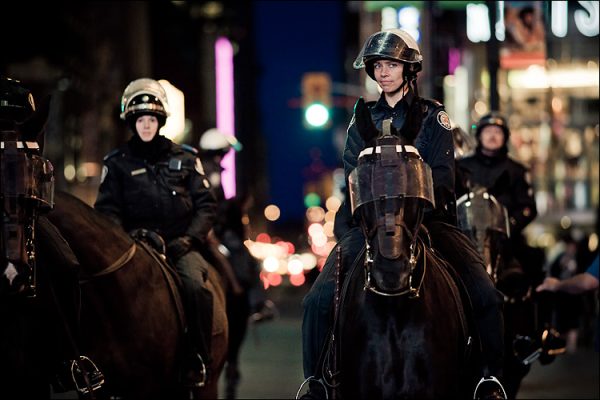
photo by Sam Javanrouh (cc)
2 comments
It’s true, Toronto’s murder rate is low and stable. It’s also true that home invasions, break and enters and car thefts in my neighbourhood, North Rosedale, are up by an order of magnitude. Recently, in a well-publicized case, four criminals broke into the house across the street from me and threatened the children with knives. The police response was consistently inadequate until Councillor Saxe started advocating for better policing. The neighbourhood response has been to hire a private security company to do night patrols. So my “lived experience” along with data, indicates that this city is a lot less safe than it used to be. Good on Mr. Bradford for making crime an issue.
Toronto is undeniably very safe, but it won’t stay that way if city leadership and TPS keep offering obtuse dismissals every time a violent trend emerges. Minimizing a murder erodes the basic trust in public safety that keeps our streets alive, which is something most other cities in North America lost long ago.
I get that caring about this is deeply unchic, but I’m quite content to lose out on all the brownie points associated with the grandest of virtue signaling, if that means keeping this unique and beautiful city functioning in a way that so few others can.