
A week ago, I saw a widely shared photo of a pair of cyclist demonstrators planted in the middle of the now destroyed Bloor West bike lane, staring down a phalanx of cops, and my very first thought was, wouldn’t it be great if Toronto‘s municipal leaders stood up to the author of this desecration the way these two ordinary residents did?
Alas, we don’t live in that world, do we? At no point in any of the Ford government’s repeated and obscene incursions into the city’s jurisdiction have our leaders, and in particular Mayor Olivia Chow, stood up for Toronto. Yes, I know, she gave the right quotes when asked. But the city’s response to Doug Ford’s Putin-esque invasion of the city’s territory has wavered between fruitless backroom negotiation and supine acceptance.
It’s infuriating, especially in the context of an election in which the number one ballot question should have been, “Do you, dear voter, endorse or reject the Ford government’s attempt to take over the city by bullying, stealth and coercion?” The rest of it — taxes, traffic, addicts sleeping in the subway — pales unless we’ve truly canvassed the big question.
Which we didn’t. No one did.
Just to get this out of the way, I wouldn’t expect any such political commentary to come from Brad Bradford, whose campaign has been breathtakingly venal.
But Chow missed a massive, glaring opportunity to frame this race properly, and we’ve just got to hope she doesn’t lose Monday to a candidate animated by no intention or principle other than the desire to win power.
Even more frustrating is the fact that Team Chow had a tested playbook at their disposal and chose, for reasons that surpass understanding, not to use it.
In 2003, David Miller, then a not especially well-known city councillor from High Park, launched a long-shot campaign for mayor by tethering together two festering issues and turning them into a bigger question about who runs the city.
One involved the chronic cronyism that had encrusted the pipes of city hall and produced a corruption scandal (the MFP computer leasing deal) whose tendrils extended into the bureaucracy, council and the mayor’s office. The other was a bid by basically the same set of cronies to build a bridge to the island airport in order to facilitate a huge expansion of air traffic in a waterfront zone just beginning to see new development and recreational uses.
Miller and his team bundled these political scandals together and then posed a question that allowed what seemed to be a localized project — the bridge — to become legible to voters across the city. Which was this: if council’s crony network was prepared to sell out one community (waterfront residents) to enrich its friends, is any Toronto neighbourhood safe?
Every single component of that earlier conflict is present in the unceasing turf war between City Hall and Queen’s Park today — the corruption, the big footing, the disdain for local communities. The one big difference, which I’ll get to in a moment, is that today’s conflict is inter-governmental whereas the 2003 fight over the island airport bridge involved a rogue agency (the Toronto Port Authority) in which the city had an indirect stake.
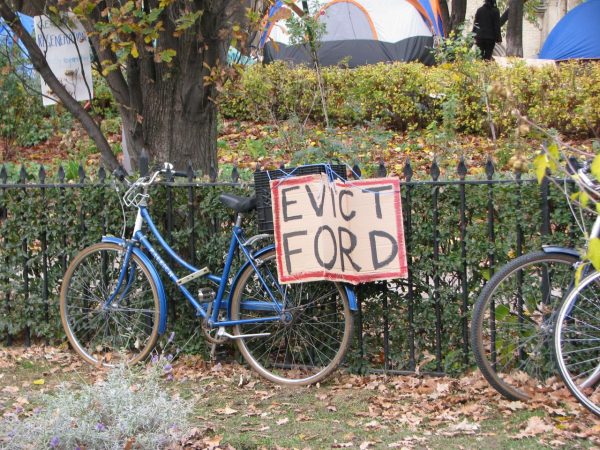
The bike lane fight, seen through the prism of that history, should have been positioned, at every moment of this race, as yet another example of Ford’s contempt for the city’s democratically supported jurisdiction. You know the list: Ontario Place, the Science Centre, the Toronto islands, the island airport, the bike lanes, the size of council, the move to cancel supervised injection sites without replacing them with adequate treatment facilities, the back-channel meddling in affordable housing projects, the colonization of the TTC.
Oh, and while we’re here: the mismanagement and cronyism within Infrastructure Ontario’s transit portfolio, the misdirection politics of highway tunnels and the like, the attacks on the city’s school boards. I could go on.
To my eye, the bike lane fiasco should have been positioned as a symbol of all of the above, but that would have required some political imagination, which was present in the circle around David Miller and is conspicuously absent from Chow’s team.
Yes, I know the public wants to hear the candidates talk about the particulars of council business. But as my colleague Matt Elliott pointed out in his Toronto Star column this week, the city’s responsibilities are much more circumscribed these days because, well, the premier has wanted to play mayor since gord knows when.
The jurisdictional elephant in this room, of course, is the fact that the provincial government has, per the 1867 constitution, a more or less unfettered right to dictate municipal affairs. But should that legal limit be the end of the conversation or the beginning of it?
Sometimes, politicians need to flex their political muscle, which isn’t quite the same thing as jurisdictional muscle. Indeed, we also have a vivid and real-time example of how a smaller power stands up to a larger one with malicious intent.
Lesson one from Team Carney’s strategy with Trump’s America: draw red lines, and then stick to them. Ask yourself: when was the last time this council, and this mayor, did something like that?
I know the answer, and I also know their answer: that there’s only so much they can do in the face of constitutionally protected provincial over-reach. But neither Chow nor John Tory did the hard spade work of ensuring that everyone, including the provincial Tories, understood the political cost of such incursions. And so one begets the next, and the next one after that, etc.
You could argue that the opportunity to stand up to the bully has passed. Too much has been given away with too few consequences. And so Ford will keep coming for our lunch money again and again until he’s voted out or retires or is taken down by a scandal he can’t contain.
Here’s the thing: if there was a last clear moment for the city to say, “enough is enough!” this election was it. But we didn’t. And now we’re going to live with the consequences.