
The past feels like a caricature of itself, compressed, simplified, stripped of everything that made it complicated. The future feels like a caricature of something that exists only in our imagination or on paper. The present is the only tense we actually inhabit. It feels permanent, while it is in fact a snapshot of moving time. The past we can access through archives and photographs, through documents and memory, but it is always filtered through who we are now. The future is a projection of our current fears and desires.
The Future That Was
In the mid-twentieth century, visions of the early twenty-first century showed flying cars and bridges threading between skyscrapers, like something out of Fritz Lang’s Metropolis. Yet the people in those flying cars were wearing the hats and attire of their time! The future that was imagined from the point of view of the present.
The past stretches back to the beginning of everything, the future extends to the end. Both infinite. The present is just now, this moment, already becoming the past as we stand in it. It is the only solid ground we have, as we cannot step outside our own temporal position.
Time and the City looked at time as duration: how cities change across timescales our short lives struggle to perceive. This article looks at a related but different constraint, not how long we live, but where we stand. We are always inside one tense, moving second by second, looking at the other two from a distance, as moving targets never quite within reach.
Past, present, future. Three different stances toward the city, each with its own logic, each with its own blind spots. The past and the future can only be observed from a distance. Distance is exactly what turns complexity into caricature.
Executed as Planned, then Adapted
The Bijlmermeer in Amsterdam was built as a large-scale modernist district, conceived in the 1960s as the residential environment of tomorrow. Thirteen thousand dwellings in thirty-one hexagonal megastructures, each ten storeys high, with a large plan following a rational order that separated pedestrians from vehicles, green space from built form, and left blind spots within its uniformity.
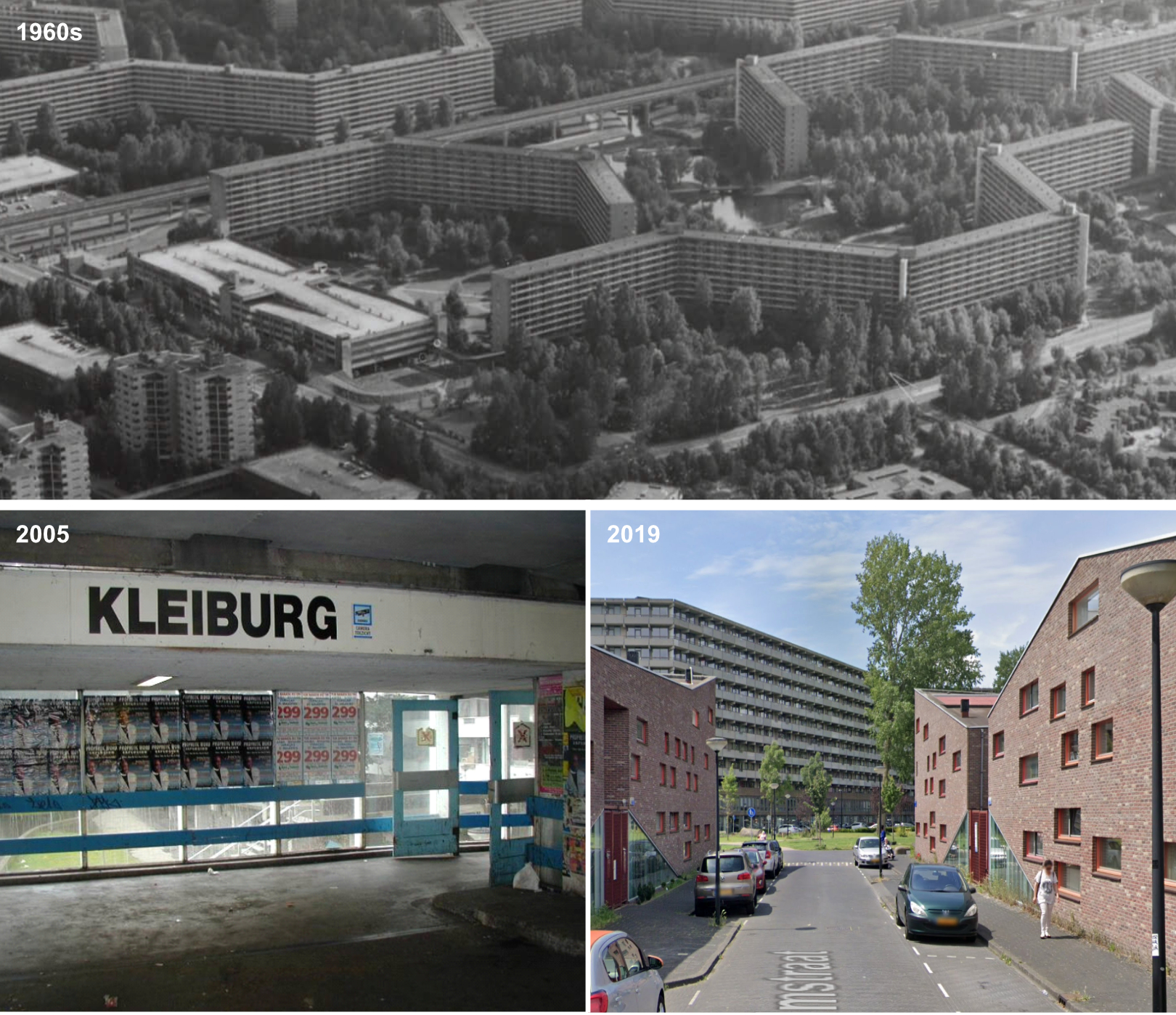
The plan was executed faithfully, but over the years the plan had been coming under criticism. The ground-level, wide-open public space was contained by ground-floor walled utility space, or lost space in the form of unsafe under bridge, no street life, and too many eyes on the open space from all the balconies on it, which meant in practice no eyes on it. The elevated common walkways integrated in the megastructures, and dark parking structures created spaces no one felt safe in. Within decades, large parts of the megastructures were replaced, not by something more visionary, but by the row houses the market understood.
I had been researching the project during my architecture studies in the Netherlands and went to experience it firsthand. You entered one of these open hexagonal megastructures directly from the metro station and communal parking structure, already at an elevated level. The corridor stretched ahead, marked only by numbers and letters indicating which part of the building you were in. Each long straight stretch ended in a turn following the hexagonal angle, repetitive, yet disorienting.
Executed as Planned, and Protected
Brasilia was a different kind of future. Designed from scratch in the late 1950s as a complete rational city, built in the interior of Brazil, it was executed with remarkable fidelity to its original plan. The monumental axis, the separation of functions, the superblocks of residential towers set in open parkland. The original Plano Piloto (named after its resemblance to an airplane) is now largely heritage-protected, inflexible to change.
The plan had a hotel district, a hospital district, and other sectorizations. The modernist framework had provided for housing, government, commerce, culture. What the plan did not anticipate was a ‘traditional’ city centre, an organic place that belongs to everyone, where people from different parts of the city naturally converge. The shopping centres, bus terminal, and hotels could only partially fill this role. Instead, people came from across the city to places originally designated as local residential amenities, where neighbourhood bars and gathering spots fulfilled the social life the plan had not imagined.
Can You Imagine This View Was Blocked?
For fifty years, the main axis of Seoul’s historic palace was blocked by a building placed there deliberately.
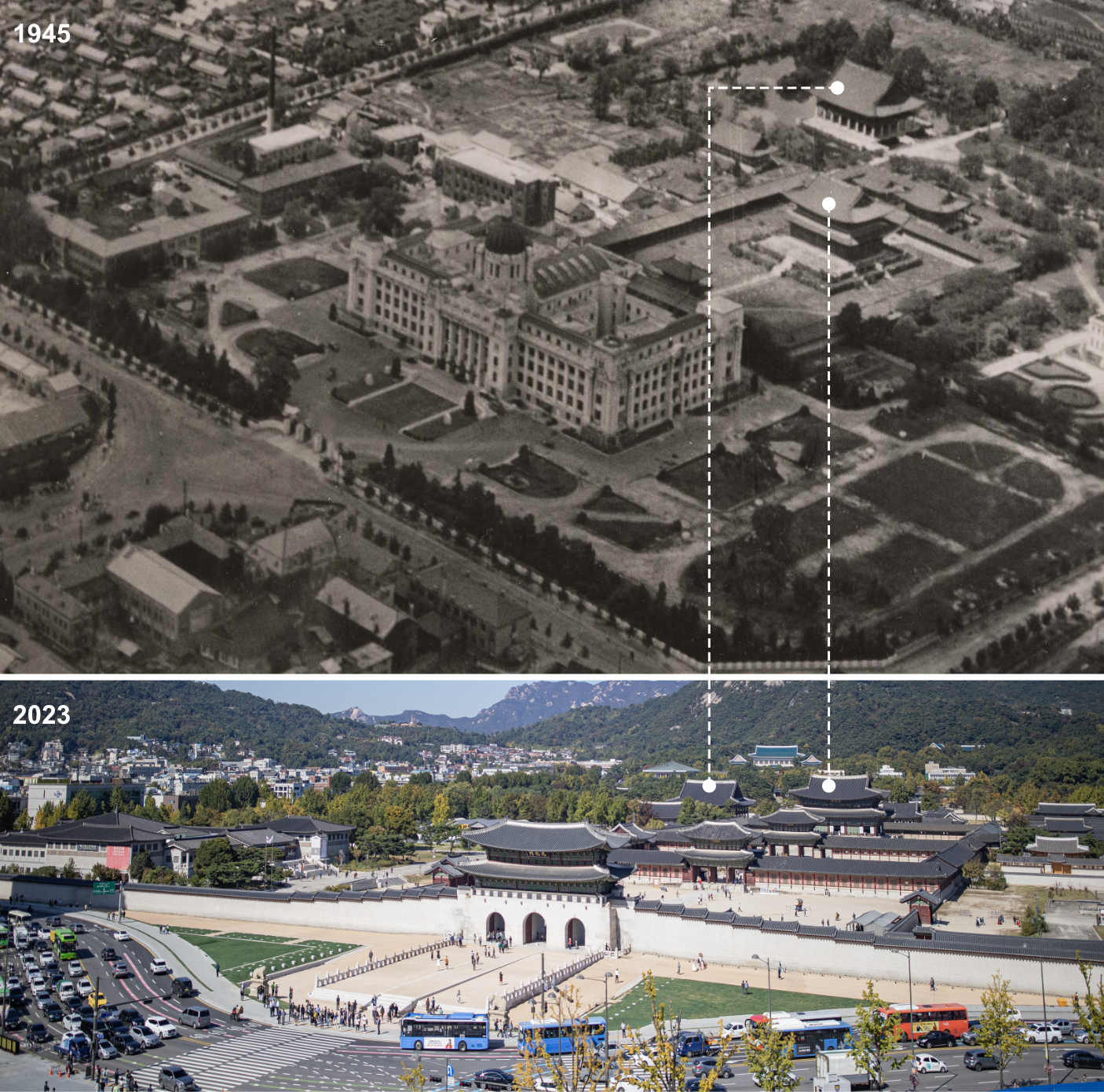
The Japanese colonial government had built a massive administrative building directly in front of Gyeongbokgung Palace, to obstruct the view of the Joseon Dynasty’s main royal palace. In 1995, it was demolished. Some argued it should stay, as evidence, as a reminder. The decision was made to remove it. One history removed so that a much older one could be restored.
When I lived and worked in Seoul, I assumed the palace had always dominated that part of the city. I had no idea it hadn’t always been that way.
What Makes Paris Paris?
Tourists often find themselves walking for hours through Paris without actually intending to. The city is well connected and proportioned for human movement; its continuous street frontages and network of boulevards make walking an intuitive choice.
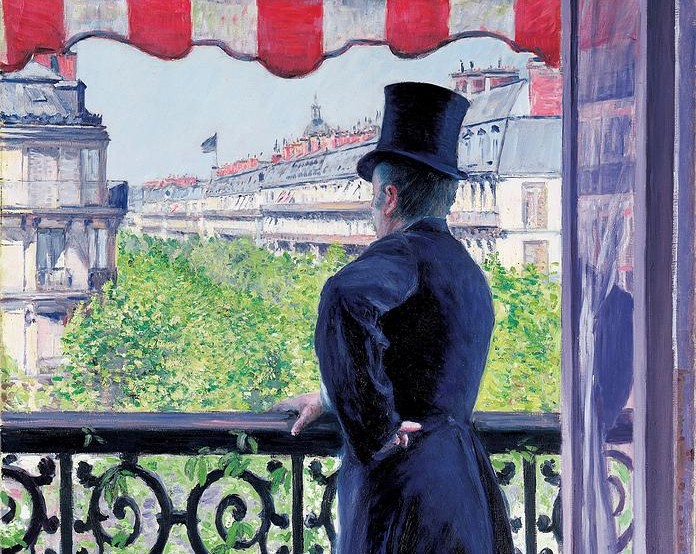
Haussmann’s wide boulevards cut diagonally through the dense neighbourhoods of nineteenth-century Paris. To build the network of boulevards, entire blocks were demolished, communities displaced, and the existing streets carved through in the name of order, hygiene, and the movement of troops. The facades were aligned, the street widths standardized, the building form brought into dialogue with its surrounding context.
What emerged is simply Paris, not the landmarks and the river Paris, but the connective tissue Paris. People from all over the world come to walk its streets without knowing why they feel the way they do. The act of bulldozing became the thing worth preserving, and the imposed order became the character.
We Are Living in Yesterday’s Tomorrow
To imagine the future as a concept, vision, or idea, we tend to have to oversimplify it and strip it of everything that makes it complicated, to the point of it turning into a caricature, but sometimes that is what enables it to be built at all. What gets built is always more complex than the image, inhabited by people, shaped by time, pulled in directions that were not anticipated, or adapting within physical and social constraints. Given enough time, as seen from afar, looking back to the past, the stories we tell ourselves about how the city came to be what it is today are seen as a caricature again.
Cities are tense, in more than one sense of the word. Grammatically, tenses place the city’s stories in time. In physics, time stretches every moment across a continuum between the past and future tense. Mechanically, tension is what holds something stretched between two opposing forces. The city exists in all aspects: its stories located in a specific moment in time, its present held in place, perpetually stretched between what it was and what it is becoming.
Whether the shape of our city, streets, and views is a result of someone’s bold vision from the past, or a result of a collection of decisions with no particular vision at all, understanding that we are living in yesterday’s tomorrow is no small realization.
***
<< Time in the City | The City in Tenses | The Pasts of the City >>
***
Yuval Fogelson is an urban designer, educator, and artist who loves to explore and understand cities. Based in Vancouver, his work spans the built environment, from public space transformations and tactical urbanism to mobility hub networks and digital twins. He is the founder of YF City Urbanism and paints maps as part of Yellow Future City.