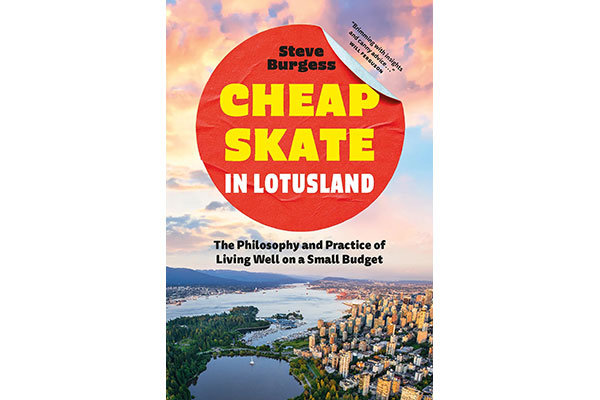

Author: Steve Burgess (Douglas & McIntyre, 2026)
Cheapskate in Lotus Land, the new book by writer/humourist Steve Burgess, delivers what he promises in the subtitle: “The Philosophy and Practice of Living Well on a Small Budget.” A myriad of brief chapters range over everything from transportation to shopping to his contented life as a long-time tenant in an older apartment building near Lost Lagoon in Vancouver’s West End.
Burgess is known to readers of The Tyee as “Dr. Steve,” delivering sharply satirical opinions on issues of the day. His previous book, Reservations (2024), reflected on his own travels but veered away from the personal with a journalist’s deep dive into the problems and challenges of 21st-century tourism. Cheapskate follows the same format, quoting studies by academics and commentators on consumer and corporate behaviours that are making life challenging for the underfunded, and life precarious for the planet itself.
Using himself as an example, “The Frugal Footprint” dives deeply into the personal behaviour of individuals, including the “voluntary simplicity” that reduces their carbon footprint. Chapters on loyalty programs, especially those of grocery chains, and Facebook Marketplace sit next to comments on the long-term costs of three items that used to be considered essential to a happy life: a partner, children, and pets.
An analysis of Costco and Walmart calls out the damage they cause to local economies while acknowledging the bargains that cheapskates can snaffle up. But another chapter, on the venerable (and threatened) Sunrise Market at Powell and Gore in the Downtown Eastside, describes eloquently how some independent businesses become an essential aspect of survival for the poorest (and a destination for Burgess on his bike).
It’s interesting to analyze the book “backwards” – that is, to ask what kind of city, what kind of neighbourhood, supports the cheapskate lifestyle. Living near Denman Street’s shops, including his favourite No Frills supermarket, allows Burgess the “15-Minute City” experience for most of his daily needs. He travels everywhere by bicycle – parking fees aren’t part of his budget. He can get shoes and clothes repaired—another thread of his anti-consumerist lifestyle—at shops including Rose Stitch in, surprisingly, the Denman Place Mall, a 1960s addition to what is still the line of streetcar-era shops framing the West End’s residential blocks (although Robson Street has evolved from the funky Robsonstrasse of the postwar decades to a glitzy fashion strip).
“Thrifting” is another aspect of the low-income, low-impact life that Burgess pursues. Back lanes are the source of some of his kitchen appliances. He refuses to upgrade his phone and laptop. And of course, he has Stanley Park practically on his doorstep for recreation and reflection.
Although Burgess states that even as a freelancer, he’s managed to save money (he compares himself with mega-rocker Michael Jackson, born three days after him, who blew millions and died deeply in debt), I couldn’t help feeling a little apprehensive about the precarious possibilities of his future as a tenant and pensionless senior citizen. Vancouver is not a European city like Vienna, where lifetime tenancies of apartments are part of the culture.
Burgess is not alone, and as we await the fates of neighbourhoods like Fairview with their affordable apartments, we wonder about the future of locally owned businesses and whether they will continue to be supported by residents. What does the future hold for this city? Will Amazon trucks clog every street?
***
For more information on Cheapskate in Lotus Land, visit the Douglas & McIntyre website.
**
Michael Kluckner is the writer/illustrator of books for more than 40 years, including ‘Vanishing Vancouver’ (1990 and 2012) and ‘Surviving Vancouver’ (2024). His most recent book is ‘Winging It: Travelling Without Reservations.’