
I believe that Vancouver is, first and foremost, a “City of Distinguished Neighbourhoods”, and that Vancouver neighbourhoods are poised to lead.
I believe the Villages Planning Programme before Vancouver City Council on June 2, 2026 could proactively transcend its generic, one-size-fits-all implementation strategy by:
- Recognizing and building on our prevailing urban pattern (we are already a 5-minute city), and
- More deeply identifying specific local attributes and their related opportunities for communities to meaningfully contribute towards implementation.
In other words, let’s ensure that a council-approved Villages Programme recognizes the value of our neighbourhoods, and then commits to the necessary follow-up engagement that identifies strategic sites and initiatives for ongoing local contribution. The primary purpose of Villages should be as the impetus to strengthen communities through “relevant” shared achievement. Let’s break this potential down.
Vancouver is a City of Distinguished Neighbourhoods
Vancouver’s previous CityWide Plan (2022), and the more recent Official Development Plan (ODP) approved by City Council on March 31 this year, introduced generic “neighbourhood types” replacing long-standing neighbourhood names that generations of citizens referred to when self-identifying their local community. I continue to support having a citywide plan, especially the ecological, open space and food security dimensions. I remain hopeful that the implementation of a generic ODP that underpins the “Villages Planning Programme” will pay meaningful attention to neighbourhood identity by reinforcing “local distinctiveness” that has reflected uniquely different urban experiences across the city.
Each of our long-standing neighbourhoods possesses its own DNA— “Distinguished Neighbourhood Attributes”—with local folks having the greatest insight into history, culture, and narrative that appreciates how best to recognize and reinforce neighbourhood “specialness”. Importantly, that local knowledge is not about protecting the status quo; it is about knowing where transformation is most welcome, most viable, and most likely to stick.
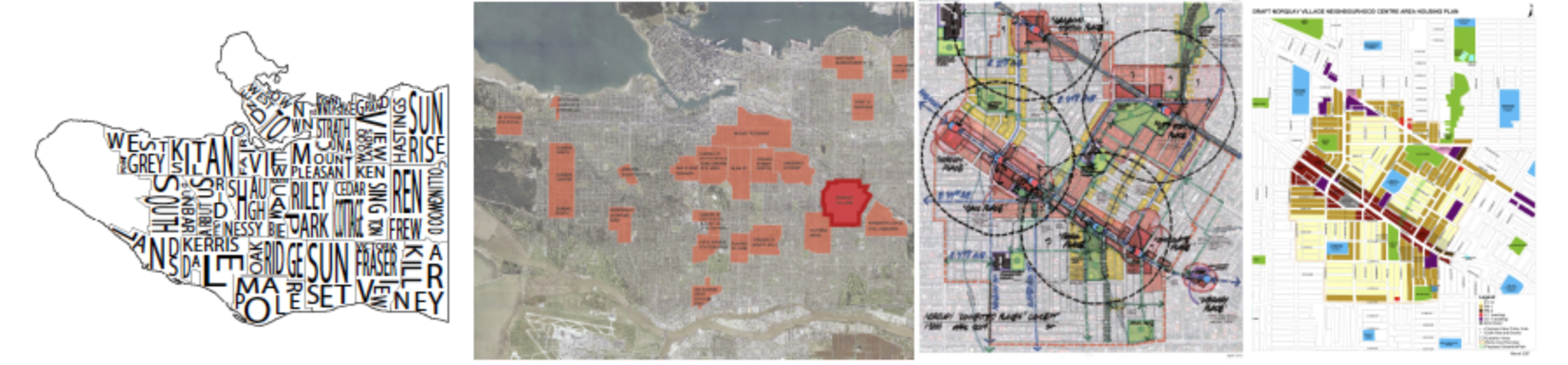
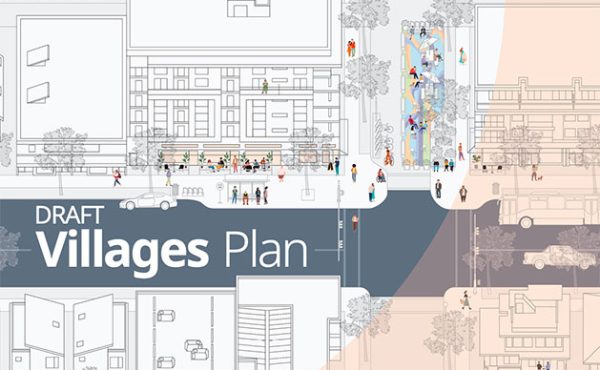
The images above remind us of when the City of Vancouver relied on deeper neighbourhood-focused engagement with local communities. The names of the neighbourhoods still appeared on city hall products. Drawings made with and for local communities had shelf life. They informed implementation priorities.
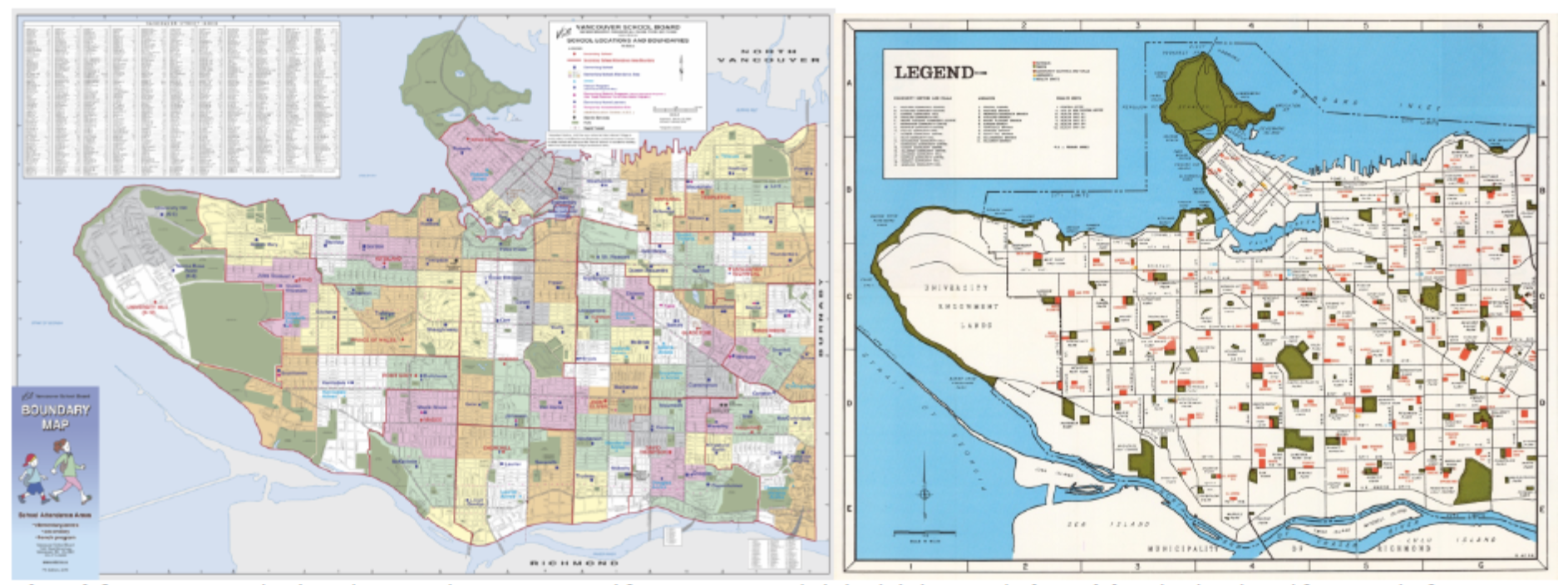
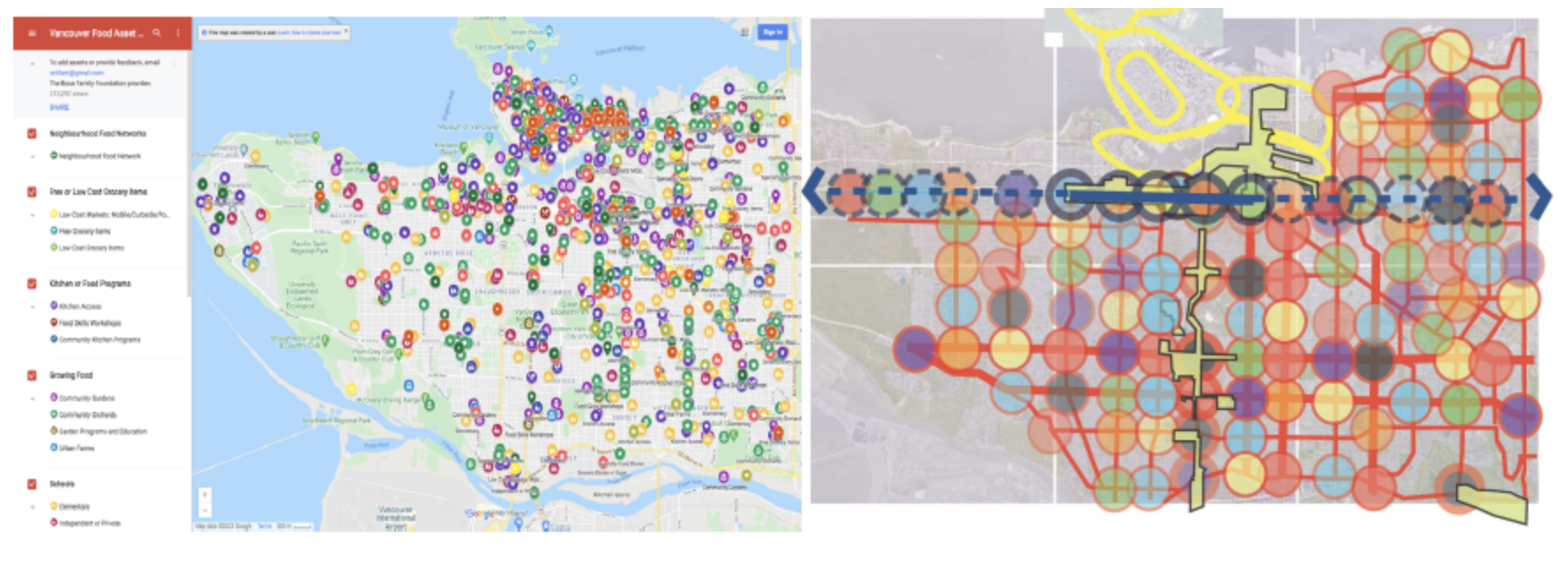
Let’s ensure that ongoing planning efforts reflect prevailing citywide urban systems, and local features that could form the foundational basis of neighbourhood “micro-frameworks” to guide implementation. These systems include the arterial grid that establishes 5-minute proximity, an established network of school catchments, a distributed approach to public open space, and recreational/institutional/food security amenities. These “layers” should act as “armature” that underpins more local mapping of distinguishing attributes.
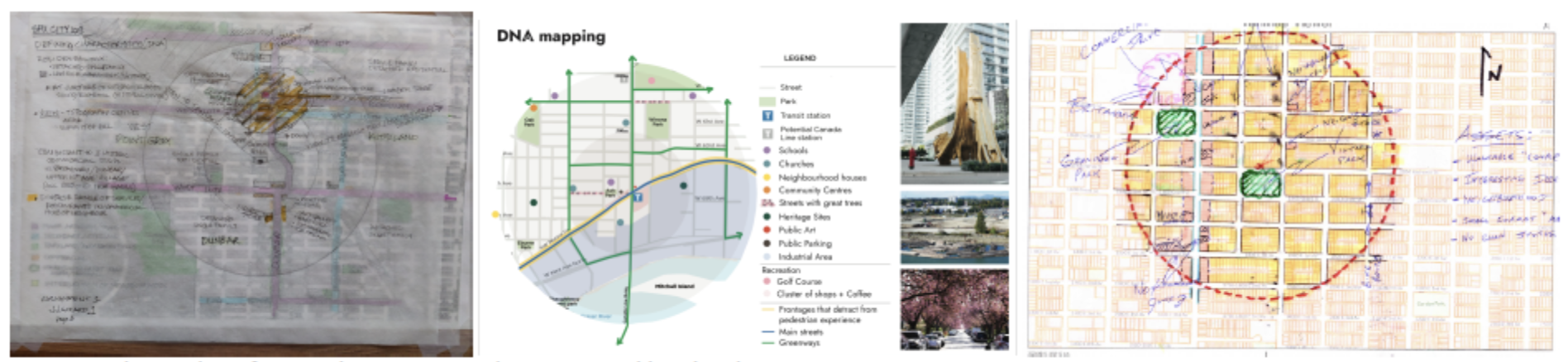
The distinctiveness of each local community can then be revealed through individual mapping, as per these wonderful examples made by neighbourhood folks that capture what is unique and special. These community-generated drawings represent special insight and passion for each local neighbourhood. They also strategically reveal more obvious places to introduce urban transformation. They make the political/density/built-form conversations about “how big and where” much easier via a shared public process that is aspirational, and therefore less divisive. Making density relevant is the key.
Density is Urgent — Which is Exactly Why Co-Design Matters
Vancouver faces a genuine housing affordability and supply crisis. More homes are needed, and needed soon. I want to be direct about this: neighbourhood co-design is not a strategy for slowing down density. It is a strategy for making density durable.
Top-down, one-size-fits-all rezoning generates conflict, legal challenges, and community opposition that frequently delays or dilutes outcomes. When communities feel that change is happening to them rather than with them, resistance hardens. Conversely, when neighbourhood residents help identify where density fits best — where a missing-middle building on an underused arterial site strengthens rather than threatens the character of a block — the resulting development tends to proceed faster, face less opposition, and produce better outcomes for all.
The examples below are not arguments against density. They are arguments that community-led processes can achieve more density, more affordably, and with greater social equity, when local knowledge is genuinely engaged. Mole Hill is the clearest proof: a community-led initiative that delivered 170 social housing units where City Hall had offered neglect. That is not an obstacle to housing — it is housing.
The Villages Programme has an opportunity to embed this approach from the outset, before generic built-form mandates are imposed. A strong declaration for continued local involvement, and financial support for strategic local initiatives, should be made clear at the onset of the Programme.
Why Neighbourhoods are Poised to Lead
I believe that the most important ideas are often borne outside city hall. The market and the neighbourhoods together are more likely to be the originators of better ways forward than centralized planning alone. Wholesale shifts in political leadership can live or die depending on which ideas are embraced, promoted, and ultimately implemented. City staff from all disciplines, at the direction of the city manager, are best positioned to help good ideas influence market trends and enhance the lived experience for all. It is possible, when all city-making interests are effectively engaged, to co-discover shared solutions where the market and neighbourhoods can symbiotically thrive. It is city hall’s role to set the context for such creative exchange, and then commit to the necessary policy and implementation work to deliver results.
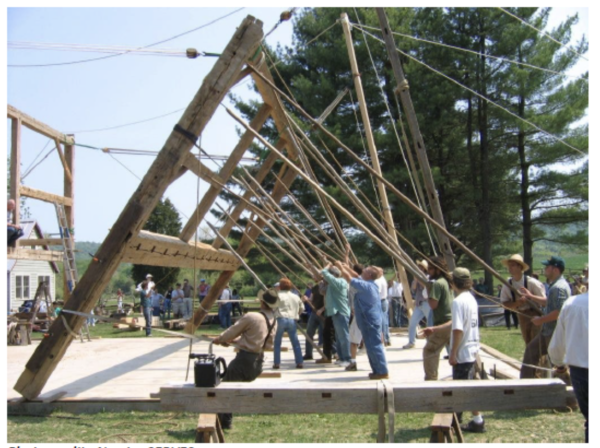
Here are examples where neighbourhoods had very good ideas that were also economically viable. These examples originate from local insight and passion that transformed into advocacy. Such advocacy, to sustain, required tenacity and perseverance. These achievements represent the best of Vancouver and our big idea as a City of Neighbourhoods. They also represent the potential, with civic support at critical moments, for delivering relevant achievements that transcend narrow stakeholder interests. I offer the metaphor of “barn raising” — neighbourhoods, supported by city hall, contributing social capital towards a shared achievement that is meaningful to the community, and viable for all who participate.
Arbutus Industrial Lands by the Kits Arbutus Residents Association (KARA)
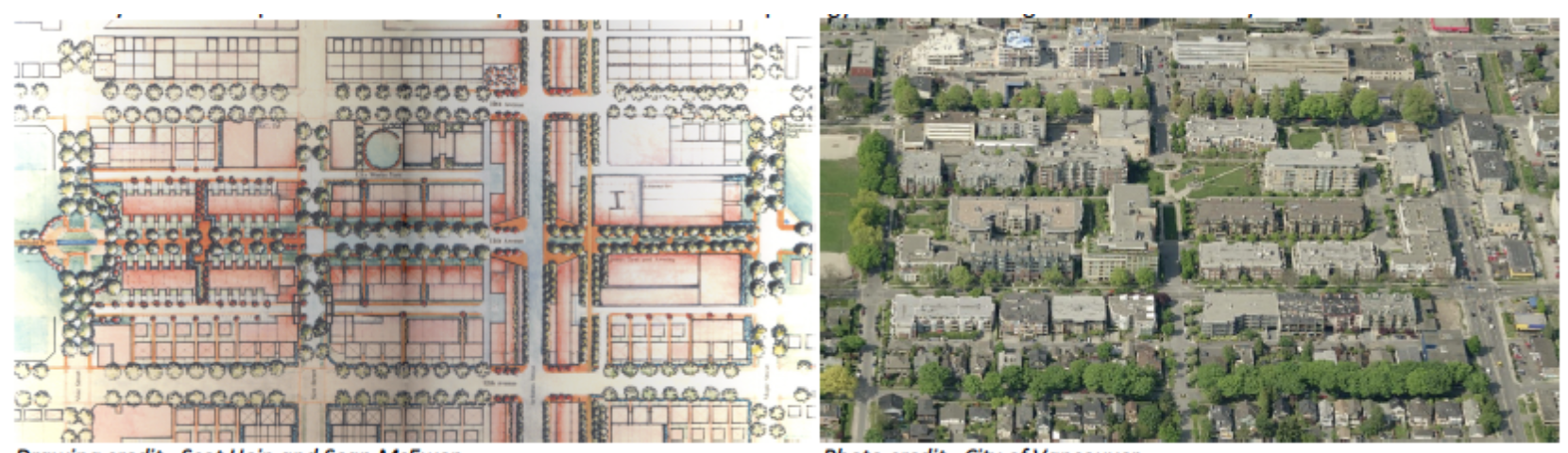
The City of Vancouver sponsored a Local Area Planning engagement process commencing in the late 1980s. The future of the Molsons/Carling O’Keefe Brewery and related adjacent “let go” industrial uses, located between Arbutus and Vine, 12th Avenue to 10th Avenue, was one focus of the civic effort to involve Kits residents, landowners, and commercial interests honourably. The city had conducted early built-form and economic analyses that considered towers. Objecting to this prospect, KARA made their own drawing that sought a dense, low-to-midrise strategy—one that would ultimately deliver Transit-Oriented Development densities.
At that time, the Planning Department demonstrated thoughtful leadership by working with residents to achieve the urban character recommended in their drawing. The planners, working closely with the proponents and their designers, convinced the landowners to pursue a “non-tower” morphology that included amenity and open space strategies. KARA also supported additional density towards securing the future of the Fraser Academy at 10th Avenue and Vine, with the city eventually acquiring the site, thereby securing tenancy for an important learning facility.
The drawing below, and the resultant community at build-out, represents how shared “roll up our sleeves” engagement can yield more neighbourly and livable development while remaining profitable for all landowners. KARA successfully made aspirational drawings that ultimately shifted the public discourse to explore an alternative morphology — and then saw it built.
Bessborough Armoury/Millennium Sport Facility/Phoenix Gymnastics/Pacific Indoor Lawn Bowling Club
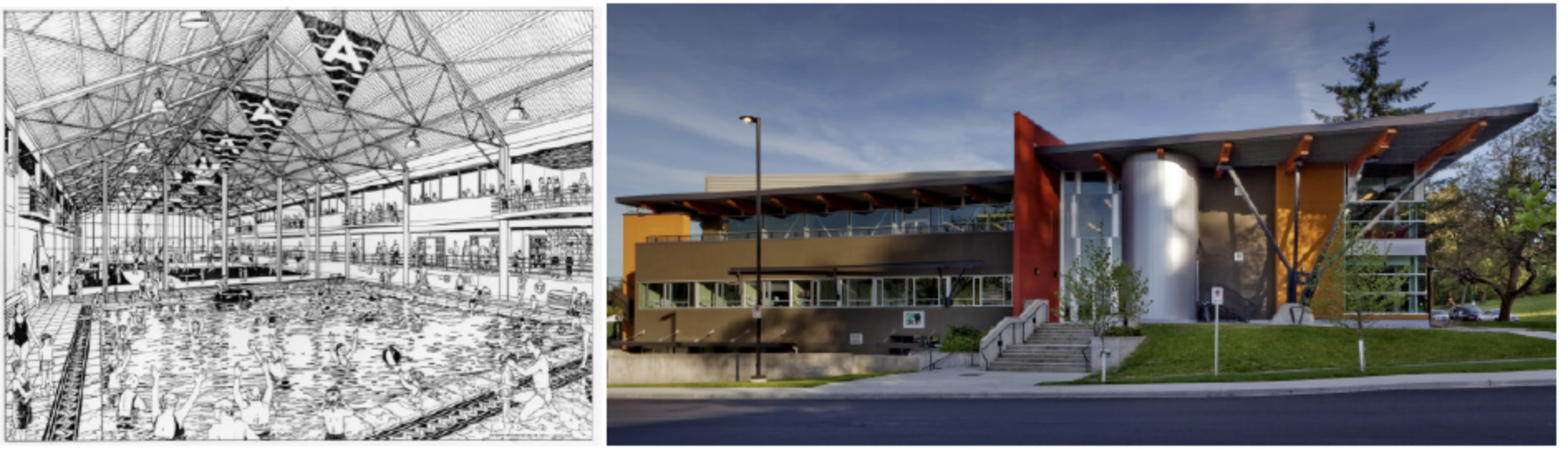
A “public amenity spin-off” of the Arbutus Industrial Lands engagement surfaced after the urban framework above became possible. The easterly block of a proposed local Greenway along 11th Avenue — connecting Lord Tennyson Elementary School with the Kitsilano Community Centre — had the potential to accommodate recreational and cultural amenities in the historic Bessborough Armoury immediately east of the Arbutus Corridor. KARA began advocacy discussions demonstrating how the column-free space might accommodate Phoenix Gymnastics Club and Atlantis Pools, both non-profits vulnerable to losing tenancy. With the assistance of Dr. Hedy Fry, KARA maneuvered a resolution in Parliament to see the armoury released for community use.
A land title complication ultimately quashed that initiative. But the momentum and advocacy drawings made for the Bessborough site had shelf life. Phoenix Gymnastics, in an “arranged recreational tenant marriage” with The Pacific Indoor Bowling Club (another non-profit at risk), ultimately developed the Millennium Sports Facility (MSF) at Riley Park. The MSF delivers secured tenure while creating new recreational infrastructure, owned by taxpayers, at no cost to taxpayers. It started with a drawing, took over ten years, and required city hall’s sustained support throughout. The result is a well-utilized public asset.
Jericho Lands Rethink by The Jericho Coalition
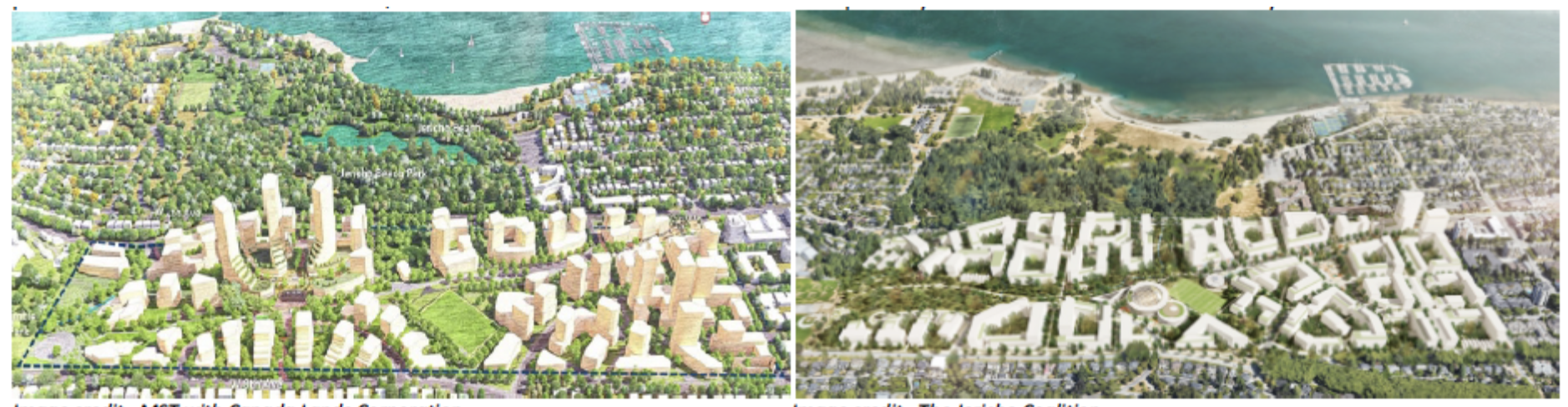
The development proponents (MST/CLC) initially declared a proposed density in the media. The Jericho Coalition (JC) sought a more respectful, liveable, and neighbourly form of development that reinforced Indigenous values of respect for the land, communal sharing, and intergenerational support. The JC envisioned a human-centred community demonstrating new ways of living and sharing — at the same density as MST/CLC initially proposed. Their work was produced on volunteer time and at their own cost, and was more risk-averse in a down market. The JC continues to respectfully share their ideas towards mutually beneficial outcomes, and deserves a seat at the table as the process continues.
Mole Hill by The Mole Hill Housing Society
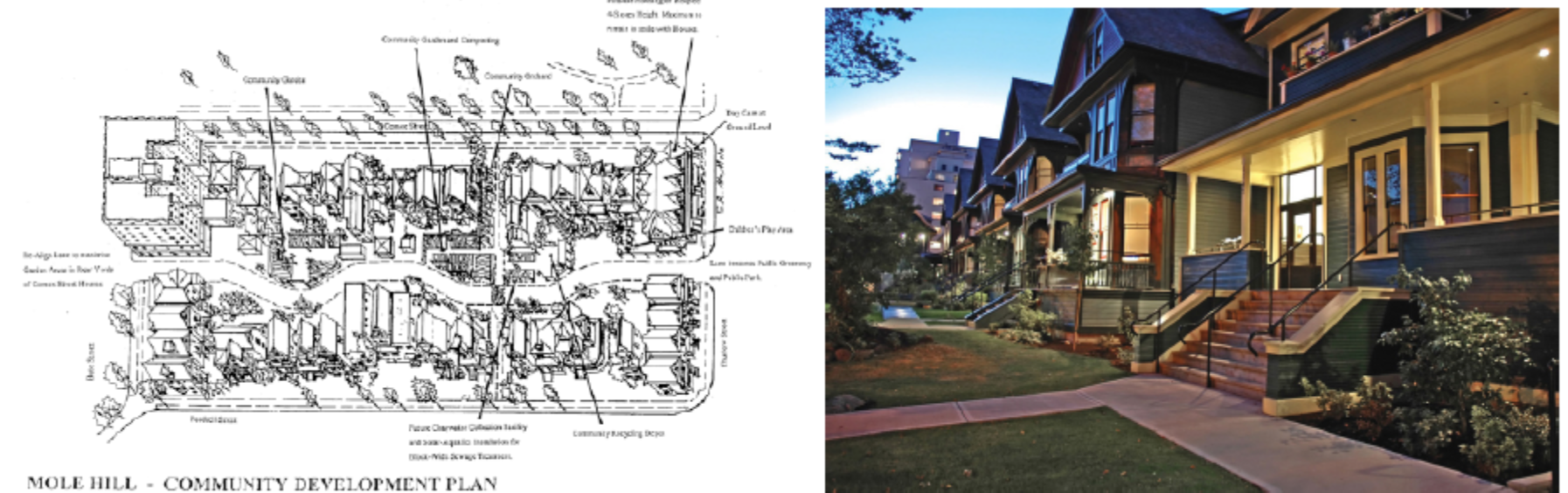
From the Mole Hill website: “Mole Hill is the last surviving block of pre-First World War housing stock in Vancouver, the most significant example of Vancouver’s Victorian and Edwardian era domestic architecture. The block has thirty heritage-listed properties built between 1888 and 1908, providing a direct link to the earliest days of the City of Vancouver.” The City neglected these heritage houses for many years, motivating tenants to unify and advocate for retention and restoration.
Architect Sean McEwen’s drawing imagined a more intensive development that retained all housing with thoughtful additions, achieving greater diversity and income mix. The tenacity and perseverance of the residents ultimately secured financial support from the Province of BC to realize a project that delivers 170 social housing units, three daycares, a group home, and a host of community amenities including a highly social lane environment with thriving urban agriculture. This is neighbourhood-led process at its best: not blocking density, but shaping it towards genuine community benefit. It started with a drawing.
St. George Rainway by Bryn Davidson and the SGR Community Group
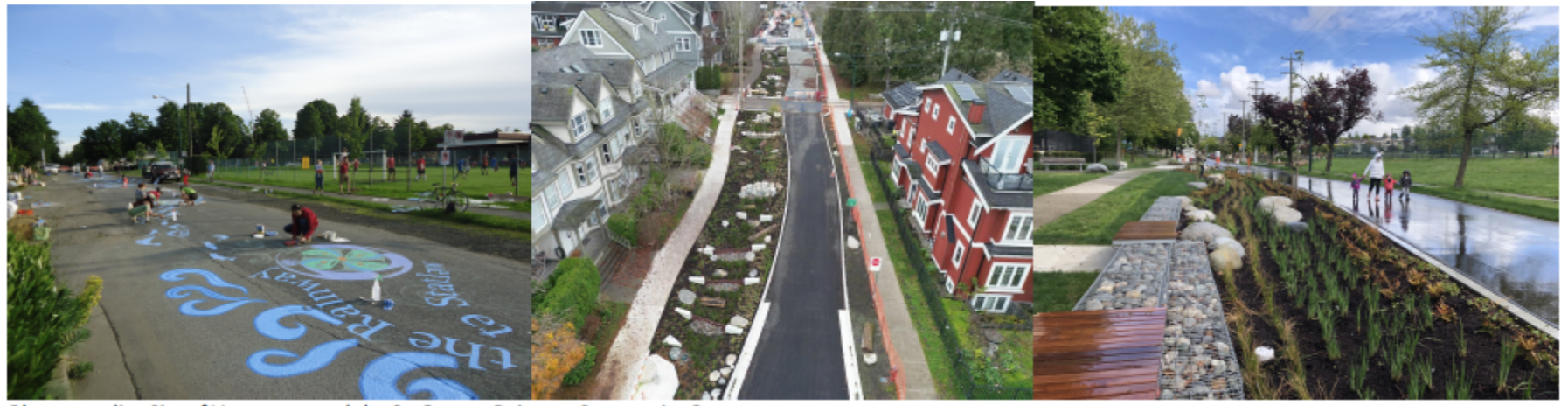
Designer Bryn Davidson’s Master of Architecture thesis imagined a “rainway” that playfully conveyed water during rain events in his own neighbourhood of Mt. Pleasant. His seminal drawing advanced new best practices for accessible stormwater experience in urban settings while reducing local reliance on expensive below-ground infrastructure. The St. George Rainway Group, motivated by Bryn’s vision, continued to advocate for city hall support over twenty years. The completed blocks represent the power of community commitment to a locally relevant idea. This achievement is relevant to all neighbourhoods. It started with a drawing.

False Creek South by RePlan
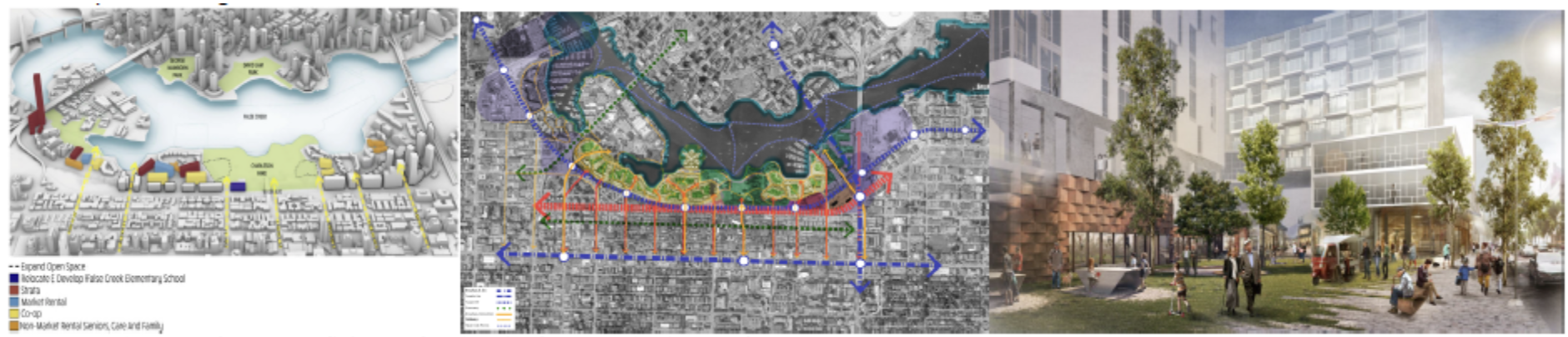
Vancouver’s south shore of False Creek is internationally recognized for its demonstration of “making community.” The form of housing and related demographic mix, human-scaled enclaves, and systems for sharing distinguish False Creek South (FCS) from other contexts. The local community, represented by RePlan, shares the recognition by the City of Vancouver that these lands have unrealized development potential on behalf of taxpayers.
Long-standing leaseholders—residents who chose to live in False Creek on leased land and have not enjoyed market escalation over many years towards accrued equity—convened proactively to explore, via design workshops and drawing, what a shared future might look like. Their summary diagram has motivated ongoing design work reflecting all stakeholder interests.
The prospect of an “Intergenerational Hub” generated by RePlan could be the initial achievement that triggers a thoughtful sequence of redevelopment throughout the site.
Returning to Neighbourhood-Centric Engagement
The examples above remind us that conversations about density and built form are more productive when they are sincere and level with the local community. This is precisely why civic engagement must start with local insight and then apply creative co-design methods that seek meaningful results that pencil out.
Trust is the key to unlocking more productive conversations that imagine a shared future that works for all. Through implementation of the Villages Planning Programme, City Hall could return to more local and sincere engagement where all interests creatively contribute to shared solutions that build a more resilient and more equitable society.
I believe a return to aspirational discourse — where neighbourhoods are invited to shape local growth, and where density is made relevant to daily lived experience — remains on the table. The Villages Programme is the right moment to make that commitment.
Let’s challenge those running for Vancouver public office to declare their support for “A City of Neighbourhoods” as our best way forward.
***
Scot Hein is a retired architect, former senior urban designer at the City of Vancouver and the University of British Columbia. He is an adjunct professor of Urban Design at UBC, a lecturer at Simon Fraser University, and a founding board member of the Urbanarium.