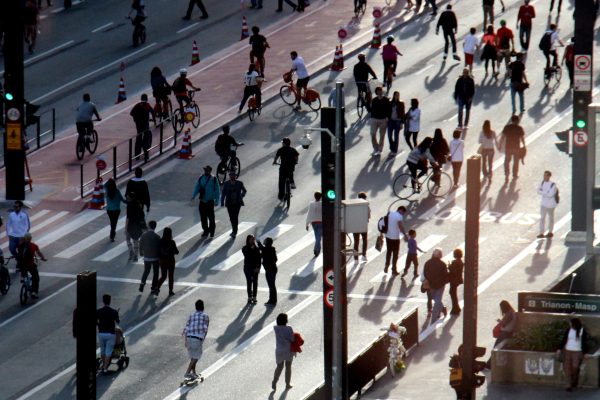

Every Sunday, Avenida Paulista in São Paulo fills completely with people. Then, as the day winds down, the street exhales. A van creeps along the avenue collecting the plastic cones. Behind it, a police motorcade rolls forward at walking pace. Behind that, the accumulated traffic, finally allowed to move, roars back to life, and within minutes eight lanes belong to cars again as if they always had. For seven hours that day, they hadn’t. The day calls itself Paulista Aberta, Open Paulista: a street closed to cars and opened to people. Planners call this an open street. What’s worth studying is not only the open street itself, but its rhythm, its frequency, how often it repeats.
An open street, a car-free Sunday, a street festival, a market: public space has long been a place to gather, to walk, eat, shop, linger. Open street transformations vary in duration and scale, shaping how we relate to and use a street. It shifts the way we perceive what public space in the city can be, even for a single day, and that shift feeds our collective imaginary of the city. This article walks through how often we hand streets to people, and what changes at each rhythm, moving from weekly to monthly, annual, seasonal, and eventually permanent. The scene above, Paulista Aberta, is the weekly version, and we’ll return to how it actually became weekly further along.
Once a Week
Something that repeats every week becomes part of the rhythm of a weekly routine. It shows up first in one of the oldest forms of all: the market.
Markets
The weekly market is one of the most common recurring patterns of temporarily shifting how a public space gets used. São Paulo has almost 1,000 of them, spread across its neighbourhoods, each occupying its own stretch of street. A small set are closer to a farmers market, others run at night, but most are the traditional daytime market. Setup at dawn, stalls up, pastel and sugar cane juice at the edges, then cleanup, then back to car traffic, until the same day next week.
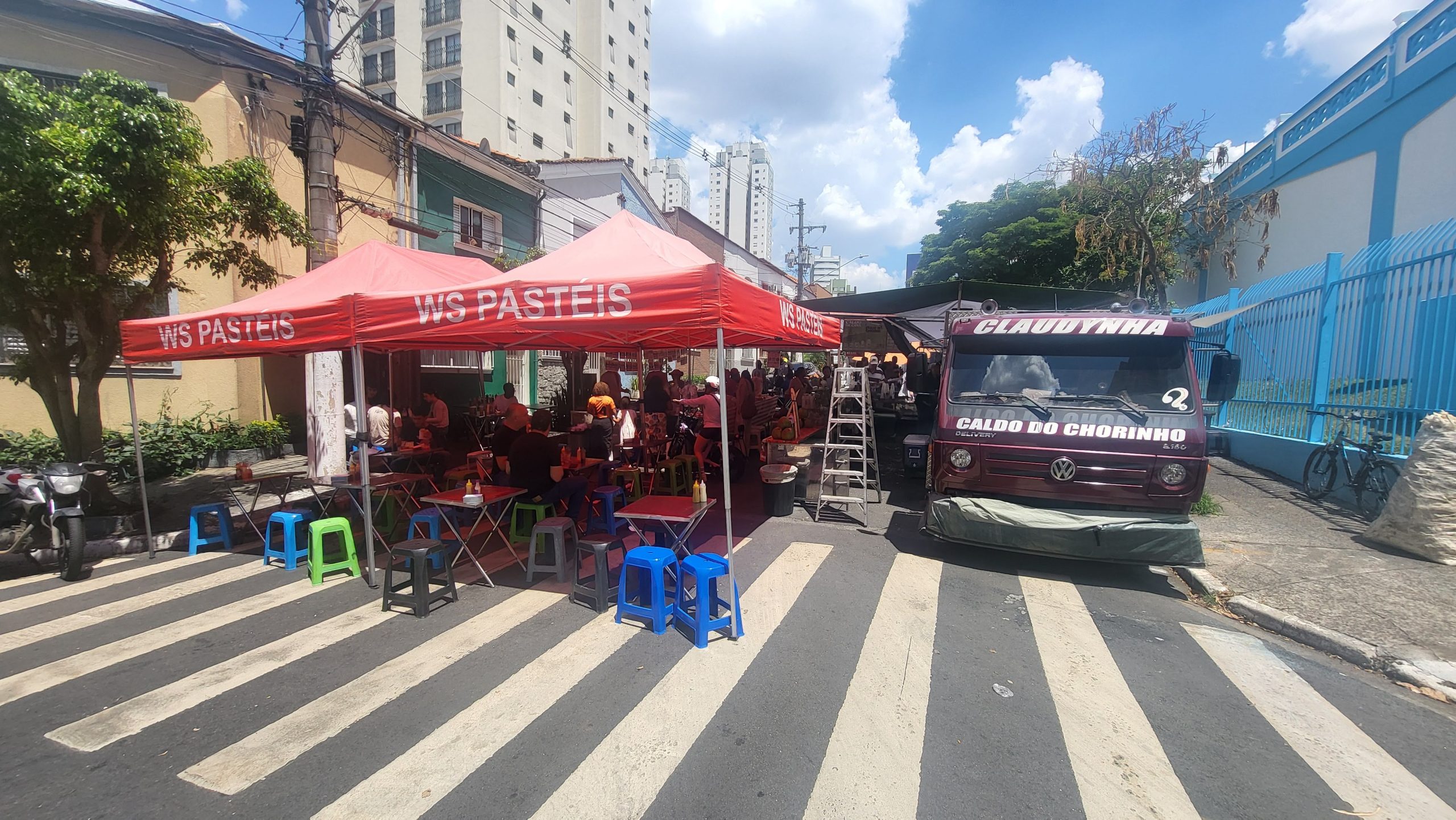
Every city has its own version of weekly markets. These can occur in spaces that need to be either temporarily cleared of cars or are pedestrian zones to begin with. A street that still carries traffic has to change what it is before a market can arrive. A market square that is already pedestrian simply gains programming, its mood shifting when the market arrives.
Avenue
A major avenue commands attention as a well-known place for the entire metropolis. Every Sunday, Avenida Paulista becomes Paulista Aberta, for seven hours six lanes are given over to bike lanes running down the middle, vendors, street performers, and an endless stream of walking people.
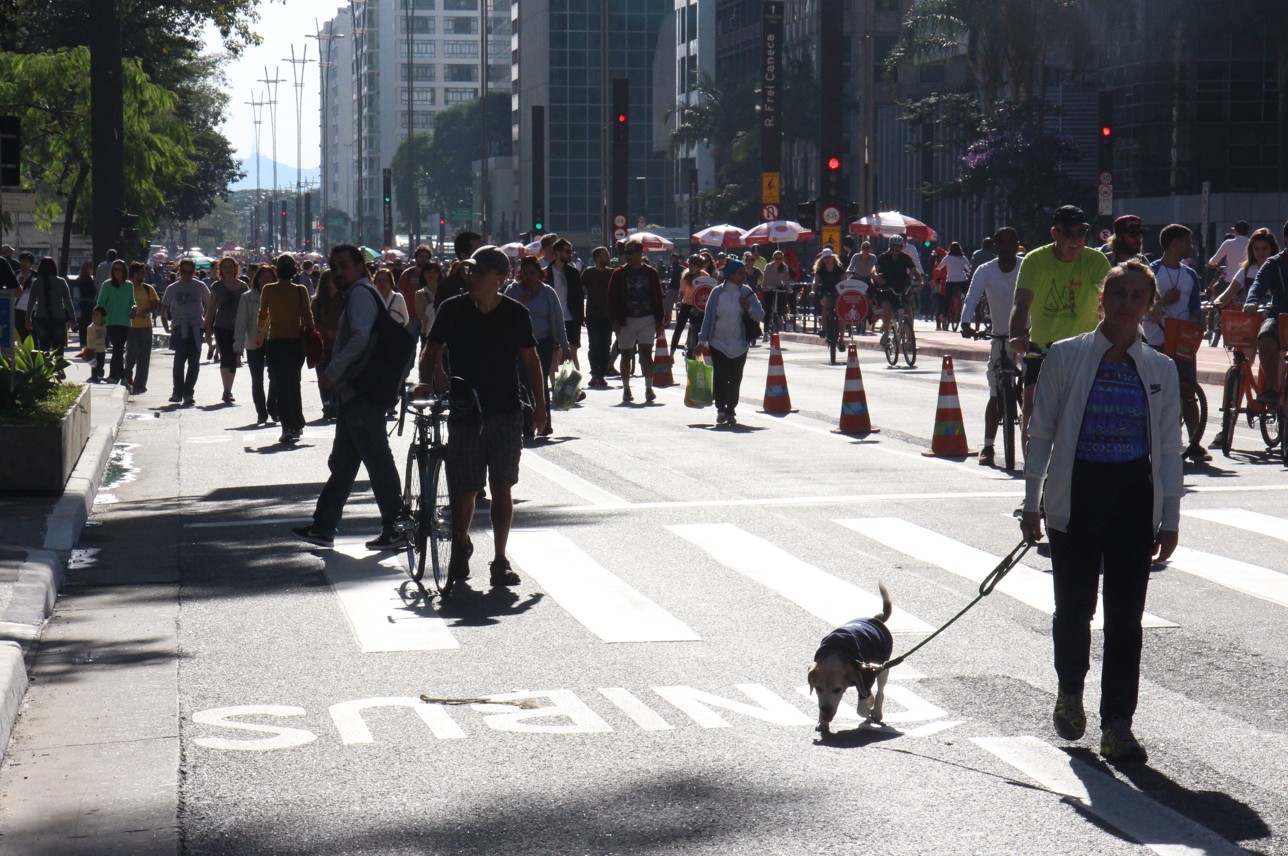
It started in June 2015, when the avenue opened for a single day to celebrate a new cycle track down the median, then again in August for a further stretch. Within weeks, the city’s own prosecutors moved to shut it down, citing an old law that permitted only three annual events to close the avenue: New Year’s Eve, a marathon, and the Pride parade. Public hearings followed, then a negotiated truce. By October, four months after that first Sunday, Paulista Aberta ran every week, and by the following year it was made official, continuing to this day.
The fight was not about one Sunday; it was about whether a closure could become weekly and, with it, part of the city’s routine. Once the closure became weekly, people stayed longer: a study found that most visitors remained for at least two hours, and in the years after Paulista Aberta began, food businesses along the avenue grew sharply, the sidewalks filling with counters and stalls built for lingering.
Highways and Parks
Sundays make this possible in a way no other day does: less traffic already, most people not working, a highway that a city can hand over without the disruption a weekday would cause.
The Minhocão, São Paulo’s elevated highway, closes most weekends too, and over the years it has been designed for it a little more, with painted benches on the median concrete barrier and added scaffolding stairs where the only access used to be a car ramp. Once, a small performance on a balcony level with the deck turned the highway into a theatre with no seats, watched only by the people walking it.
Other cities also have open streets on parkways and waterfront roads every Sunday, cars swapped for cyclists and joggers rather than for markets and stages.
Network
Bogotá’s Ciclovía began in 1974 as an experiment, was made official two years later, and has grown from a few kilometres of closed streets to well over a hundred every Sunday, a network more than a single route. That weekly rhythm is only part of a greater program, which changed the population’s pattern of movement. Former mayor Enrique Peñalosa has said the city went “from zero to 300,000 people who go to work by bike.” Repeated enough times, it stops being an event and becomes an expectation, the street rewires what people assume is possible on it, even on the days it carries cars again. Repetition is, in fact, an important ingredient of this system. Many cities have since adopted their own versions of the idea.
Once a Month
A monthly cadence introduces a different type of predictability that is frequent enough to anticipate, but rare enough to feel like an event.
The Champs-Élysées works similarly to Paulista, a grand avenue lined with shops, except here it happens only once a month. Since 2016, the first Sunday of every month hands the avenue from the Arc de Triomphe to Place de la Concorde over to people on foot, part of what the city calls Paris Respire, “Paris breathes.” Retailers feared ruin when it launched; instead, foot traffic rose.
A month has the moon, and a few places build around it. On Koh Phangan, since the 1980s, when the island had little or no electricity, a full moon was something to celebrate; a monthly beach party grew and grew, with tens of thousands of visitors at its peak. For one night the streets leading to Haad Rin Beach turned into a pedestrian carnival, purely because the moon completes its cycle.
Once a Year
Many recurring events in cities across the world echo each other without ever needing a name for the pattern. Annual street festivals and car-free days often recur across the calendar in different locations, main avenues, squares, or parks and their surroundings, even if no single street sees them twice. Food trucks, vendors, signage totems, stages, and temporary beer gardens are common features of annual festivals. There is also a nocturnal version where streets are given over to installations and performances until dawn. Marathons and parades are different again: they hand most of the street to participants, while everyone else is kept to the curb as spectators. Many annual events land when the weather delivers thermal comfort, and longer daylight pushes things later before additional lighting and security are often needed.
Unlike a weekly market or Ciclovía, which the city runs and absorbs into its operations rhythm, an annual festival is typically a one-off production, often privately organized, that spends a year building toward a single occurrence, and its rarity is not incidental, it’s the actual source of its status as a “special event.”
For a Season
A seasonal transformation shifts the scale of the experiment. Handing a street over for an entire season is long enough to make it feel like a different city for a while, without committing forever, and with a potential permanent transformation in mind.
Montreal
Montreal goes further than almost anywhere. Each summer, a dozen or so commercial streets close entirely to cars for months at a time, not one flagship but a whole network: Mont-Royal Avenue filled with planters and furniture, and many others, Wellington, Duluth, Bernard, Ontario, each with its own flavour. Mid-May to mid-October, then it all comes down.
Winter isn’t a failure of the model; it’s built into it. The materials are tactical urbanism‘s usual toolkit: painted asphalt, wooden platforms, planters, concrete blocks for sitting, string lights, all cheap and quick to install, rarely built to survive a Montreal winter. A street that empties for six months gets to open fresh each spring, reinvent and try new things.
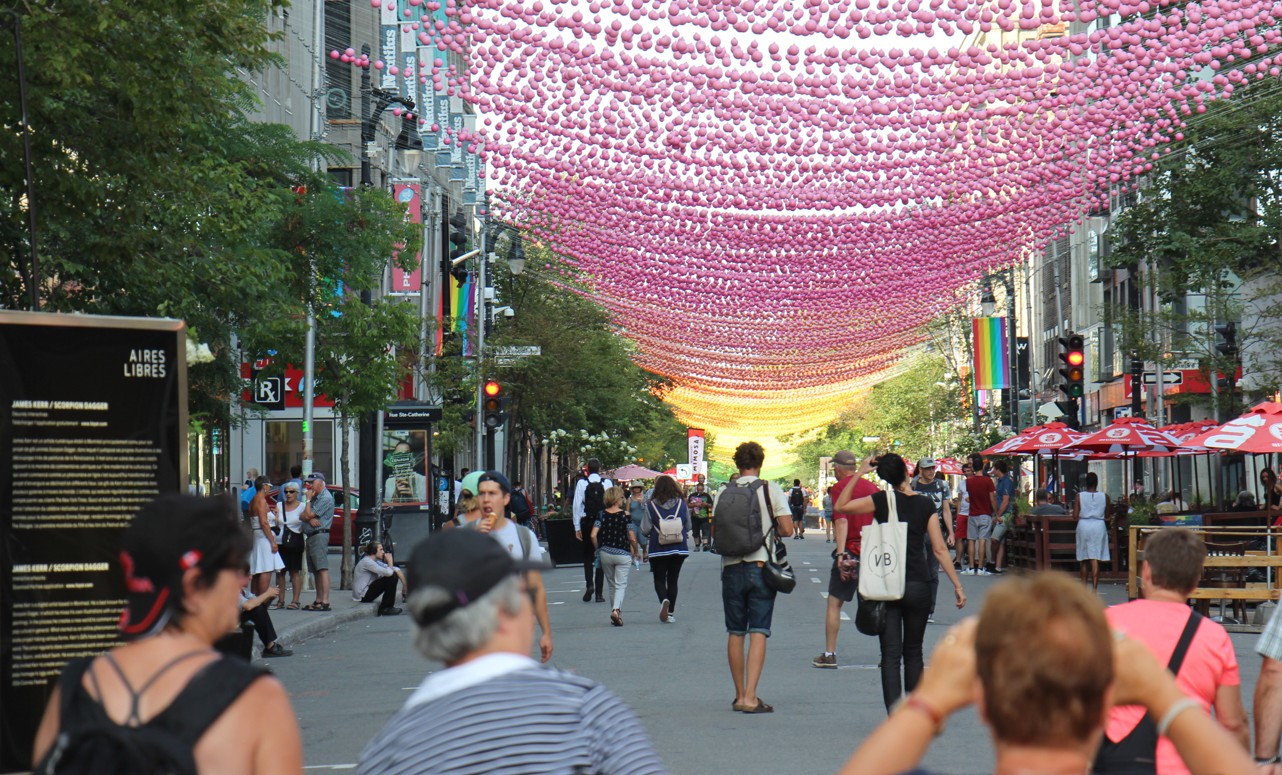
One stretch has already outgrown the cycle. A segment of Sainte-Catherine East is being rebuilt as a year-round pedestrian zone. People used it heavily, summer after summer, and that built the case for it: the public support, the data, the businesses proving the model worked. Winter used to empty it out the way it does elsewhere; the redesign works against that, a permanent illuminated canopy overhead, heated seating, a street engineered to stay busier through winter.
Vancouver
Vancouver has a seasonal version of its own question unfolding.
During the FIFA World Cup, the Granville Street Pedestrian Zone included restaurant patios that expanded into clearly defined wooden platforms, with screens set up outside bars for the games. Street performers moved between them, extra public seating appeared, and interactive elements filled in the gaps. It was meant to end when the tournament did. Instead, due to popular demand, the closure was extended through September.
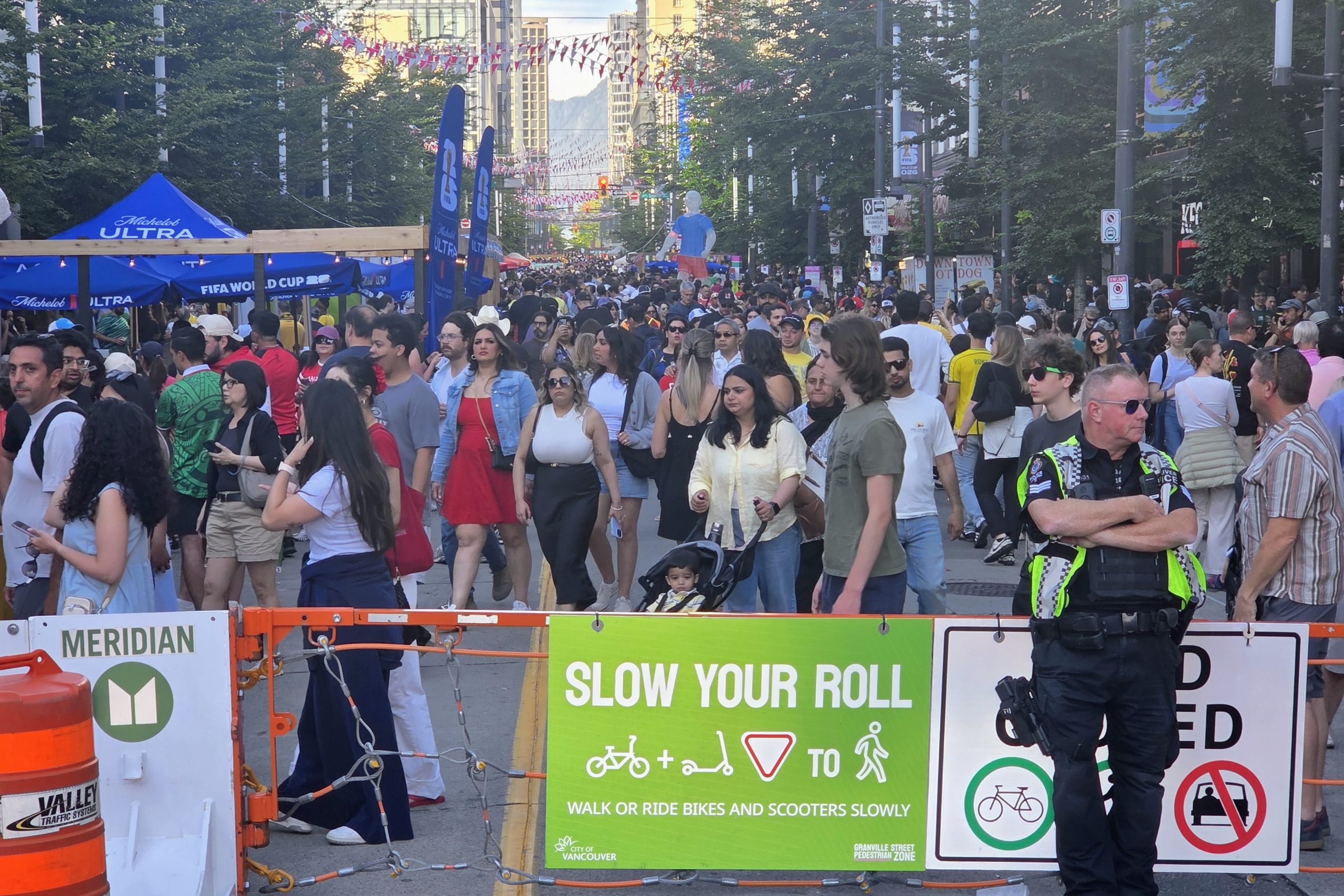
As of the summer of 2026, Granville’s future is still open. The city’s longer-term plans for a hotel and entertainment district sit on a longer horizon. In the meantime, the initiative could return next summer after pausing in winter, testing a different configuration. It could then repeat the seasonal cycle, or it could settle into something permanent sooner if there is demand and interest. Either way, it is a way to see, in real time, how people actually use a street when it is handed over to them. The World Cup weeks made that visible for a while. On game days, a stadium’s worth of visitors and locals filled every patio, and Granville felt briefly like one of the city’s highly attended annual festivals. A seasonal trial does not solve every challenge: on quiet days with no match, the street can feel exposed and uneasy, now without even the buses and taxis whose passing passengers once added a slight sense of being watched, the eyes on the street keeping it feeling somewhat safer.
People have now lived through one dense, pedestrian version of the street, and that memory becomes part of what they can plausibly ask for again, not only here but elsewhere. People carry these versions of streets with them: a visitor who experiences a busy summer event elsewhere comes home with something concrete to point to.
Seen together, open streets turn public space into a stage where the city can schedule, rehearse, and rewrite its stories. Each repetition is a small test of what a street can hold and a chance to change how people perceive and experience the city, until people-centred streets start to feel expected, even demanded, rather than a one-off exception. Given enough runway, some streets end up being handed over to people permanently.
***
Yuval Fogelson is an urban designer, educator, and artist who loves to explore and understand cities. Based in Vancouver, his work spans the built environment, from public space transformations and tactical urbanism to mobility hub networks and digital twins. He is the founder of YF City Urbanism and paints maps as part of Yellow Future City.