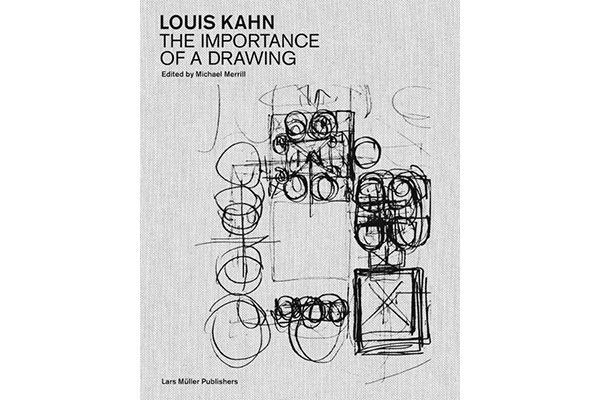

“Although this book includes works from all phases of Kahn’s career, it is neither a “complete works” nor a monographic survey. To maximize the area dedicated to Kahn’s iterative and exploratory drawings means to minimize those photographs and print-ready images that are the conventional means of presenting architecture. The text, too, by focusing on drawing and representation, omit much contextual information that belongs in more general project descriptions. And yet architectural drawings such as those reproduced here work best in the space between what we see and what we know. Those readers who know Kahn’s work well will hopefully recognize in this lack of photos and conventional descriptions an invitation: to dwell in that space between seeing and knowing, and so to participate more intimately with Kahn and his associates in their acts of creation.
- From the Preface
Edited by Michael Merrill, Lars Müller Publishers (2024)
Rare are books that have distilled a subject to its essence, allowing an auteur the ability to curate a reading of a particular idiom, as is the case in this book on architect and educator Louis Kahn. For an architect who passed away in 1971, his legacy continues to inspire architectural students and practitioners alike, and editor Mike Merrill has done a masterful job of providing us with a view of the great architect through his hand drawings, with reproductions of many yellow trace doodles along with formative sketches from his travels.
As noted early in the book, those who know him less (and shame on you!) should have a monograph with the photos of the many works featured here close at hand, but the learned crowd will revel through the details of his work as they appear in a new and wonderful way.
Louis Kahn: The Importance of a Drawing offers a compelling exploration of the relationship between drawing and architectural thought in the work of the celebrated architect Louis Kahn. Rather than presenting drawings merely as preparatory sketches for completed buildings, the book argues that drawing was central to Kahn’s creative process and intellectual development.
Through a rich collection of sketches, travel drawings, architectural studies, and project documents, the publication reveals how Kahn used drawing as a means of inquiry, reflection, and discovery. For architects, students, and scholars interested in design methodology, the book provides invaluable insight into one of the twentieth century’s most influential architectural minds.
The book’s central premise is that drawing was not simply a technical tool for Kahn but an essential way of seeing and understanding the world. Throughout his career, Kahn filled notebooks with observations of landscapes, ruins, urban spaces, and architectural details. These drawings were not intended as polished artworks; instead, they functioned as explorations of form, light, proportion, and spatial relationships.
The authors demonstrate that Kahn’s sketches were instrumental in shaping his architectural philosophy and that many of the ideas found in his most celebrated buildings can be traced back to his drawing practice.
The book itself is cloth-bound and hard-covered, and at 512-pages, 12″ x 9.5″ and two inches thick, it provides for the large-format reproduction of his drawings, in which one can pore over all of Kahn’s glorious details.
The book includes hundreds of reproductions of Kahn’s drawings, ranging from quick observational sketches to carefully developed studies. These images allow readers to witness the architect’s thought process directly. Unlike conventional architectural monographs that focus primarily on finished buildings, The Importance of a Drawing emphasizes the creative journey that precedes construction.
The drawings reveal moments of experimentation, uncertainty, and discovery, reminding readers that architecture is fundamentally a process of investigation rather than a straightforward path from concept to completion.
The organization of the book contributes significantly to its effectiveness—rather than presenting drawings chronologically alone, the editors group them thematically, allowing readers to understand recurring concerns in Kahn’s work. Themes such as light, monumentality, geometry, and the relationship between nature and architecture emerge repeatedly throughout the volume.
This approach highlights the consistency of Kahn’s intellectual interests while also demonstrating how his ideas evolved. Readers will gain a deeper appreciation of the continuity between his early sketches and later architectural masterpieces.
One of the more fascinating aspects of the book is its treatment of Kahn’s travel drawings. During his journeys through Europe, Egypt, and other regions, Kahn produced numerous sketches of ancient ruins, historic cities, and monumental structures. These drawings reveal his profound fascination with timeless forms and enduring architectural principles.
Rather than merely documenting what he saw, Kahn interpreted these places through drawing, analyzing their spatial qualities and emotional impact. The book effectively illustrates how these experiences influenced projects such as the Salk Institute, the Kimbell Art Museum, and the National Assembly Building. Readers can clearly trace connections between the architect’s observations of historical architecture and his own innovative designs.
As we are all currently navigating the undiscovered country of AI, perhaps the book’s most important contribution is its challenge to contemporary assumptions about architectural practice. In an age dominated by machine learning, digital modeling, and computer-generated imagery, Kahn’s drawings serve as a reminder of the value of hand drawing as a mode of thinking. The book argues convincingly that drawing enables a unique form of engagement with space and form that digital tools cannot entirely replace.
Kahn’s sketches demonstrate how the physical act of drawing encourages observation, contemplation, and experimentation. For architecture students accustomed to working primarily on computers, this message is particularly relevant and thought-provoking.
In addition to his drawings, the accompanying essays written by architectural historians, critics, and scholars provide valuable context for understanding Kahn’s work. These texts explore the theoretical and philosophical dimensions of his drawings. Rather than simply describing the images, the essays analyze how drawing functioned within Kahn’s broader design process. They discuss his belief that architecture should express fundamental human values and explore how drawing helped him search for what he called the “beginnings” of a project. These scholarly contributions enrich the visual material and help readers understand why drawing occupied such a central place in Kahn’s practice.
The book also raises broader questions about creativity and design. By examining Kahn’s drawings, readers are encouraged to consider how ideas emerge and evolve. The sketches reveal that innovation often results from sustained observation and reflection rather than sudden inspiration, demonstrating how, in Kahn’s work, a drawing can function as a dialogue between the designer and the world, allowing complex ideas to develop gradually over time.
Louis Kahn: The Importance of a Drawing succeeds as it reconfirms for the Kahn cognoscenti the importance of drawing to the architectural act, while for those new to his work, it will illuminate the importance of this essential but often overlooked aspect of architectural practice—revealing drawing not as a secondary activity but as a fundamental mode of thinking.
Through its extensive visual documentation, insightful essays, and thoughtful organization, the book provides a nuanced understanding of how Kahn developed his architectural vision, deepening our appreciation for both his buildings and his creative process.
Overall, Louis Kahn: The Importance of a Drawing offers an outstanding contribution to architectural scholarship and visual culture, reconfirming for those who know his work well that drawing was at the heart of his approach to architecture and offering readers a rare opportunity to engage directly with his creative thinking.
Richly illustrated and intellectually stimulating, the book will appeal to architects, students, historians, and artists alike in the relationship between observation, imagination, and design. More than a study of one architect’s drawings, it is a powerful argument for the enduring importance of drawing as a tool for understanding and shaping the world.
***
For more information on Louis Kahn: The Importance of a Drawing, go to the Lars Müller website.
***
Sean Ruthen is a Metro Vancouver-based architect.