
– The editors, from the Afterword
Edited by Despina Stratigakos & Elana Shapira, Princeton University Press (2025)
In 2022, Princeton Architectural Press released The Women Who Changed Architecture, featuring 122 architects, among them several trailblazers unknown to most. Marion Mahony Griffin, Louise Blanchard Bethune, Signe Hornborg, Lois Howe, Theodate Pope Riddle, and Mary Colter were among the early pioneers, practicing before women could vote, and many—as was often the case—working in the shadow of a famous male architect. For the better part of them, their names have been all but erased from the canon of architectural history, with present-day scholars currently working to right this grievous wrong.
Of particular note with that 336-page encyclopedic volume of architects, released to coincide with International Women’s Month, was the book’s introduction:
…although presenting an unprecedented record of these remarkable individuals, together with their revolutionary educations, innovations, awards, and influential design, the book, no doubt, has inadvertently overlooked individuals. The record will continue to grow and develop.
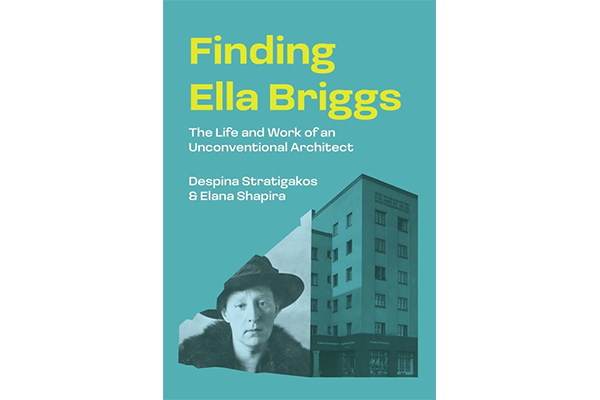
These words could not be more fitting to describe the subject of Finding Ella Briggs: The Life and Work of an Unconventional Architect, as this remarkable individual—the first woman architect to be registered in Vienna—was missed by the 2022 book’s nine editors. With Ms. Briggs also miscredited by the late Robert Stern in his New York 1900, much of the book’s telling of her story reads as much a mystery of why she has been forgotten, given the amazing body of work she realized in five different countries.
As such, Finding Ella Briggs is an ambitious and important attempt to restore a remarkable woman to the history of modern architecture. And as noted by the book’s two editors in the opening pages, it is the first major biography of Ella Briggs (1880–1977), an architect, designer, writer, and artist whose career crossed several countries and some of the most turbulent decades of the twentieth century. What makes the book especially compelling is not simply Briggs’s unusual life, but the fact that her disappearance from architectural history is itself part of the story. Through extensive archival research and contributions from an international team of scholars, Finding Ella Briggs demonstrates how easily women’s achievements can be obscured—and how much can be recovered when historians are willing to look again.
Briggs’s career was extraordinary in both its geographical scope and its historical circumstances. She trained in Vienna among the Secessionists and subsequently worked in New York, Vienna, Berlin, Italy, and London. Her professional life encompassed private interiors, housing, architectural writing, and projects connected to social reform and modernist design. She designed modernist housing in Austria, worked during the culturally vibrant period of Weimar Germany, and later fled the consequences of Nazi persecution. She was even jailed in Mussolini’s Italy as a suspected spy. Eventually, she reached London, where she contributed to postwar reconstruction.
The result is a biography that reads as part-adventure novel, with Briggs’s life shaped by wars, political upheaval, migration, and changing attitudes toward women. All this with a background of the development of modern architecture itself, exposed as she was to the Secessionist and settlement housing movements in Vienna, as well as the Bauhaus.
Yet the authors resist the cliché of telling her story as a hero figure who overcame adversity. Instead, they place her decisions and professional ambitions within the wider networks of architects, institutions, and political movements that shaped modernism—with influences from Secessionist architect Josef Hoffmann to early modernist Adolf Loos. Told this way, Briggs emerges not as an isolated genius but as a participant in an international architectural culture.
While there is a tinge of mystery and adventure in its narrative, the book’s most significant contribution is its historical research, as much as it is a biography of Briggs herself. Briggs was not simply forgotten because she produced insignificant work. Rather, the archival record of her career was fragmented, and the institutions of architectural history were often poorly equipped—or unwilling—to preserve the work of women on equal terms with that of men. According to the editors, the project began with surprisingly little information about Briggs but eventually uncovered a substantial amount of material through research in archives around the world. The process of “finding” Briggs consequently becomes part of the book’s central argument: recovering forgotten figures requires new research methods and a willingness to question established versions of architectural history.
The structure of the book reinforces this idea—the first major section provides a biography of Briggs, while the second consists of thematic reflections by other scholars. The volume concludes with an afterword describing the research journey itself: the resulting collaborative structure distinguishes Finding Ella Briggs from a conventional single-author biography. As noted by the book’s two primary researchers, sixteen scholars and researchers in all contributed to the project, bringing expertise from architecture, design history, women’s history, and related fields.
The book is a clear testament to how this collaborative approach allows readers to see Briggs from multiple perspectives and to understand the connections between her professional practice and the social world around her: one particularly valuable aspect being the attention paid to Briggs’s writing. She did not simply design buildings and interiors; she also communicated ideas about modern living to a broader audience, including through American women’s magazines such as Good Housekeeping. This expanded lens looks beyond the standard definition of “architectural”; in Briggs’s case, by focusing on the domestic architecture of the house and home, she saw how design can shape culture not only through good buildings but also by providing ideas about how people should live in them.
Another strong aspect of the book is its showcasing of the relationship between architecture and gender, as Briggs worked in a period when women seeking professional recognition in architecture faced substantial barriers. Her career illustrates how women architects could occupy spaces that conventional histories would often overlook: interiors, domestic design, journalism, housing reform, and collaborative projects. Rather than treating these activities as secondary to “serious” architecture, Finding Ella Briggs presents them as essential components of modern design.
Above all else, the book provides a window into how, over the course of Briggs’s life and career, she dedicated herself to the design of good housing, with her work in social and modernist housing showing an interest extending beyond aesthetic experimentation. She was concerned with the practical needs of modern clients and the possibilities of improving everyday domestic life, with her later connection to the Stowlawn housing project in Bilston as a particularly striking example.
According to architectural historian Michael Dring, Briggs played a central role in translating Otto Neurath’s vision of 1920’s Vienna social housing into refined domestic architecture, although her contribution had previously received little attention. The Vienna Settlement Movement would have been a time of profound influence on Briggs. She would’ve been at that time exposed to the teachings of Adolf Loos and Margarete Schütte-Lihotzky, designer of the Frankfurt Kitchen.
While the book can at times be quite dense given its serious research ambitions, Finding Ella Briggs is not meant as popular entertainment, but instead presents itself as a serious challenge to our version of popular history—what we remember and how we remember it. With its extensive bibliography, endnotes, archival research, and illustrations, Finding Ella Briggs will be of interest not only to general readers but also to students and researchers interested in architecture, design, women’s history, and modernism.
And with Briggs having spent much of her career moving between countries, disciplines, and professional roles, the scholars reconstructing her life here have likewise had to cross institutional and national boundaries. The result is more than a biography of a forgotten architect—it is an argument for a broader understanding of architectural history, one that recognizes women, migration, domestic design, social housing, writing, and international networks as central rather than peripheral to modernism.
Briggs’s story is ultimately about persistence: the persistence of an architect who continued working through extraordinary political and social upheaval, and the persistence of researchers determined to recover her legacy. By bringing Ella Briggs back into view, Stratigakos, Shapira, and their collaborators demonstrate that history is not always lost forever. Sometimes it is simply waiting to be found.
***
For more information on Finding Ella Briggs, visit the Princeton University Press website.
**
Sean Ruthen is a Metro Vancouver-based architect.