

The collaboration of music and architecture is having its moment.
This past month, ORO Editions released Music and Architecture in Harmony, an exploration of ninety of Europe’s most rewarding opera houses and concert halls, highlighting their architectural beauty, acoustic design, and musical excellence. On this side of the Atlantic, Diamond Schmitt Architects released Set Pieces this past year, featuring fifteen details from several concert halls the firm helped design—including the much-lauded Four Seasons Centre in Toronto and the David Geffen Hall in NYC.
Here on the West Coast, the connective tissue between music and architecture is being mined in several exhibitions and performances happening around the Lower Mainland. Starting with Metro Vancouver’s newest art gallery, the Gibson Art Museum at SFU atop Burnaby Mountain, its new exhibition space is barely a year old yet has taken on an ambitious program showcasing not one but eight artists looking at the interface of music and architecture, including the late Rodney Graham’s 3 Musicians serving as anchor and centerpiece to the other seven artists’ contributions.
Among them is Kathy Slade’s Chart (2006), a series of guitar entablatures embroidered at plus-size in numerous iterations, hung on the wall in the Gibson’s eastern gallery space, greeting visitors as they enter. Along with several other musical curiosities on display, the Gibson’s curators have also engaged the musical community, having featured its first live performance of a local jazz trio in the space this past month. Called Music on the Mountain, its first iteration saw about fifty invited audience members listen to how the original music of the Madeleine Elkins Trio interacted with the mass timber roof joists, brick walls, and hardwood floors of the Hariri Pontarini-designed central ‘hearth’ space. More performances are in the works.
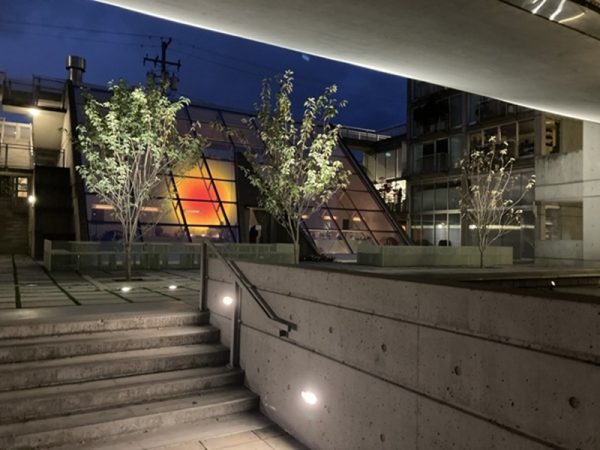
With the building-as-a-musical-instrument in mind, Vancouver recently saw another performance in another local architectural landmark, the Waterfall Building. Designed by Arthur Erickson and Nick Milkovich, it opened in 2001 to great fanfare within the architectural community, especially for its courtyard and water feature from which the building gets its name. Over the years, the curious little wedge-shaped space the architects composed to complete the live-work residential building’s inner courtyard has morphed from a gallery to a cafe, and has from time to time provided a space for architectural events, including hcma’s book launch of Pools in 2013.
This past Tuesday, in front of a crowd of 90+ curious attendees, Steve DiPasquale, in collaboration with Matt Corlett and sound engineer Matt Elton, improvised/performed a forty-minute sonic composition bespoke to the Waterfall building. It was produced on several instruments, accompanied by an avant-garde choir called Vex.
Talking to DiPasquale a few days after his performance, it was clear he was completely over the moon with the reception, and happy to share the details of its genesis, which began three decades ago while he was in high school. As he told me, after several years of playing punk rock music with his friend Matt (Corlett), the origin of Tuesday’s performance occurred at one of those long-ago rehearsals, when the two decided to put down their guitars and turn to the potential of sounds created by a single cymbal.
The second part of the origin story was a happy collaboration between Matthew Soules of SALA and hcma‘s artist-in-residence program. Called TILT, and now a successful part of hcma‘s office culture for several years (and sadly one of the few offices in town to have one), the artist-in-residence program prompted Steve to look at how the interiors of their office could perform as a sonic landscape. This prompted the beginnings of Building as Aural Device, and it was after this performance for their office, which included guests from SALA, that DiPasquale and Soules got to talking about another space in town where they could perform. This was when the Waterfall Building was first mentioned.
Once the venue had been selected, Steve got to work doing research to determine which instruments would provide the best outputs given the space’s acoustics. And for the band name, he and Corlett came up with Xania Xin Laka, chosen simply for the way it sounds, not a translation from another language.
The culmination of this thirty-year collaboration between the two was on full display, and certainly something that Erickson and Milkovich may never have imagined for the space. In fact, one of the evening’s guests was Nick Milkovich himself, and as part of the panel that spoke afterwards, we got to hear what he thought of the performance along with how the Waterfall Building had come into existence.
For the performance, DiPasquale and Corlett ‘tuned’ the space for several instruments, including an acoustic double bass, complete with bow; a stack of conventional drums and cymbals; an amplifier and electric guitar; a set of kettle drums, along with other miscellaneous building parts that were played percussively. But it was the room’s single cymbal hanging from the building’s central concrete buttress at the cafe entry that provided the intended conversation piece. And with chairs set up in a semi-circle at capacity, once the audience had taken their seats, they themselves became a part of the music spectrum, as was noted by Trevor Boddy in the Q&A following the performance.
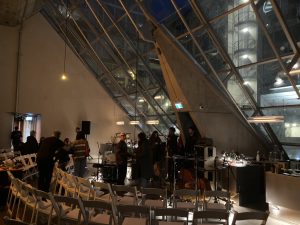
The musical composition was broken into several movements: the performers moving back and forth between the prepared instruments at the front of the room, one of them often playing the double bass while the other played percussion. One moment saw the performers playing the bottom cords of the trusses holding up the building’s canted glass walls. Stints on the cymbals were juxtaposed with bursts of sound from the kettle drums, oscillating between moments where unconventional sounds were produced from conventional instruments. The occasional unconventional instrument was thrown in for good measure, however, including air escaping from a SodaStream machine.
The finale of the piece was both aural and visual; ten people seated at the west end of the room promptly stood up and exited the building, only to emerge moments later through the space’s central door, all of them singing. For as much as DiPasquale and Corlett’s composition included the performance art of their instrumentation, Larissa Loyva and the Vex Choir provided an exclamation point to the proceedings, connecting the performance to its primal roots through atonal chanting, and providing a visual counterpoint to the sonic performance.
Following the performance, Matthew Soules conducted a brief Q&A with the assembled panel, including Nick Milkovich, the performers, and Clinton Cuddington, who was there on behalf of the Arthur Erickson Foundation, and commented that Phyllis Lambert had been listening in.
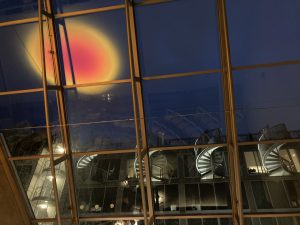
Rounding out the panel, architect Mira Yung of Sml Studio, who designed the interiors of the new Ellipsis cafe, was given a moment to speak about reimagining the space. Her design’s biggest move is its simplest—a single coloured light bulb, suspended in the middle of the space, illuminating the room’s back wall to create a red-orange sun. With the room’s angled glass wall, the light reflection is captured a second time: its ghostly double appearing to hover overhead in the central courtyard. The effect is stunning, especially so given the north-facing courtyard never gets direct sunlight, let alone a view of the sun during the day.
When asked what the next project might be for him and Corlett, DiPasquale admitted to needing a moment to pause and reflect after the significant time and creative energy spent on this work over the past year. He and the three Matt’s should be proud of what they have accomplished, having created a true ‘happening,’ an amalgam of physical and sonic performances, treating the Waterfall building’s interior space and finishes much as John Cage had approached his prepared pianos of the 1950’s.
And with writers from Canadian Architect and other publications present for the performance, the word is sure to get out that we have not heard the last of Xenia Xin Laka.
***
Sean Ruthen is a Metro-Vancouver architect.