
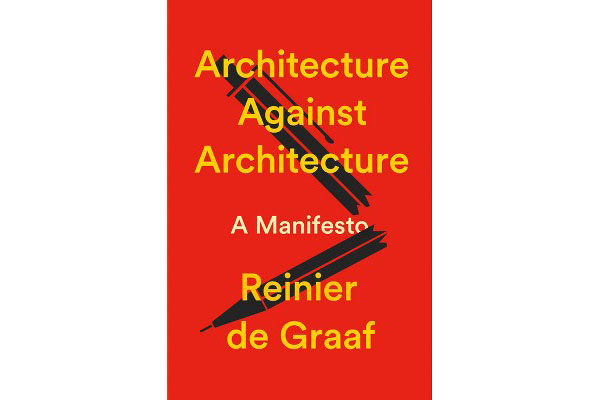
 Author: Reinier de Graaf (Verso, 2026)
When Reinier de Graaf published Four Walls and a Roof in 2017, it stood out for its rare willingness to expose architecture’s contradictions from within the profession itself. Architecture appeared there as a strange, conflicted discipline: simultaneously ordinary and extraordinary, technically modest yet culturally overburdened, deeply implicated in global systems it neither controlled nor fully understood. The book did not propose solutions so much as illuminate fault lines—an act of exposure that felt both necessary and, at the time, sufficient.
Five years later, de Graaf’s architect, verb—with its chapter on Vancouver, republished with permission in Spacing Vancouver—demonstrated how easily architecture’s language of care, livability, and design excellence could be mobilized to legitimize deeper structural forces. In Vancouver, livability emerged less as a social achievement than as a brand: a symbolic asset deployed to reconcile inequality, speculation, and environmental stress with a reassuring image of urban success. Architecture did not drive these dynamics, but it helped render them palatable.
Architecture Against Architecture marks a decisive shift from those earlier modes of critique. In the book’s Preface, de Graaf offers a revealing self-assessment of his previous work. Four Walls and a Roof, he writes, dismantled myths cultivated by architects themselves, while architect, verb. took aim at myths cultivated about architects. Both were provocations rather than prescriptions. Writing, he insists, “isn’t necessarily propositional; in fact, the best writing isn’t.”
And yet, the Preface closes with an unmistakable escalation. “No debunking of myths this time,” de Graaf declares. This book, he writes, confronts “uncomfortable realities” that, if left unaddressed, will inevitably get the better of the profession. It is, explicitly, “a manifesto for the future of architecture.”
That tension—between a long-standing refusal of solutions and the adoption of manifesto form—animates the entire book.
Structured as a two-part manifesto, Architecture Against Architecture addresses, first, the organization of architectural practice itself, and second, the discipline’s relationship to the wider world. Part I, “Architects,” is an unflinching examination of how architecture is produced: the persistence of figureheads and founders, the feudal logic of authorship, the concentration of symbolic capital in individual names, and the widening gulf between those who design and those who own the means of production.
De Graaf’s discussion of celebrity architects, labour exploitation, and unionization is not framed as moral failure but as structural inevitability within a profession that continues to mistake reverence for relevance.
The now-familiar scandals surrounding high-profile figures are treated not as aberrations but as symptoms. A discipline that insists on branding collective labour as individual genius, de Graaf suggests, should not be surprised when power concentrates, accountability dissolves, and abuse follows. The call to “end the focus on figureheads” is less a cultural critique than a survival strategy.
Part II, “Architecture,” widens the lens. Here, de Graaf argues that architecture’s traditional preoccupations—form, authorship, permanence, even beauty—have become increasingly detached from the realities that now define the built environment: climate breakdown, political instability, inequality, and technological acceleration. The provocation to “stop building” is not a literal injunction but a challenge to architecture’s default assumption that construction itself constitutes social contribution. What the world requires, de Graaf insists, is not more architecture, but fewer illusions about what architecture can meaningfully deliver.
Across both sections runs a consistent claim: architecture depends on the world far more than the world depends on architecture. The discipline’s failure lies not in its marginality, but in its refusal to accept it.
Taken on its own terms, Architecture Against Architecture is at its strongest when it abandons nostalgia for professional authority altogether. De Graaf is unsparing about architecture’s impotence in the face of climate change, its complicity in housing speculation, and its habit of mistaking symbolic gestures for political effect. The book’s clarity derives from its refusal to console: there is no return to ethical purity, no redesigned toolkit that will restore architecture’s moral standing.
At the same time, the manifesto form introduces an interesting, unresolved tension. Historically, manifestos announce collective direction, shared purpose, and future action. De Graaf’s manifesto does something stranger—and arguably more real. It names the end of architecture’s self-mythologizing, but it remains deliberately ambiguous about what follows.
Is “architecture against architecture” a strategy for transformation, or a call for withdrawal? Does the future of architecture lie in institutional reform, in diminished ambition, or in ceding ground altogether to other forms of expertise and governance?
As mentioned, de Graaf has already disavowed the expectation that critique must culminate in solutions. The absence of a program is not an oversight but a position. By invoking the manifesto, the book invites a question it cannot entirely evade: whether refusal alone can constitute action, or whether it merely sharpens the terms of an impasse.
Important food for thought.
The significance of Architecture Against Architecture extends beyond the discipline it addresses. The book reads as an anatomy of professional authority under late modern conditions, tracing how expertise persists even as its capacity to shape outcomes diminishes. In this sense, architecture appears less as an exception than as an early warning. Other fields—planning, academia, policy, even governance itself—may recognize similar patterns: symbolic influence without control, procedural power without democratic legitimacy, and a growing reliance on image to compensate for structural inertia.
De Graaf’s intervention matters because it refuses to defend the profession against these conditions. Instead, it asks whether architecture’s continued insistence on relevance may be the problem itself.
To be clear, Architecture Against Architecture is not a hopeful book…it is an unusually lucid one. Its ambition lies not in charting a new future, but in insisting that the old one is no longer tenable. Whether the profession can endure the level of introspection the book demands remains an open question. What de Graaf makes clear is that the time for debunking myths has passed. What remains is the harder task of deciding what, if anything, architecture is willing to give up to persist at all.
That this question is posed from within one of the world’s most influential architectural practices only sharpens its force. The manifesto does not arrive from the margins. It comes from the center—and it is addressed, uncomfortably, to everyone still standing there. As such, Architecture Against Architecture stands as a must-read for architects willing to confront not just their image, but the costs of continuing to defend it.
***
To learn more about Architecture Against Architecture, visit the Verso website.
**
Erick Villagomez is the Editor-in-Chief at Spacing Vancouver and teaches at UBC’s School of Community and Regional Planning.