
– From the Introduction, “The Architecture of Possibilities”
Edited by Agata Toromanoff, Prestel Press (2025)
This past week, the UN confirmed that the planet’s global temperature is now set to pass the Paris Accord’s target of 1.5 degrees Celsius within the next few years. Except for a short plateau during the 2020 COVID pandemic, the world’s global warming has continued unchecked, and perhaps even worsened in the last few years due to a new wave of denialism and inaction.
From this daunting place, this new book, 75 Architects for a Sustainable World, emerges — and is needed more than ever, as the author notes in the book’s opening pages. Given the fact that building construction and its ancillary economic activities continue to contribute to 40% of global warming, the desperation and hopelessness Agata says she first felt in writing the book (and perhaps the reason why she stopped at 75) slowly transformed into one of inspiration and optimism, given the caliber of architects and designers within the book and their amazing work.
Having written about architecture and sustainability for the past two decades, since the advent of LEED and the release of Al Gore’s Inconvenient Truth, I share Agata’s frustration that we are living the reality of Franny Armstrong’s poignant 2009 film, The Age of Stupid. But in all fairness to architects and architecture, these are not the only 75 firms practicing their trade with a sustainable mindset. As Patricia Patkau told my graduate class at UBC SALA back in those hopeful, early days, sustainability is bred in the bones of architecture, part of an architect’s means and methods for enabling us to design buildings.
Just as much as we weigh material options for fire safety, occupant health, cost, and aesthetics for a new project, so do we assess how and where the material is manufactured, what new technologies are being implemented for its production, the impacts it will have environmentally both due to its extraction and within its new building footprint, along with larger issues of urban demographics and material circularity—all the while weighing and monitoring our existing building stock. These topics, as it happens, provide the framework for 75 Architects, divided into five sections (with some architects appearing in more than one section).
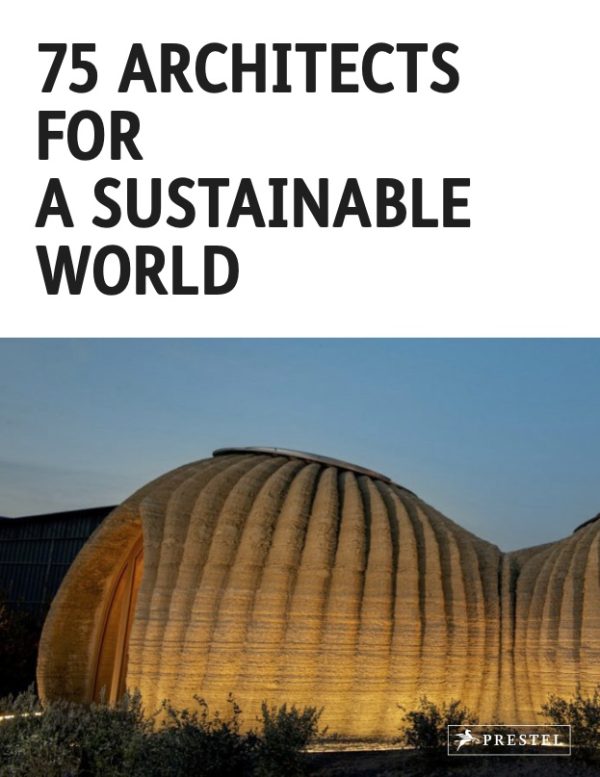
In the book’s opening salvo, Sustainable Materials, Agata highlights the use of old-school materials like timber, rammed earth, paper, and cork, featuring architects whose projects work with local sources to minimize transportation impacts, along with recent innovations using renewable materials which can be 3D printed in situ. Shigeru Ban makes an early, and obvious, appearance in the book, notable for his exploration of lightweight, renewable materials, alongside one of Mario Cucinella‘s 3D-printed structures, which also graces the cover of the book. But it is the amazing work of Anna Herniger that steals the early spotlight, who—while not as well known as several others featured here—has perhaps had one of the biggest global impacts over her career, contributing to several sustainable structures in Africa, Asia, and Europe.
The book’s next section, The New Dimension of Innovation, looks at sustainability more holistically, focusing on larger economies of scale beyond the single building to understand the systems influencing architecture and design. It is therefore no surprise to see a project currently underway for a new Google campus by BIG and Heatherwick, whose ambition is to be 100% carbon-free operationally by 2030. Small-scale impacts on land use and development are also here, whether it is the single-family dwellings in Pekka Littow‘s micro-units or at the neighbourhood scale as seen in Space&Matter‘s waterfront development in Amsterdam. At the scale of the cultural building, Studio Gang makes an appearance for their innovative Richard Gilder Center for Science, Education, and Innovation.
In the next two sections, Architecture, Greenery, & Landscape and Reinventing by Converting, Agata spends some time looking at architecture’s two ancillary sustainable pursuits: landscape design and building preservation. In the former, we see evidence of several innovative landscape strategies for reducing the heat island effect and rainwater management, while in the latter section, a reminder that sometimes the most sustainable building is no building at all. Japanese architect Sou Fujimoto is here in the landscape section featuring his House of Hungarian Music in Budapest. In the conservation section, Agata includes a broad selection of innovative re-use, with PAU‘s repurposing of an old Domino sugar factory into a new, vibrant waterfront hub in Brooklyn being a standout (and whose Principal, Vishaan Chakrabarti, was also the subject of a 2025 Spacing review).
For the book’s final section, Visions for the Future, Agata has selected a rich crosscut of designers and firms, from the Sunflower Houses of sole-practitioner Koichi Takada alongside the behemoth SOM with their latest carbon-neutral residential high-rise. Also here are cultural innovations by Benedetta Tagliabue and Chipperfield Architects, with the former represented by her Bamboo Cultural Experience Centre in Sichuan, and the latter by his work renovating such important architectural icons as the New National Gallery in Berlin and National Archaeological Museum in Athens. These latter two projects show the different ways our current practitioners can meaningfully and positively impact our ecological footprint, providing for the inspiration and optimism alluded to in the book’s opening pages, as noted by Agata along with Charles Wu of Polysmiths.
The book is a must-read for architects, designers, and students. Particularly for the practitioners and educators who will adversely impact the next generation if they choose to carry on with their heads in the sand. For as the book’s author notes:
Writing this book was an exceptional adventure and an opportunity to immerse myself in the ingenious philosophies and architecture of tomorrow. My first impression upon becoming aware of the impact of the industry and its global scale was devastating. However, my research with architects and learning more about the newest projects have brought promising hope.
With this book, it is clear the next move is ours—we can choose to be Nero and play our fiddle while civilization burns, or we can be Marcus Aurelius and find within ourselves what is most noble: that which represents the best of our humanity needed to overcome this global problem. As Charles Wu notes in his opening remarks, humanity has demonstrated it can come together to overcome a global pandemic, so there is hope we can do the same for climate change.
And as is clear from the contents of 75 Architects for a Sustainable World, though we may be the cause of the problem, the projects here are more than a testament that with hard work and innovation we can also be the purveyors of the solution.
***
For more information, go to Prestel Verlag.
***
Sean Ruthen is a Metro Vancouver-based architect.