
EDITOR’S NOTE: Cross-posted from Spacing Montreal, by Chris Erb
– – – – – – – – – – – – – – – – –
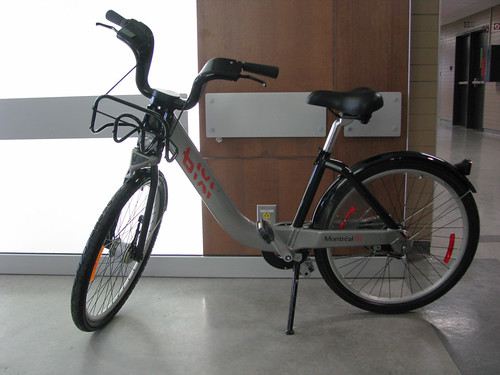
MONTREAL — Yesterday, I had the opportunity to attend some of the Micro/Macro conference hosted by CAPS (Canadian Association of Planning Students) which took place between the four universities. A representative from Bixi, the public bike-sharing program set to be launched this spring gave a presentation (which I unfortunately missed) on the project. As everyone lined up for lunch, one of the bikes were rolled out for everyone to have a look at. Unfortunately, I didn’t have time to take any close-up shots of the different parts of the bike but was glad to be able to take a good look at it.
The bike, designed by Michel Dallaire Design Industriel (also responsible for much of the furniture in the Grand Bibliothà¨que as well as much of the urban design of the Quartier International) seems to be very well built and designed. The bike is incredibly simple and obviously made to be very rugged with all delicate parts such as the brakes and derailleur encased in plastic or metal to keep them from being damaged or tampered with. I was however, surprised by how heavy it was and by the fact that it has very wide tires rather than thinner tires that are generally much better of city streets. This design will inevitably cause the bikes to be much slower but perhaps that is the rationale behind the design. Nonetheless, I was very impressed with the bike and look forward to seeing them on the streets this summer.
Also, this map (below) of the future station locations has been posted on the Bixi website. Click the map to see a larger version.



7 comments
Wider tires would not require the higher pressure that skinny tires would require, and as a result would not need to be reinflated as often. Perhaps that was the reason for the wide tires. The lower tire pressure also wouldn’t transfer bumps in the road to the rider as much, and so would be more comfortable.
“by the fact that it has very wide tires rather than thinner tires that are generally much better of city streets.”
haha clearly you don’t live in montréal ;p
maybe they are better for normal city streets, yes.
The author, Chris, is from Montreal.
I find thinner tires better on city streets as they allow you do ride much faster and are much more maneuverable especially in tight spaces on streets that are congested with cars. ALthough, yes fatter tires are more comfortable which is probably a higher priority than speed.
I think the wider tires also provide stability. Keep in mind that not everyone that will use this bike share program will be professional cyclists. Wider tires will mean more control when going over sewer grates or odd shaped bumps.
not that this is an issue in MTL, but here in TO, the thin tires do not play nicely with the streetcar tracks. I have a couple scars to prove it
Comfort over speed. I agree.