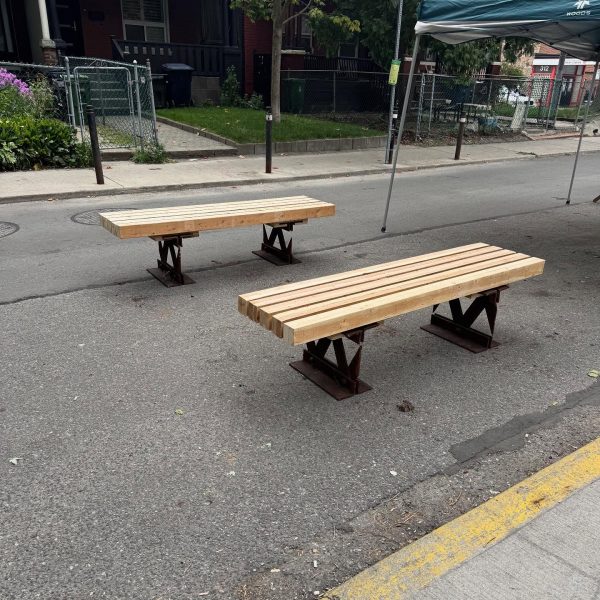
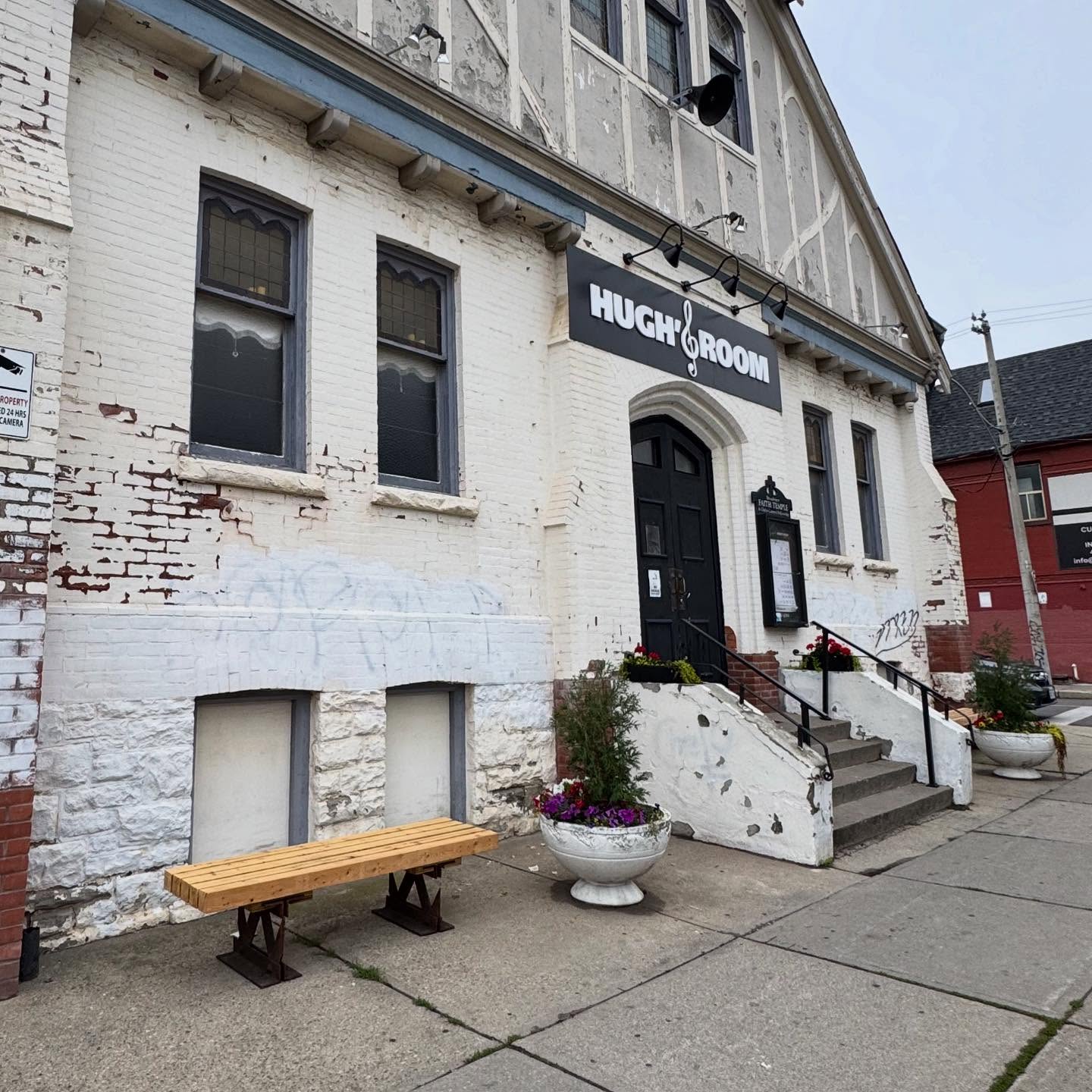
Steel girders that used to carry cars across the Don River now carry conversations on a quiet stretch of East Chinatown. Outside Hugh’s Room, two benches sit along the sidewalk, their industrial frames and wooden seats hinting at a past life quite different from their current use.
At first glance, they blend easily into the streetscape, but their presence reflects a larger story about salvage, collaboration, and how reused materials can quietly reshape public space. Built from reclaimed bridge steel and salvaged wood, the benches are the result of a local effort to preserve fragments of the city’s past while creating something shared and practical in the present.
For Julie Bogdanowicz, a registered architect with more than eighteen years of professional experience and a background in urban geography and environmental studies, the project began when the Eastern Avenue Bridge was scheduled for removal. The bridge, which had stretched across the Don River since 1932, had long outlived its original purpose and eventually became a flood risk as river revitalization work expanded. Bogdanowicz lives nearby, and rather than see the structure entirely dismantled and discarded, she tried to save part of it.
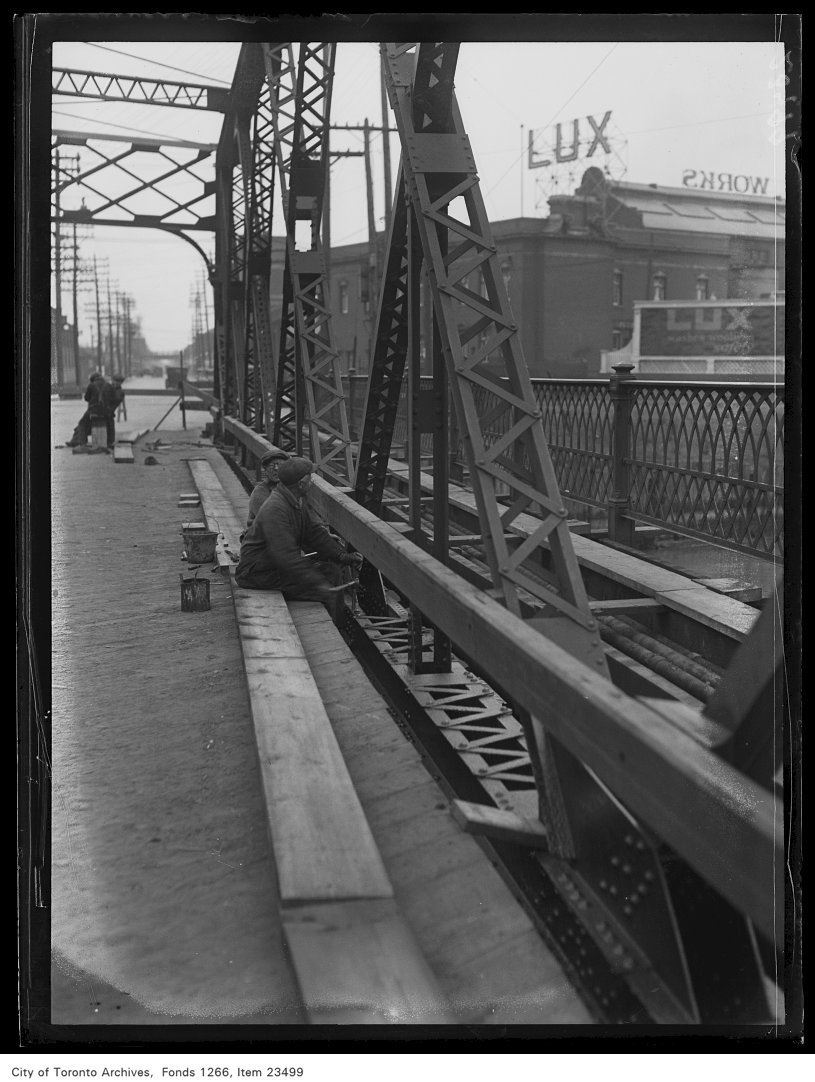
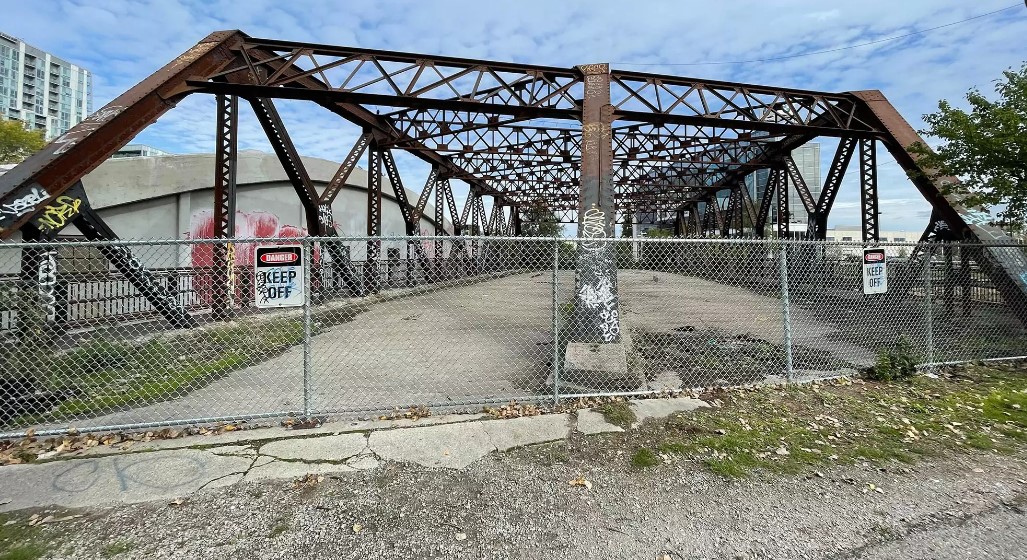
“The genesis of this project is that the Eastern bridge was being removed and we wanted to salvage parts of that bridge and reuse parts of the bridge for public infrastructure elements, whether it’s furniture or public art,” she says. At first, there was no plan for how the salvaged pieces would be used. That changed quickly once Bogdanowicz got a good look at them. “It occurred to me that the height of the trusses were basically the height of a bench. And so we asked them to cut kind of smaller sections that we could use as the legs of the bench.”
From there, the project grew through neighbourhood collaboration, as the early stages relied on informal connections rather than a formal team. Bogdanowicz partnered with Paul Young, a neighbour who works in transportation services, and Etienne, another neighbour, who has a basement workshop. Together, they retrieved the bridge pieces and began shaping the benches. Bogdanowicz describes the process as “an organic coming together of interested people who had time to work on the project.”
The wood used for the benches was donated by another salvage source in the neighbourhood. Bogdanowicz connected with Ouroboros Deconstruction, a local shop that reclaims construction materials. The seating surfaces were built from wood salvaged from old construction pallets that had been dismantled for reuse. “Every part of the bench is basically a piece of recycled material,” she says. The pallets themselves had been used on a project she worked on years earlier, creating a material link between different sites through reuse.
The benches were first introduced at a community block party. They now sit outside Hugh’s Room, a music venue that recently moved into the neighbourhood. The business agreed to “adopt” the benches after the party. “It was kind of an organic thing that came together,” Bogdanowicz says. The placement filled a noticeable gap in the area, where public seating is otherwise limited.
For her, reuse is also about keeping neighbourhood identity visible. As Toronto changes through constant construction and demolition, she sees salvage as a way to prevent neighbourhoods from feeling interchangeable. “If we’re not doing this, I think the risk is that we’re just ordering things out of a catalogue and it could kind of create a homogeneous sort of city.” Some other steel trusses from the bridge were also salvaged and are waiting for adaptive reuse in future projects.
Since the benches were installed, they have begun to function as gathering points rather than just design objects. Neighbours pause on them while running errands, people linger before performances at Hugh’s Room, and conversations start where they might not have otherwise. The benches quietly extend the collaboration that built them into everyday use, turning a reuse project into a shared piece of public life as opposed to a one-time intervention.
That idea of shared effort is what stands out to Gauri Singh, a fourth-year Urban Studies student at the University of Toronto. As a member of the Urban Studies Student Union and editor-in-chief of its undergraduate academic journal, she thinks a lot about how cities are shaped by collective work. “Someone had to plan it out, someone had to build it, someone had to get the permits. It’s an example of a community effort that benefits people beyond the group who built it,” she says.
Bogdanowicz describes the benches as “a pilot project or a proof of concept that we could take old things and turn them into new pieces of public infrastructure in the city.” Small as it is, the project points to a model where residents, local businesses, and city staff work together to shape public space using what already exists.
Now installed outside Hugh’s Room, the benches quietly link the industrial history of the Don River to everyday life in nearby East Chinatown, just a short walk from where the bridge once stood. Elements that once supported traffic over the Don are now a part of everyday moments along the sidewalk.
Built from reclaimed steel and wood, the benches are modest objects shaped by an uncommon process. They show how memory, material, and community can come together in something as simple as a place to sit, and how even small interventions can carry deep-rooted stories about the city.
Photos by Julie Bogdanowicz unless otherwise specified