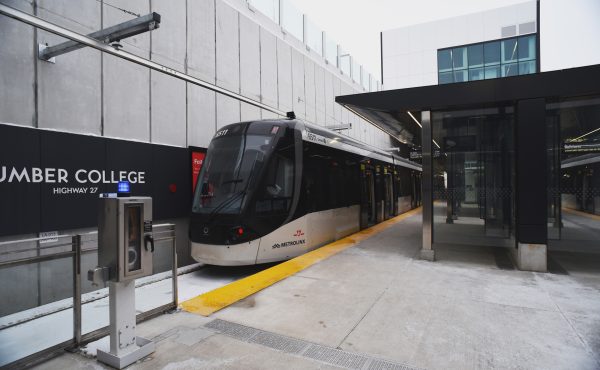

In the past few days, Toronto’s chronically testy conservation about mobility glommed onto the disappointing launch of the Finch West LRT (Line 6), which crawled along on its maiden journeys thanks to deliberately slow operating speeds and the lack of priority signalling.
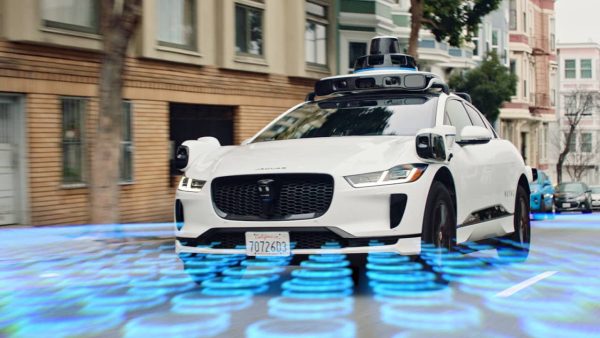
The focus will shift soon enough, first, presumably, to the formal launch of Eglinton Crosstown LRT and then whatever else seems to be gumming up the city’s streets. But one day soon, the object of our opprobrium may be Waymo’s fleets of white fully autonomous ride hailing vehicles (AVs), which are fitted out with all sorts of external sensors and Lidars.
The company — which last month registered StrategyCorp as its lobbyist at City Hall — is in the processes of dramatically expanding its North American footprint after launching commercially in four cities last year: San Francisco, Los Angeles, Phoenix and Austin. (The Alphabet-owned company also is rolling out a joint venture with a large Tokyo taxi app, and its launch in London, U.K., will occur later this year.)
While the heavily-hyped business case for AV-based ride hailing services fizzled out once the pandemic began, tech giants like Alphabet, Tesla and Amazon (Zoox) continued to test and invest, with Alphabet securing first mover advantage for its Waymo fleets.
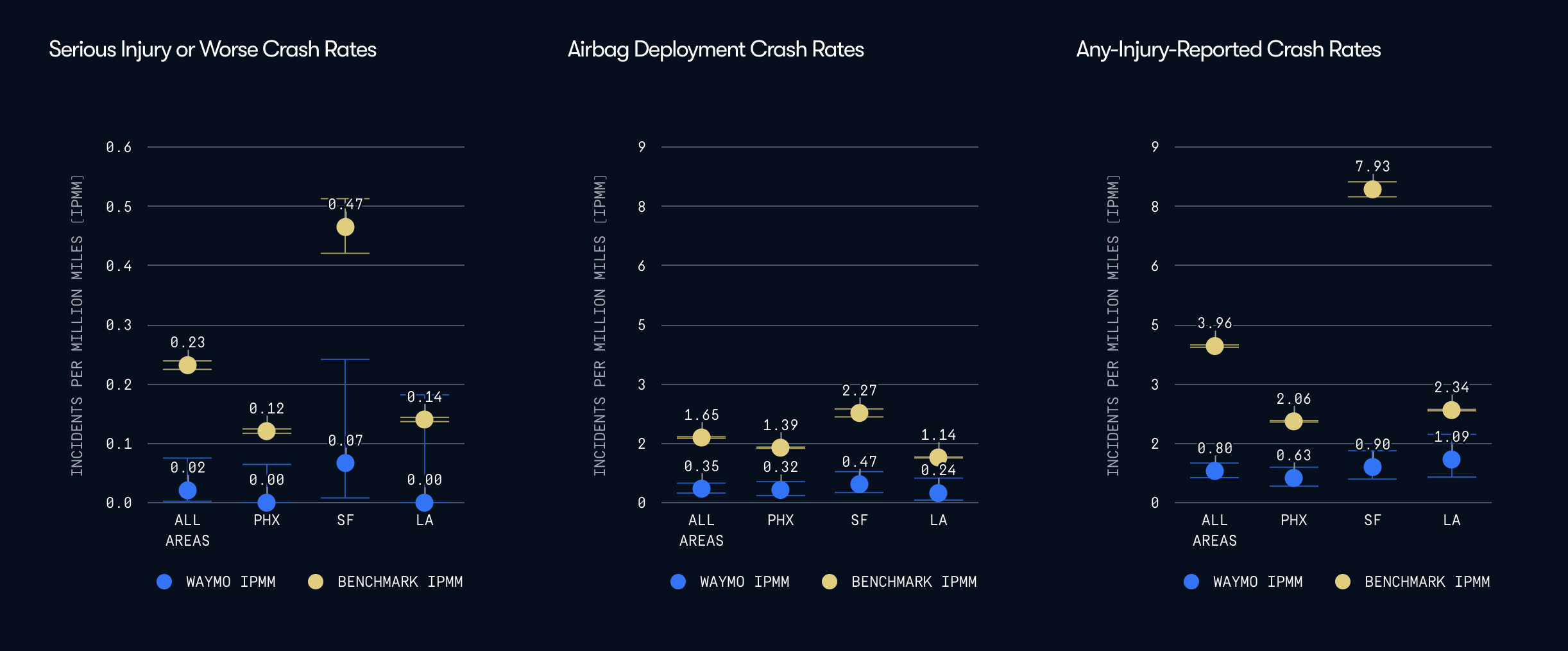
Waymo recently released a tranche of operational safety data, compared to “human benchmarks,” from the three cities where it’s running “rider only” vehicles commercially (i.e. no one at the wheel). The “incidents per million miles” numbers involve large denominators: from 16.5 to 46 million miles recorded as of June, 2025. The aggregated results seem impressive: 91% fewer (20 accidents) serious injury or worse crashes; 92% fewer pedestrian crashes with injuries (i.e. 35 people); and 80% fewer injury-causing crashes (304 incidents).
Those data, in turn, have been touted in high-profile venues, including a highly laudatory New York Times op-ed last week by Dr. Jonathan Slotkin, a neurosurgeon who writes about the grim experience of treating victims of car crashes, as well as his analysis of the collision data.
“If Waymo’s results are indicative of the broader future of autonomous vehicles, we may be on the path to eliminating traffic deaths as a leading cause of mortality in the United States,” he said, citing the 39,000 deaths caused by car accidents and collisions last year. “While many see this as a tech story, I view it as a public health breakthrough.”
Slotkin doesn’t deny that there have been highly-publicized AV crashes, including some with fatalities, and these incidents tend to attract, with good reason, a lot of media attention. Still, think about the following thought experiment: say all the vehicles on the road today were AVs, and the proposal at hand was to introduce, or re-introduce, human drivers. Our terrible safety record, especially in today’s super-sized vehicles, would surely shut down that idea fast.
By contrast, Waymo’s AVs seem to be good at following the rules of the road and also detecting what else is on said road. They don’t get tired, angry, or distracted, and they stick to posted speed limits.
In a way, the commercial expansion into numerous other cities can be seen as that juncture when a new drug has performed sufficiently well in many large clinical trials that it receives the go ahead from regulators to be dispensed for general use.
Yet this analogy fails in the same way that newly regulated drugs do: once they leave the more closely controlled conditions of clinical trials, new medicines have to perform in imperfect real-world conditions: missed doses, poor diets, the presence of contraindicated drugs, etc.
Indeed, even Waymo’s seemingly impressive safety data raises questions that the company has not addressed, most notably the fact that these vehicles performed differently in the three big cities that provided the data. Unsurprisingly, the data for Phoenix and L.A. — both sprawling, car-oriented cities — were similar, whereas the delta between San Francisco’s pre-Waymo collision stats and then the performance of Waymo’s AVs on those same streets is quite large. Maybe AVs do better on all those hills? Place appears to matter, even with AVs that are engineered to be responsive to whatever happens to be in their immediate environment.
In fact, one could surmise there are a range of place-based variables — urban form, road lay-outs, density of non-vehicle users, highway driving as a proportion of all vehicle miles travelled, local driving `culture,’ etc. — that could affect the safety performance of Waymo’s AVs.
What’s less clear is how, or why.
Besides all the test-track and limited pilot driving that AV researchers have clocked in recent years, many of the academic studies (Waymo publishes a whole library of this stuff) of how they perform involve a mash-up of all that real-world performance data extrapolated into complex statistical models of traffic, of which there’s no shortage. For instance, a 2021 University of Tennessee study published in Accident Analysis and Prevention, which sets out to make predictions about how AVs fare in mixed traffic.
But the findings aren’t observational; rather, the authors derive a series of proxy measures and equations that suggest what happens when a human driver is following an AV too closely and it stops abruptly. “Experimental results show that automated vehicles can induce behavioral changes in following conventional vehicle drivers,” the authors assert. “Drivers exhibit lower driving volatility, and higher time-to-collision when following automated vehicles.”
Less common are studies that look at what happens in mixed traffic in specific places or kinds of places. I found a few — e.g., a Chinese evaluation in Nature’s Scientific Reports on how AVs perform when merging onto a large highway interchange — but they seem uncommon.
In any event, these big Waymo roll-outs are beginning to offer real-world clues, but as I mentioned earlier, the safety stats to date can’t be described as representative, whatever that might mean, because they elide the problem of what mixed traffic looks like in specific places.
If most of the driving recorded by Waymo vehicles in L.A. and Phoenix are on large, clogged highways and arterials where there are no pedestrians, cyclists, parked cars, etc., you’d expect different results than within a city with narrow streets, lots of pedestrians, bike lanes, etc. If those kinds of variables don’t matter, then the onus is surely on Waymo to prove that fact, which the company hasn’t done with its latest safety reports. All we can infer is that the Waymo cars performed better relative to the baseline in San Francisco, with its hills and angled intersections, than either of those other two cities. The question to my mind is whether this kind of outcome will be replicated in other cities with messy street grids.
It’s 100% foreseeable that the City of Toronto (and possibly Queen’s Park) will come under intense corporate pressure to say yes to Waymo’s AV ride hailing fleets, as happened a dozen years ago when Uber up-ended the city’s taxi licensing system. From where I sit, I’d rather the City of Toronto find out how Waymo’s AVs do in mixed traffic conditions in gnarlier urban environments, like London or Tokyo, and make its decisions accordingly.
I’d say the case for improved safety with AVs is fairly compelling, but there’s no reason Toronto needs to be one of the earlier adopters. Nor should we assume we now know all there is to know about what happens when this highly disruptive technology is introduced into an urban environment. One thing is certain, though: there will be unintended consequences, and these will play out on a street network that is already vastly over-stressed and precarious.
If the city’s leaders think such vehicles might make things better and safer for all types of road users, they owe it to Torontonians to be able to demonstrate this central fact. And no, Waymo can’t do that just yet.