
Transit planning is a long-term endeavour, not a one-time project with a single solution. In a municipal election year, we need to demand more from leaders and those charged with planning and running transit services than simple soundbites that recall old political slogans.
On Friday, January 2, the Toronto Star published an op-ed titled “To fix transit in Toronto, we need to embrace a simple idea: subways subways subways.” The author of that article, blogger and transit advocate Reece Martin, provocatively uses the words of controversial late mayor Rob Ford to advocate for his preferred solution to Toronto’s transit woes: building more subways.
On Saturday, January 3, CBC Toronto published a story titled “Scarborough residents say they’re being left out of transit improvements in the city.” In it, reporter Olivia Piercey quotes several local advocates, including the president of a local residents’ association, who want to see more subways in the city’s east end as well as the construction of the Eglinton East LRT, which would connect Kennedy Station with Guildwood GO Station, University of Toronto’s Scarborough Campus and the Malvern neighbourhood. They also want better transit to speed up travel within Scarborough, rather than serve the suburb-to-downtown trips. Piercey also writes, incorrectly, that “Scarborough has been without a subway line since the Scarborough RT shut down in 2022 after a train derailment.” It is worth noting that there are three subway stations within the old boundaries of Scarborough: Victoria Park, Warden, and Kennedy, and that three more are being constructed.
Unfortunately, neither of these transit takes address some of the major mobility issues in the Greater Toronto Area, nor do they offer solutions for affordable, quick, and effective transportation that can move people efficiently and comfortably across the city and the region. This includes making better use of our existing infrastructure and fixing LRTs and streetcars to match speeds elsewhere in North America and in Europe. It also means investing in buses, which have helped to make the TTC a success story in years past.
In his article Reece Martin makes several worthy points. The Eglinton East LRT will not be faster than the buses it is intended to replace because it will run entirely on the surface, subject to the same problems faced by the Finch West LRT, despite Scarborough advocates pushing for that project. The costs of transit construction – be it subway or LRT – have become unsustainable. Meanwhile, Metrolinx, which is expanding the GO Transit rail network, is ambivalent about the role regional rail can play in the Toronto area, reluctant to expand beyond operating a commuter rail service. Though construction delays and cost overruns are seen as a specifically Toronto problems, rapid transit projects in peer North American cities such as New York have also struggled to get started, never mind completed, in a timely fashion.
But then Martin goes on to tout subway construction, quoting Rob Ford’s mantra. Mayor Ford, along with his brother, Doug, was obsessed with the idea of a “war on the car.” During his short term in office, Mayor Ford moved to rip out cycling infrastructure in Downtown Toronto and on two Scarborough roads, raised TTC fares, reduced bus service, and even ordered TTC buses pulled from regular service to pick up the high school football team he was coaching in 2012. At Queen’s Park, Doug Ford has continued fighting the “war on the car” by restricting the installation of new cycling infrastructure, removing speed enforcement cameras, and focusing on the construction of new and expanded highways.
Furthermore, by declaring the Transit City LRT plan “dead” Mayor Ford only delayed the start of construction of the Eglinton-Crosstown and Finch West LRTs, increasing the costs of both. The replacement of the Scarborough RT with a modern and extended grade-separated LRT was cancelled; it took a decade for construction to begin on a subway extension to Scarborough Town Centre. It will not open for at least another four years as it too has seen major construction delays.
The Finch West LRT, which opened just a month ago, was never intended to provide the same speeds as a rapid transit subway, nor should it. The prior bus route, the 36, was one of the busiest surface routes in the TTC’s network, yet it mostly served local needs; the LRT was intended to provide more capacity along with a higher-quality ride, with modest – yet real – improvements in travel times. The slow speed on Finch is not just a matter of having too many stops or not introducing aggressive transit signal priority (though it would help), but also reducing station dwell times, speeding up service through intersections, and eliminating unnecessary schedule padding. These lessons can be applied to the surface section of the Eglinton LRT, as well as those now underway in Mississauga and Hamilton. In Kitchener-Waterloo, the Ion LRT has active transit priority, and its trains run like clockwork, every 10 minutes on weekdays. In Minneapolis-St. Paul, a city region with even harsher winters than Toronto, light rail trains on suburban arterials get full signal priority and they speed through signalized intersections without the restrictions placed on Finch.
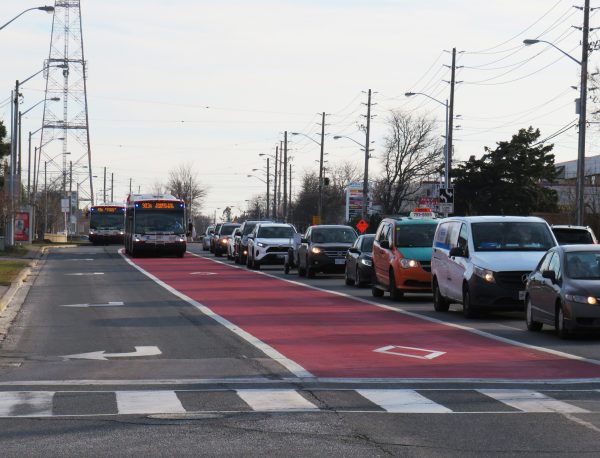
It is one thing to advocate for subways, it is quite something else to plan where they should go, which neighbourhoods should be served, and how to pay for construction, operation, and long-term maintenance. Replacing LRTs already committed to with limited-stop subways is not always a viable solution, as we learned when Rob Ford was mayor. What we can do, right now, is speed up buses with measures such as all-door boarding, transit priority, dedicated lanes, and queue-jumps at intersections. In New York, social democratic mayor Zohran Mamdani was elected with a platform to improve the city’s buses. In Toronto, Mayor Olivia Chow is also leading plans to speed up buses on priority routes.
Speeding up buses and fixing our LRTs can provide the solutions commuters across the city are looking for quickly and at reasonable cost, while connecting neighbourhoods together, rather than just to downtown. Toronto already has a network of 900-series express buses that can be prioritized.
We simply cannot rely on a single solution to our transit woes.
Sean Marshall is a Toronto-based geographer and writer, with a passion for walkable cities and great public spaces. His writing and consulting work focuses on public transportation, pedestrian safety, and public spaces.
Photo by Sean Marshall
7 comments
I think we can safely qualify Transit City as a cult at this point.
Toronto should be looking to Calgary and Edmonton as the gold standard for LRTs. Both use railway crossing arms to protect the right of way of LRT vehicles zooming through intersections.
I rode the Finch LRT on the weekend and it is an unmitigated disaster. Billions of dollars and years of waiting for a badly designed and snail-paced service that is even worse than downtown’s streetcars, famously the slowest in the world. The Finch LRT stops for every traffic light (they were all red!) and takes literally two minutes at each stop, and stops at each “station” even if nobody gets on or off, which happened twice on my quiet Sunday afternoon ride. The rarely reached top speed was 33km/h on a wide suburban street where buses easily reach 50-60km/h in no traffic. Insiders report that the Eglinton Crosstown will be the same – noticeably slower than the buses it replaces. Metrolinx is a plague on GTA transit – disband it, scrap all future LRT plans and force the TTC to focus on buses and subways, which do work. And drive a stake through the heart of any remaining “Transit City” plans.
Why are we framing this as a subway v. buses debate? I simply don’t see why anyone could take issue with advocacy of better rail infrastructure in Scarborough. Scarborough deserves better than what the current plans has to offer, and 3 subway stations simply isn’t enough, because Scarborough has a capacity issue that buses simply doesn’t fix. Building better bus infrastructure is not meant to be mutually exclusive with building more rail, and I am appalled to hear from the author intending to frame it as such.
If we listened to you, Alan, transit would be worse and cost more to build, as well as take time (LRT’s were floated by David Miller with the Transit City project because they work for North York/Scarborough/Etobicoke/East York/York due to those areas having not enough density to justify building subway lines across them); not building them would result in the expensive (and just an excuse to have condos be developed) Sheppard Stubway debacle that has one station (Bessarion) with few users and only having five stations overall (these articles by Patrick Condon [https://thetyee.ca/Opinion/2019/01/29/Last-Voice-Against-SkyTrain-to-UBC/ ] and [https://thetyee.ca/Opinion/2016/01/25/Bad-Transit-Projects/ ] illustrate why ‘subways, subways, subways’ is a bad road to go down for Toronto, and why light rail’s better for the Inner Suburbs.
Lots of cities across North America are embracing light rail over hideously expensive subway lines (and somebody expressed the idea of New York City having them for the Bronx, Queens and Brooklyn too [https://m.youtube.com/watch?v=J6YoMY-z8SA&pp=ygUuTmV3IFlvcmsgc2hvdWxkIGhhdmUgbGlnaHQgcmFpbC1NeXN0aWMgVHJhbnNpdNIHCQmHCgGHKiGM7w%3D%3D ] ); why should Toronto be any different? There’s not enough density in the rest of Toronto to build them to begin with, and light rail’s a better solution (although the TTC does have to speed up the Finch West line.)
Slogging Streetcar, ‘Transit City ‘is a cult’? Not anything like the subway cult that’s been bedeviling Toronto for over a decade now (hell, three decades if we’re being honest) and making any kind of transit expansion that isn’t subway impossible to do, even when other cities in North America (Edmonton, Calgary, Buffalo, Portland, Oregon, Seattle, Washington, Boston, Massachusetts, Philadelphia, Pennsylvania, Salt Lake City, Utah, San Diego, California, Dallas, Texas, and last but not least, Los Angeles, California-the last one that Toronto’s more like physically than like New York City [we’re only officially like NYC in that we’re the financial and media capitol of Canada-Toronto outside of downtown and midtown’s more like L.A.]) have had light rail and have made it work successfully (with Buffalo and Edmonton expanding theirs to go to places like the airport. There was nothing wrong with Transit City aside from people like you thinking that it would’ve messed up automobile traffic or whatever else you think light rail would ‘mess up’. Toronto could’ve had it for all the parts of the city that needed it-as the saying goes-yesterday, but people like you kiboshed it by voting out Miller and voting in Ford, who them proceeded to destroy it even though both the city and province were ready to build it and have it completed by 2016 (hell, even further in the past, the Scarborough RT could’ve been light rail just like the Mattpan-Ashmont line in Boston-and with a further expansion from McCowan station into the rest of Scarborough-but shortsighted , subway addicted politicians were so tied to a linear induction toy that UTDC dangled in front of them that they replaced the perfectly working and proven CLRV/CALRV streetcars that were to run on it with the unproven and experimental demonstration linear induction system that had no spare parts for it-which means that it would have to be eventually shut down, which did happen-and had to be winterized [by shutting the system down] every winter.) A big waste of money, but because of subwayitis, that’s what Toronto built, along with the Sheppard Stubway, the expansion of Line 1 to another city, and now, the Ontario Line.
When is is ever going to percolate in your head (and of others like you) that Toronto’s not that dense a city like New York, London, Tokyo, Paris, Moscow, or Seoul is to be building subway lines all over it? When?
Much needed perspective in the headwinds of Subways, Subways, Subways! We need to make LRTs work, we have a number of streetcar & LRTs already, and more are planned (Scarborough East LRT, Hurontario LRT), not give up and go underground. Not every transit corridor is or will be dense enough to justify a subway line, nor can we afford at current construction costs to keep building subways extensively. Enabling proper traffic signal priority on Eglinton Line 5 and Finch West Line 6 will help, but so will increasing speeds between stops. Furthermore, LRTs provide higher line ridership vs bus lanes, and the latter are being infringed upon frequently, and the Police ‘don’t feel like enforcing transit-only lanes’. The booming city needs more such lanes nonetheless, more LRT lines, as the city continues to densify, as rideshare Lyfts & Ubers clog our streets, and as self-driving cars like Waymo invade our streets.