
After years of relatively mild winters, the darkest season is once again bringing sustained cold and abundant snow to Canadian cities. And if spring excites thoughts of romance in some of us, then winter is for generalized complaining.
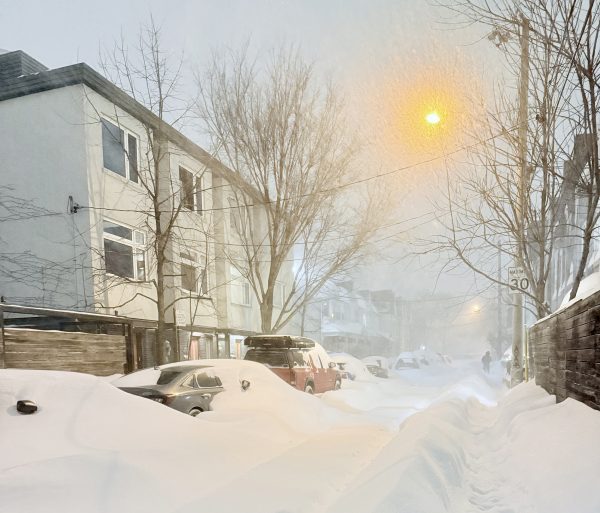
Toronto sank into a polar freeze sometime around Christmas. Two major snowfalls buried the city deep and deeper in the new year, uncovering our collective sourness. By February, whole swaths of the city seemed to only be held together by overlapping gripes: the snow removal was too scarce and slow; the salting was too much; the parking was too restricted; the transit was too broken; the days were too short; the air was too dry. Weeks later, sidewalks remained impassable.
We are a winter city by geography and climate, but less so by services and civic constitution. There is the distant but still jarring memory from the end of the last century, when then mayor Mel Lastman asked the Canadian Forces to bring armoured vehicles and personnel to battle the snow on Yonge Street like it was a foreign horde. Recently, there was last year’s failure of our gargantuan hauling and melting machines. More personal and lived deficits are everywhere we look this season — cars without snow tires spinning out or stuck on side streets, frozen switches on commuter tracks, salt selling out on the day you really need it, burst pipes, flooded condos, falling ice, surge centres for the unhoused closing their doors when temperatures warm to -14 degrees. Let’s face it, Toronto kind of sucks at winter.
Two people who have a different take on winter are my children, ages six and eight. Their first instinct whenever it snows is to get outside as soon as possible. After the late January (record-breaking!) snowfall, my kids were out the door within minutes of waking, piling more snow atop a natural drift on our small lawn to build a slide taller than my son.
I brought them their hats, watching them work as I shovelled. The snow continued to fall or blow throughout the morning, giving everything a satiny surface sheen. A single car passed slowly in the street, looking lost and out of place, while the only discernible sounds in our downtown neighbourhood were the short commands my kids gave each other as they worked together in flow state: “Put more of the heavy snow here. Pack it down like this.” The slide grew and grew. Their effort proclaimed unison and discipline, two lesser known qualities of their sibling dynamic.
My daughter stood at the top now, shoveling armfuls of snow down the slope like it was a sluice in need of slicking. Her brother, lying on his stomach at her feet, squirmed to the edge.
“You want a little push?” she asked.
Down he went at alarming speed, smashing his face in the landing zone they had prepared in the middle of the sidewalk. He turned over and lay on his back, taking stock.
“Again!!” he screamed.
“No way,” his sister replied. “It’s my turn.”
For them, the snow was a liberator and virtuoso. It had deposed their ruler and elevated all children to temporary positions of power for one day at least, providing endless opportunities for play and invention. Snow was soft and forgiving, protean, full of mysteries — “Don’t walk over there, it’s like quicksand!” my daughter warned. School, on the other hand, was a blunt brick building.
In the afternoon, after soup to warm the body cavity, we set out on an errand of sorts. My kids wanted to see (and hopefully climb) `The Rock,’ an ancient tonnage of stone re-assembled in a local urban park as public landscape. The Rock is located directionally east, but whatever way we walked, snow blew directly in our faces. The parked cars that lined the streets had disappeared beneath dunes, while the sidewalks underfoot were more notional than concrete — “It’s so deep. I don’t even feel the ground!” my son cheered.
Moving forward required slow and steep vertical steps, frequent breaks, wiping of noses, warming of hands in balled fists, and emptying of snow from boots. None of this dented their enthusiasm, and our progress was marked every now and then by one of them diving impulsively into a snow bank. What was normally a 15-minute walk took us an hour.
The Rock was completely buried. Glacial and prehistoric in origin, the generational storm had turned it back into a giant hulking mass of ice and snow in a canyon of tall buildings. My kids had climbed The Rock maybe 200 times in their lives, in all weather and dress, but this was something new. A swirling vortex turned clockwise, then counterclockwise, around the base. On his first attempt, my son took a few steps up its incline, then folded forward, face-first, as his footing disappeared beneath him. He tried again but each ventured step provoked a mini avalanche. Finally, my daughter took a good run at it. She used momentum, balance, and the strength in her arms to dig into the snow on an angle, climbing on all fours like an ibex goat. My son followed in her path. She summited a few steps ahead of her brother, and they hugged each other in triumph.
We retraced our steps home, thus saving some effort. The city was dark and quiet, with all of its edges softened. “Can we do that again tomorrow? Will there be more snow?” my daughter asked as we reached home, where the peak of their slide reached the lintel of our bay window. Her tone was pleading, with a hint of “We shall be as gods” vibes.
My son had returned with a single glove, its twin still buried in the drifts atop The Rock or a curbside snowbank. Inside, we peeled off layers of damp clothes and shook out tufts of snow. His face was red with abrasions. I covered his cheek with my palm and it burned to the touch.
“Does that hurt?”
“No Daddy.”
Weeks after the storms, our street was still lined with hulking mounds of unmelted snow, stained yellow at the base, and the slide stood as a monument or altar on our lawn. My neighbour worked for a full day to extricate his Volkswagen, which had frozen into a curbside snowbank like a cubist sculpture. The minor key laments kept up our civic discourse while weather reports began speaking rapturously of the prospect of days above zero. Around this same time, a Florida city freed a manatee from a storm drain. My kids asked what the manatee was doing there, how a 400-pound sea cow ended up in the drain, and I told them it was searching for warmer waters. The whole continent was freezing over. “Really?” they asked excitedly. They had it on good authority that winter would one day end, but they kept up hope for one more big storm, one more school closure, one more taste of freedom.
photos by Matthew Blackett
One comment
An addendum to this story: yesterday, in the dregs of a melted snowbank on our street, we found the glove that my son lost in the late January snowstorm. It’s thawing on our radiator now before being reunited with its pair.