
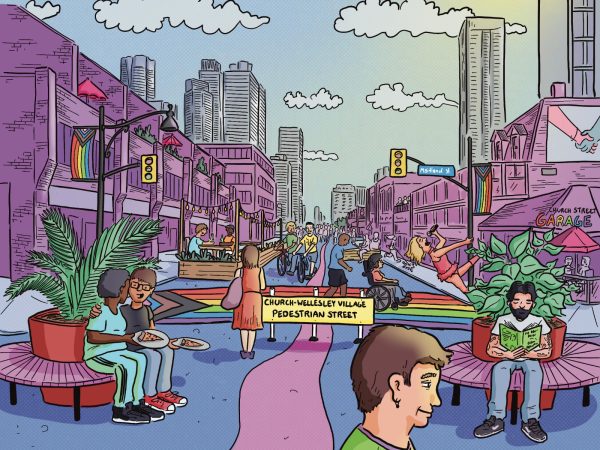
It’s evening in Toronto’s Gay Village and the sidewalks are bustling with people. The air is warm and electric. People sweaty from the dance floor pop out of bars onto the sidewalk, glowing with joy from being with their friends and relief at the chance to escape momentarily into the fresh air of the street. Just up Church Street, two friends who haven’t seen each other in months catch each others eye, exclaiming and running to embrace each other boisterously while on a nearby patio, two old friends watch the exchange while sipping their cocktails quietly, remembering when they too would have worn a revealing tank top and shorts on a night out. Long lines squiggle along the sidewalk to bars, pushing people who are out for a smoke or chat to stand in the street between parked cars. People regularly spill out of the sidewalk into the street. So why don’t we plan for how people already want to use the space instead of restricting them? As anyone who walks down Church Street can tell you, people want a place to linger, to sit, to chat, and to eat.
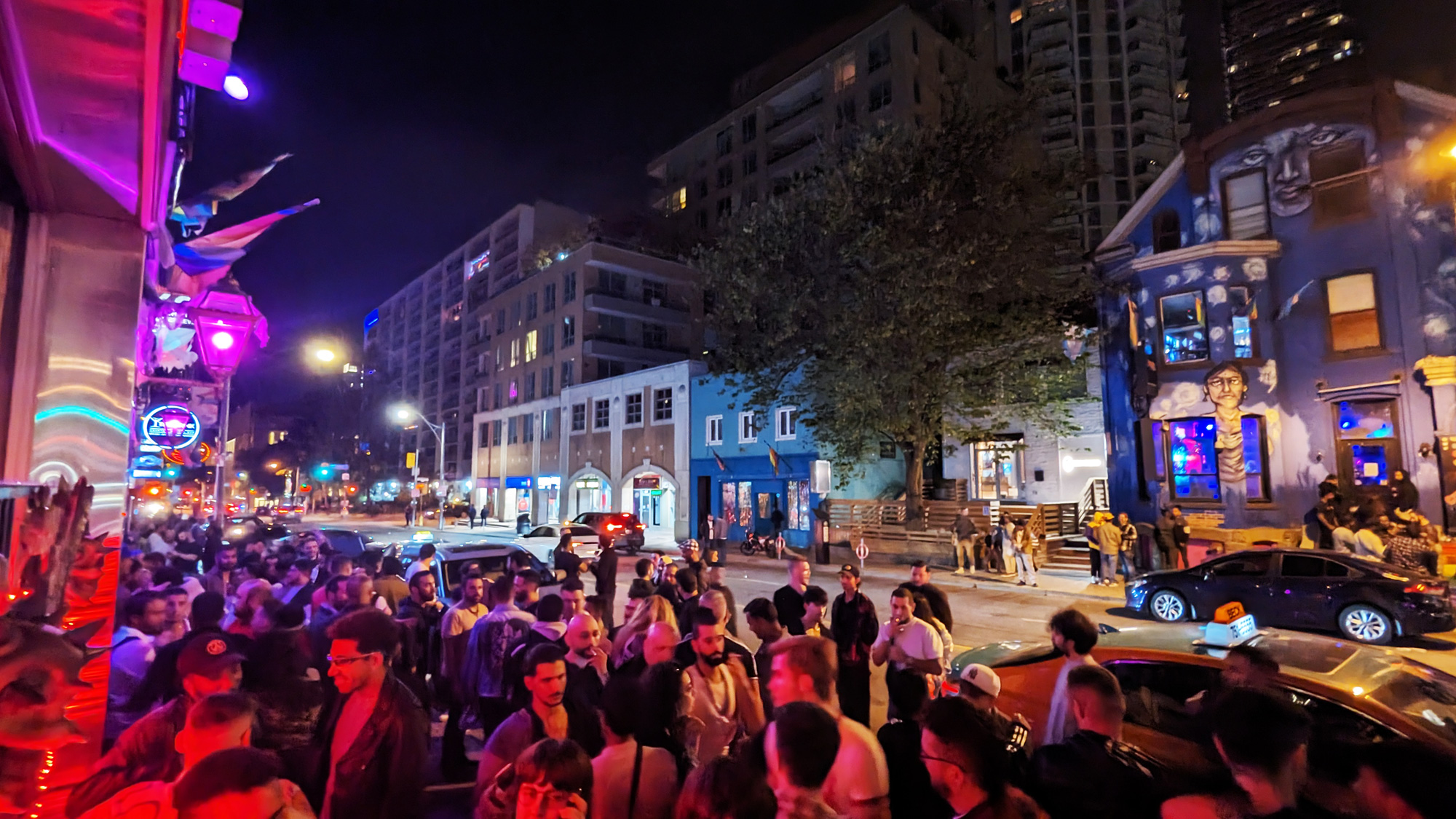
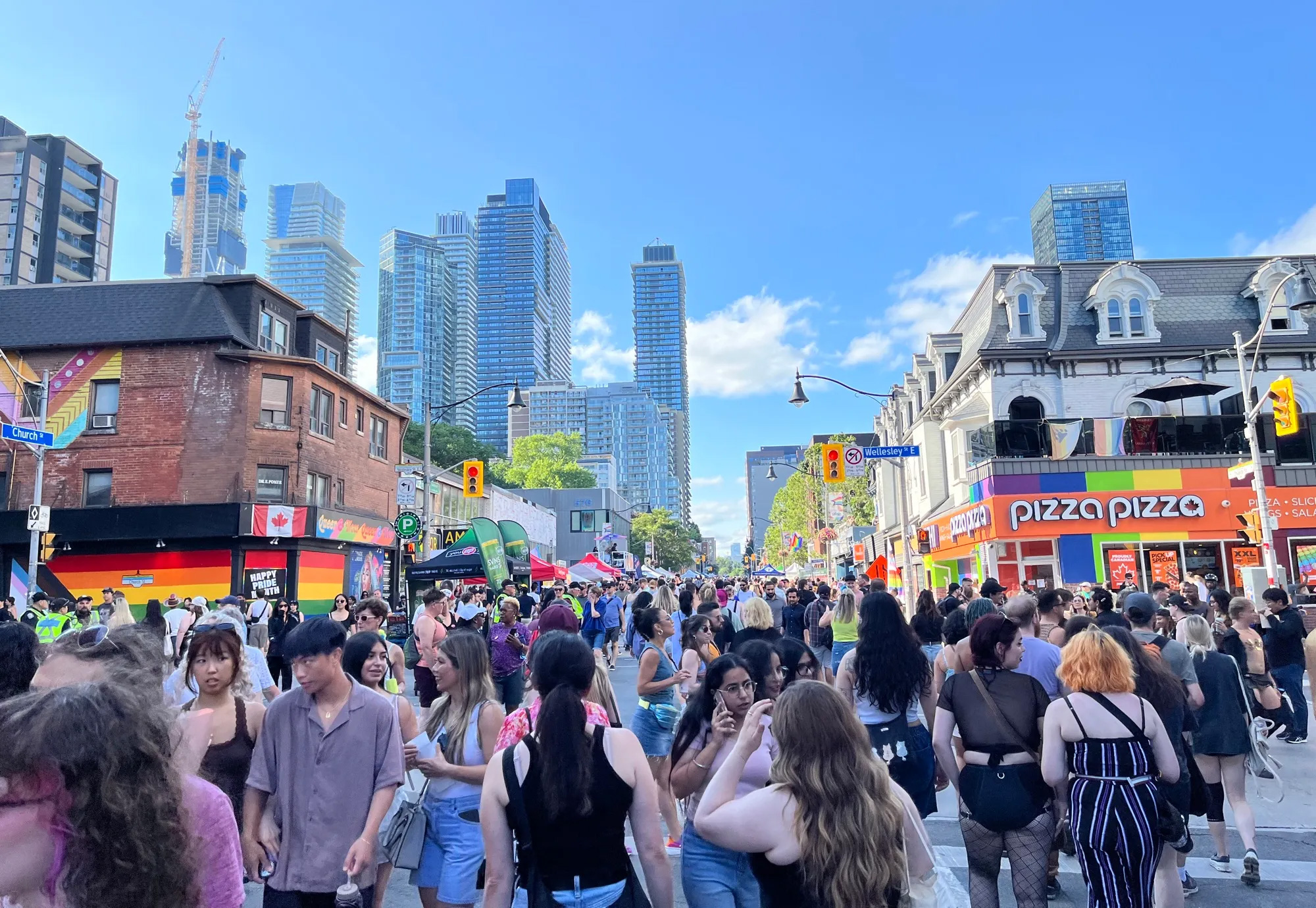
As a regular in the Village, experiencing these crowds over the years got me thinking how things can and should be better. We have glimpses of what it could be like –– the Village is already creating pedestrian-only spaces during Halloween and Pride, drawing even larger crowds. It seems like a no-brainer to do it year long, or at least seasonally.
Pedestrianization Examples
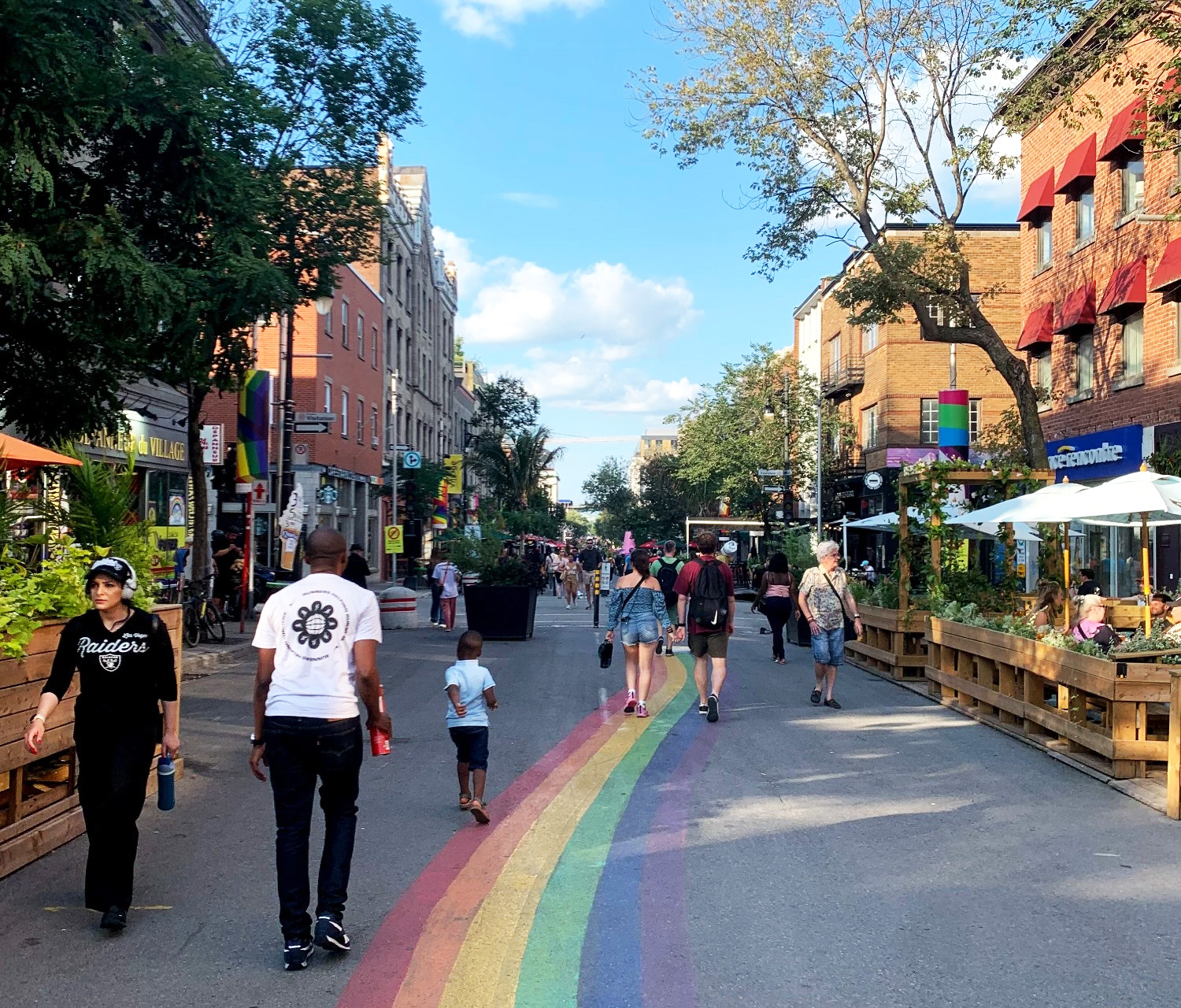
Montreal has many pedestrian streets, both seasonal and permanent. Their Gay Village along Rue Sainte-Catherine already seasonally pedestrianizes every year. It’s been so successful that they’re rebuilding the road to be a year round pedestrian street. Studies have shown that many businesses overestimate the amount of people who come to their business by car versus walking, biking, and transit. Fortunately, some businesses like in the Church Wellesley Village BIA have started to realize that people bring business, not cars. There are also so many other great international examples of pedestrian streets that I can’t list them all, but as a sample: Mexico City, Barcelona, and Tokyo all do a great job in different ways.
The Posting to Policy Pipeline
This inspired me to create a conceptual map of what Toronto’s Church Street could look like pedestrianized from Carlton to Dundonald. This particular section is the heart of the Village, with most of the restaurants, bars, and businesses. I chose Carlton as the southern end because that’s where a busy arterial and the 506 Streetcar runs. I wanted to make it transit accessible, but also to naturally encourage people to walk up Church from Carlton. Originally, I wanted to end the pedestrianization at Wellesley where another transit route (94 bus) and major street is, but I extended it to Dundonald as I felt including Barbara Hall Park and The 519 Community Centre were essential. By recognizing these culturally significant institutions and spaces, we could fully realize the potential of the project.
The area is also well-connected to transit and cycling infrastructure. The entire section is within a 5 minute walk of both Wellesley and College subway stations on Line 1. The area is easy to reach by bike, with bike lanes east-west on Wellesley and Gerrard, while the Bloor and the Yonge protected bike lanes nearby can funnel in people from the rest of the city. There are also an abundance of Bikeshare docks in the area.
I posted this map last year across social media in March of 2025, garnering lots of attention. Most importantly, local councillor Chris Moise took notice when I reposted it many months later in August. He had also been thinking about pedestrianizing Church Street and had visited Montreal, realizing its benefits. His office reached out to me and we have since been working out the details for the last eight months. I’d especially like to thank Francesca Policarpio at Councillor Moise’s office who’s been working tirelessly to make this work. This has included extensive stakeholder consultation with the Church Wellesley BIA, Pride Toronto, the local neighbourhood association, The 519, Buddies in Bad Times Theatre, city staff, transportation services, emergency services, and police.
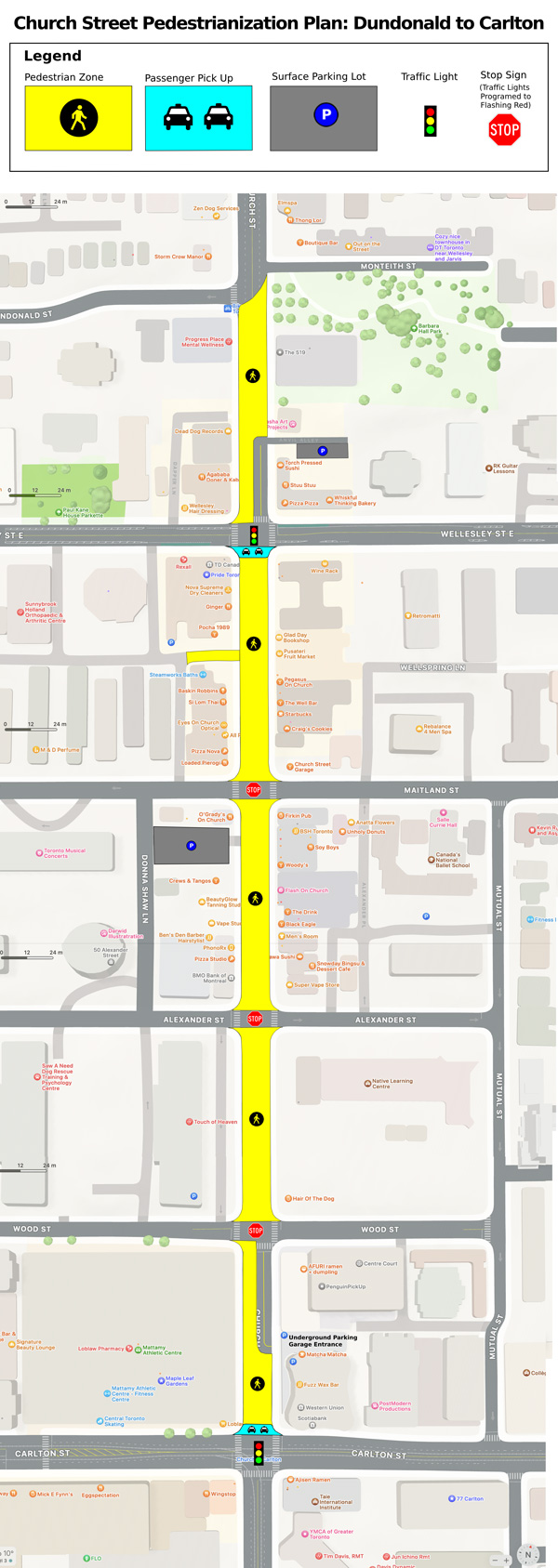
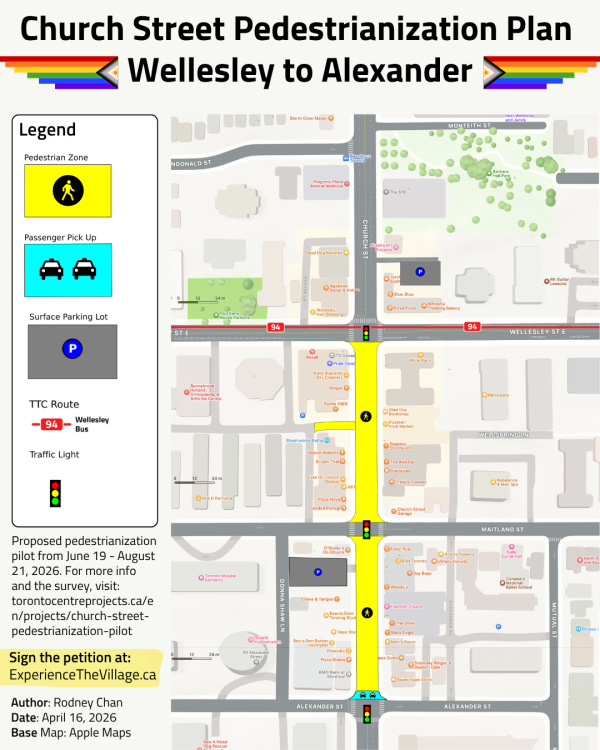
Creating a plan with all these stakeholders meant contending with a long logistical list of permitting, insurance, licenses, waste collection, security, deliveries, traffic management, hostile vehicle mitigation, and other issues before we could even talk about what activating the street could look like. By the end of the scoping process, it looked like we were only able to do Alexander to Dundonald, but I was happy with this being the busiest three of the five blocks I initially proposed. However, we recently had to further cut it down from just Wellesley to Dundonald as there is a development soon to be under construction which required traffic lanes open north of Wellesley. Still, I’m confident of the remaining two blocks –– that’s where the Village contains the most businesses and sidewalk overcrowding. Hopefully, the pilot’s success will mean extending the pedestrianization further in length and time span.
Traffic
Regarding traffic concerns, Church is a minor street. For most of the day, it’s one lane both ways with parking lanes on both sides. There are much better alternatives on parallel streets to the west on Bay St and Yonge St, and to the east on Jarvis St and Sherbourne St. Shutting down two blocks in a city with over 5,600km of streets is not going to break the system. At just 400 metres, the proposed area would be 0.00007% of the city’s streets. Plus, this is one of the most transit, cycling, and walking accessible areas of the city, and yet we still have cross-street access, passenger pick-up areas, and many parking options available, making the street truly accessible to all.
Pedestrianization Policy Context in Toronto
While I listed inspiration elsewhere, Toronto actually has done pedestrianizations before. Gould Street on the Toronto Metropolitan University campus has been extremely successful, starting with a one-year pedestrianization pilot in 2010 leading to permanent pedestrianization in 2012. Originally two to three car lanes, it is now a wide pedestrian promenade for students to walk, sit, eat, study, chat, and linger. It makes walking from class to class easier and safer. The University of Toronto also pedestrianized Willcocks Street in 2010, and while it’s much smaller in length and may need some sprucing up today, it shows Toronto is willing to pedestrianize if institutions like universities are willing to partner to upkeep the space.
Kensington Market has had very popular pedestrian days on the last Sunday of each month from May to October. More recently, Market Street beside St. Lawrence Market has been regularly pedestrianized for the summer and for events like the popular Winter Market, demonstrating the possibilities of pedestrianization in all seasons. There is precedence in Toronto for pedestrianization as long as an entity is willing to commit to taking care of the space. In the case of Church Street, the Church Wellesley Village BIA has been one of the biggest supporters of the project and would take a large role in managing and activating the space. This means upkeep, street art, performances, and other activities.
Alignment with City Policy and Goals
The project also closely aligns with many of the City’s goals. Vision Zero aims to reduce road deaths to zero. This means prioritizing the safety of the most vulnerable first, namely pedestrians. TransformTO aims to get Toronto to net zero greenhouse gas emissions (GHGs) by 2040 and transportation is the city’s second largest source of GHGs, accounting for roughly 36% of emissions. Getting people out of their cars and walking is essential for this to happen. This further matches the city’s Downtown Mobility Strategy that adopted the long-term goal of reaching 75% of trips under 5 kilometers as active trips (walking or cycling) by 2050. This means attracting people to walk by creating safer and more pleasant streets.
Future Opportunities
This pilot provides multiple opportunities into the future. Church Street is being resurfaced in the next two to five years and this pedestrianization pilot will inform the design of it, hopefully recognizing the merits of pedestrian-centered design. This project will also provide the city with a stronger framework for seasonal pedestrianization elsewhere. There is currently a permitting system for few day or weekend street festivals that shut down streets, but no formal system for longer seasonal projects. The Church Street pilot is a crucial step toward how the city will consider these types of transformative street projects in the future, which is why it’s so important to support it now.
How to Support the Project
To support the project, make sure to do the survey and sign the petition. The motion will go to Toronto East York Community Council on April 30th as a member motion, and once it is on the agenda, you can write a letter of support or sign up to speak at the meeting. If passed, it will then move on to City Council for final approval. If you would like to speak, please email me (rodney.chan3@gmail.com) and Francesca (francesca.policarpio@toronto.ca).
If approved, the pilot will run from June 19 to August 21, overlapping with FIFA and Pride, giving the city much needed space to celebrate both events. To be honest, this is still surreal for me –– I never thought this would happen, spurred by a social media post. I’m extremely grateful for all the hard work people have done on this project, and the outpouring of support that has already come from the community. Help me turn this dream and community vision into a reality! Lastly, come say hello to me if you ever see me hanging around in the Village. See you on Church Street!
Rodney Chan is a safe streets and public transit advocate. He is currently finishing his degree in urban planning. Follow him @_chanface on Instagram and X, and chanface.bsky.social on BlueSky.
Top illustration by Jake Tobin. Maps and photos by Rodney Chan
One comment
I appreciate the data-driven approach here regarding traffic. Realizing that Church Street represents such a tiny fraction of the city’s road network puts the ‘congestion’ concerns into perspective. Prioritizing Vision Zero and pedestrian safety in one of the most walkable areas of Toronto is a common-sense move. Let’s make this pilot a permanent reality.