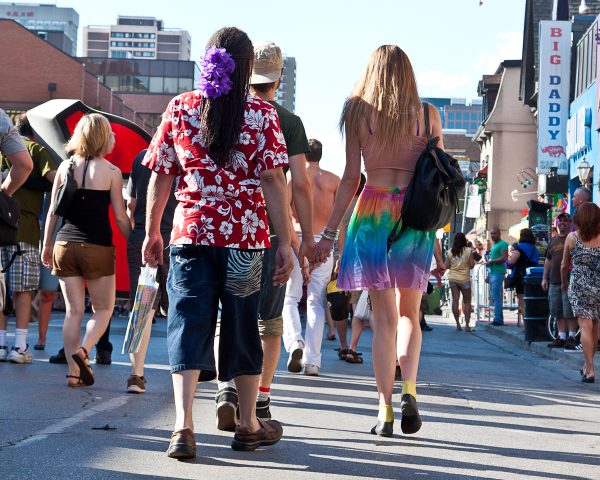

In well under a year, which is like the blink of an eye in City of Toronto time, a plan to pedestrianize that portion of Church Street bisecting The Village went from being the subject of a master’s thesis to an election year pilot project, with scarcely a pothole on its journey to yes.
The prospect of closing Church to cars had the backing of The 519, the local BIA, the local city councillor Chris Moise and about 3,500 signatures, the CBC reported — sufficient for the plan to sail through council earlier this month. Brad Bradford, who is aspiring to hoover-up the city’s no-fun voting block in this fall’s mayoral race, made sure to add an escape clause to the council decision, to the effect that staff could shutter the whole thing if mayhem ensues.
It’s worth parsing the official council decision to acknowledge what was presented to the politicians and the public, and what wasn’t.
Moise’s motion, which had the blessing of the Toronto and East York Community council, runs to 230 words, which is to City staff reports as a post on X is to War and Peace. It is, perhaps most conspicuously, a pilot project — in other words, a politically liminal condition, which happens to be what Toronto council calls policy when it doesn’t actually want to make policy.
During the debate, councillors were also presented with a four-page memo from the Transportation Service’s street permits director, which begins by stating that the civil service didn’t have enough information about the proposal to properly vet it. Scandal!
The memo goes on to note that in the absence of a formal “pedestrianization policy or program,” the closure — from mid-June to late August — will be treated like an “event” for the purposes of processing documents. It then dutifully itemizes all the other blockages in the arteries of downtown Toronto, and has not a single thing to say about garden-variety excuses such as road re-construction on Church, the need to eventually replace sub-surface infrastructure, the coordination of the utilities doing the work, etc., etc., etc.
You don’t need to squint too hard to recognize this decision as (i) locally popular; (ii) politically well-supported; (iii) timely. Did I mention it is an election year?
But, whatever. Spring’s here. Let’s not get hung up on the sausage-making and instead applaud the City of Toronto for joining, however tentatively, the rest of the urban universe. (To date, our only other pedestrianization zones include Kensington Sundays and Market Street.)
At the risk of sounding like an ingrate, I think it’s important to point out that the easily approved Church Street pedestrianization thoroughly puts the lie to the myriad excuses the city has advanced in the past to justify not proceeding with pedestrianization projects elsewhere, or, in the alternative, proceeding with them at a pace that would make a glacier blush.
After all, we’re in the midst of the latest consultation on the lower Yonge Street pedestrianization — Queen to College — which is not actually a full-throated pedestrianization, and is conditioned, mysteriously, to events that will occur at some point in the middle distance, like the opening of the Ontario Line’s Queen Station.
YongeTOmorrow indeed. Forever tomorrow.
Likewise the John Street (Cultural) Corridor, the idea for which can be traced all the way back to Barack Obama’s presidency. A quasi-pedestrianized stretch from King to Grange Park, this scheme continues to go nowhere, trapped as it is in the hamster wheel of construction coordination and endless consultations. The period during which the city has been farting around with the John Street plan has seen a huge amount of new density land in that very area, rendering it ideally suited for (i) not cars; (ii) pedestrians. Suffice it to say, there are lot of cars.
Montreal, as everyone knows, has been the Canadian trailblazer, with a summer pedestrianization strategy that was born during the pandemic and shows no signs of flagging. There, the city puts out calls for proposals and then partners with local business associations; there’s even funding! Two years ago, I asked Barbara Gray, then the head of transportation services, about lessons learned and she replied that just closing a street won’t necessarily produce salutary results. To make such projects works, she implied, the city, local businesses and the surrounding community all need to be singing from the same hymn book.
Yes, all that’s true for Church. But there’s also something conveniently passive about this stance. If the planets don’t align, the works, transportation services and planning departments will leap into the breach with infrastructure projects and consultations extending to the horizon.
What’s more, it provides way too much cover for recalcitrant BIAs. Can anyone think of an area more specifically conducive to pedestrianization than Yorkville? It would be jammed all spring, summer and fall. Lots and lots of money would be spent and made. No thoroughfares would be harmed. Transit could literally not be more convenient. The only noses out of joint would be those guys in the muscle cars who thrum their way up and down Cumberland.
Bloor-Yorkville BIA moved heaven and earth to get the city to pave the sidewalks in black granite. Closing streets to cars, not a word. Dianne Saxe, the local councillor, also not a word.
I guess the point I’d make here is that I’d like to see more local politicians do what Moise did, which is seize on a proposal, get the political pieces to fit together, make an argument to city officials that it’s possible to execute these kinds of seasonal projects without unduly impairing major road-reconstruction work, etc., and then go for it.
Church, in the end, proves council can actually get behind a street closure proposal that won’t cause massive disruptions, but will cause more Torontonians to enjoy their city for more of the year. Something to remember the next time the no-birds start chirping.