
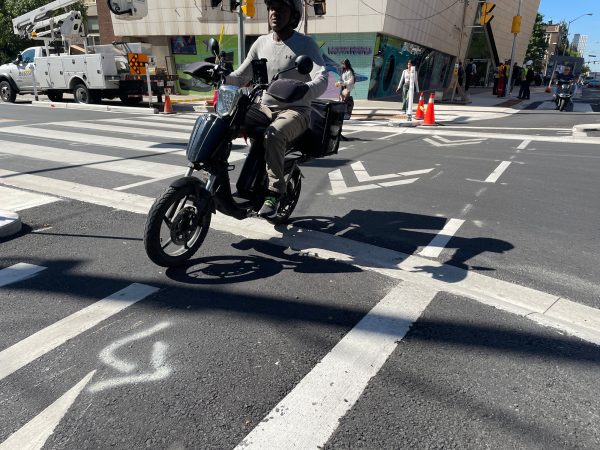
This article is co-authored with Muskan Fatima.
E-bikes are good for our cities. They offer reliable transportation for people of all ages and abilities. They are quiet and energy efficient. They don’t emit harmful air and climate pollutants. And as fuel prices rise, they allow commuters to bypass the anxiety of the gas pump. The Ontario Ministry of Transportation’s proposals to modernize rules governing e-bikes are therefore timely. In fact, the changes would facilitate the continuing expansion of e-bike usage by addressing legitimate concerns about the weight, power, and speed of some e-bikes models.
In theory, the Highway Traffic Act (HTA) distinguishes e-bikes as between those that are more like pedal bicycles and others that are more like “motor vehicles.” The latter require the driver to obtain a licence, insurance, and registration. In practice, however, the lines have become too blurred — and the range of e-bike options too broad — to provide a clear distinction.
Some retailers tout anything with an electric motor and two wheels as an e-bike that’s supposedly exempt from HTA motor vehicle rules. Ambiguity in the law means that enforcement is almost non-existent. The updated rules and definitions provide much-needed clarity.
Under the provincial proposals, moped- and motorcycle-style e-bikes will clearly fall under the motor vehicle category. Other e-bikes that are limited to 32km/h and a motor capacity of 500 watts will fall under a new Class 1 or 2 that remain exempt from motor vehicle requirements. This classification system resembles ones in force in many U.S. and European jurisdictions.
Parents with cargo e-bikes will appreciate that carrying children under age 16 would become legal, provided the e-bike is designed for this purpose.
Ontario’s proposed Class 2 includes e-bikes that can be operated by throttle (or accelerator) alone. The throttle undermines the notion of a bicycle as requiring some physical exertion. This proposal is sometimes rationalized as accommodating individuals with disabilities, but creating a rule grounded in an exception is a questionable proposition. (Admittedly, telling e-bikes apart based on whether they have a throttle is difficult.) How we resolve the issue will depend on whether we prefer consistency with the most common U.S. approach or the European one. The U.S. classification framework allows for a throttle while European jurisdictions often have a baseline requiring some physical input by the rider, with an “assist” from the motor. (Approval can nonetheless be sought for other e-bike types.)
The maximum 120kg weight and 500W motor power for Class 2 e-bikes are curiously high. Consider, for example, that under current rules even cargo e-bikes are limited to 55kg. The public consultation that ends on June 7 will allow for adjustments.
The proposed rules do not cover kick e-scooters. Aside from the fact that these scooters (where the rider stands on a platform) and e-bikes have two wheels, there is little reason to lump them together.
It’s likely that most riders of moped-style e-bikes will switch to Class 1 and 2 e-bikes to avoid the obligation to obtain a licence, registration, and insurance.
The potential impact of the new rules on food couriers, for whom moped-style e-bikes are common, will require careful assessment. A one-year education and awareness phase-in period is a good start. Depending on their quality, many mopeds used heavily for year-round delivery will have relatively short lifespans. In addition, many e-bikes on the road today are already captured by HTA rules for motor vehicles. A recent review by the Ottawa Coroner into five e-bike deaths found that all of the vehicles involved exceeded the prevailing HTA speed capability or weight limits. The rider, however, lacked the required class of licence and associated testing.
In order to enhance the effectiveness of the new rules, the province should grant municipalities the authority to licence food delivery companies. This could ensure that these corporations bear more of the burden now being foisted on the public (and couriers) for e-bikes that are in poor condition, improperly operated, or reliant on uncertified batteries that create fire risks. In terms of e-bikes on the market, government oversight must also impose consequences for misrepresenting e-bikes as Class 1 and 2 on retailers, not consumers.
E-bikes make valuable contributions to the fight against traffic congestion, poor air quality, and climate change. The proposed rules offer a path forward for the ongoing — and welcome — expansion of safe e-bike usage.
Muskan Fatima recently completed a University of Windsor Faculty of Law Externship focused on e-bike law reform. Albert Koehl is an environmental lawyer, author of Wheeling through Toronto, and Executive Director of Community Bikeways.
Photo by Albert Koehl

2 comments
It hardly matters what the rules around e-bikes are so long as there is no one to enforce them or the will to do so. The city has no one to do this and one only has to look at the number of illegal scooters to know that rules are broken with casual impunity. The police couldn’t be bothered and already fail to enforce motor vehicle traffic generally. The province thinks it’s a mistake to regulate speeding motor vehicles on downtown streets; how likely is it to give this enforcement the resources it would require?
We have to be honest with ourselves: we live in a city in which transportation is an unregulated free-for-all: speeding cars; unrestricted scooters; cyclists on the sidewalks; motorcycles in the bicycle lanes. I mistakenly and illegally turned left at an intersection just over two years ago and applied for an early resolution hearing. That is the last I ever heard of it.
It would take more discipline and determination to tame this chaos than exists at any level of law and regulatory enforcement.
I am concerned about the large amount of delivery scooters entering the elevator of 10 Macey Ave, Scarborough, Ontario. During day’s and nights, to charge there scooter’s.
Ps:The mess they bring in is left for the cleaning lady, They ram in and out of these elevators and lobby, leaving diferente kinds of reperairs, not to mention the dirty wheels into the walls, the paint is just a big mess left on the walls.
I am just a concerned tenant , When rent above guideline is charged, All pay equally, if you have a scooter or not, And are they getting restoration for money’s on charging the scooters?
And not to mention we had in this great city many apartment fire’s in apartment dueling’s
We don’t have the five lanes in Toronto, like in some cities in ather countries.I have seen to many people getting rum over by scooters.We have to educate, that even in a city that has no rules in place to deal with such great issues.
I am feeling overwhelmed.
I think these scooter’s should not be permitted in residential family high rise duelings. Not during day’s or night times.
There are places for electric bikes allover this cityand others, someone should have designated places for scooter’s as well.