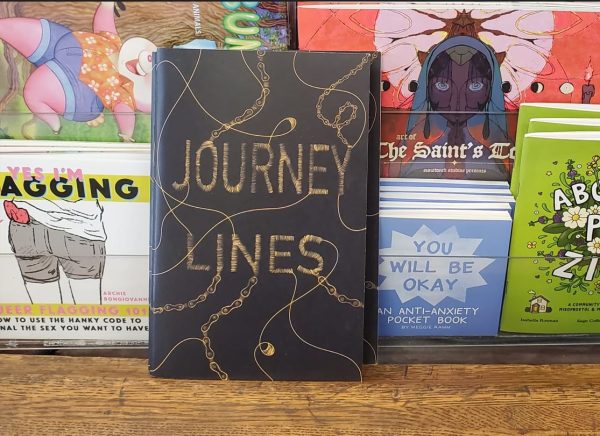
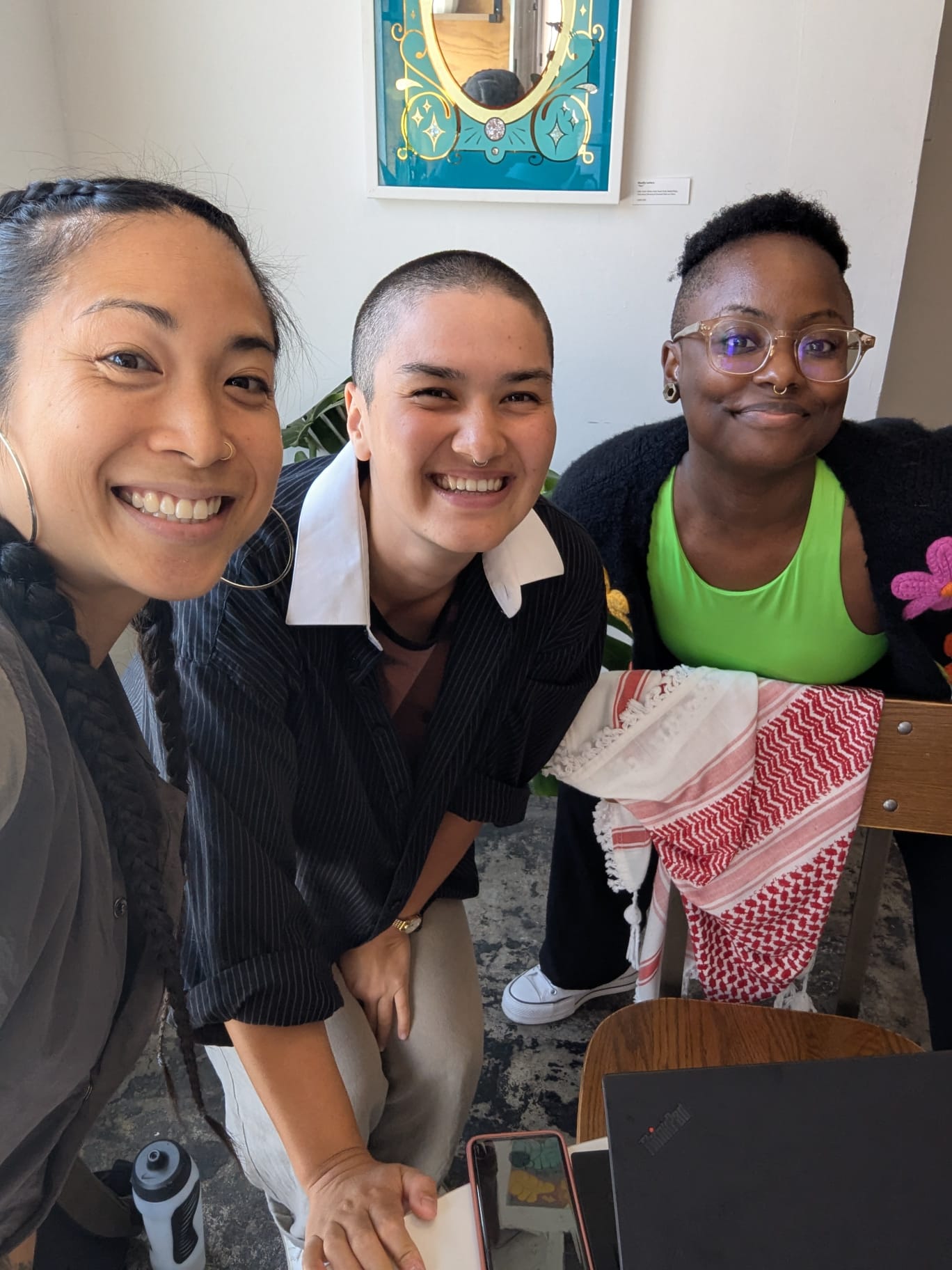
Sabat Ismail (SI) met with Rachel Wang, Sylver Sterling, and Jess Nachman, creators and editors of the Journey Lines zine, to discuss the zine and its launch. The zine explores the art, experiences, and stories of queer trans black people of colour (QTBIPOC) cyclists in their own words.
Rachel Wang (RW) (she/her) is an environmental consultant and founding Executive Director of the Bike Brigade. Her work centres art and culture as pathways for collective resistance and visions of collaborative survival beyond systems of oppression.
Sylver Sterling (SS) (she/her) is an artist and designer with 9 years of experience creating for communities, movements, and people who care. Her work lives at the intersection of design and storytelling, always rooted in emotion, clarity, and intention.
Jess Nachman (JN) (they/them) is a queer, Asian, anti-Zionist Jewish graduate student and mobility justice researcher. Jess organizes with Climate Justice Toronto and Sport Scholars for Justice in Palestine.
SI: Can you introduce Journey Lines and how it came about?
RW: Over a year ago, we submitted the concept for this zine through the LUSH Charity Pot grant and were successful. Initially, it wasn’t specifically a zine, just something artistic. This led to connecting the three of us to envision this project. In short, the three of us came together as friends to envision this project, and it grew from there.
JN: It was something that we were comfortable with pursuing because we had the funds to pay artists to contribute to the zine. For transparency, we paid folks $150 each to do a piece of their choice. Otherwise, it would not have been easy to pursue this project.
Also, during my master’s, Rachel was the director of the Bike Brigade and helped me with my project with the Bike Brigade, which was also arts-based and featured BIPOC cyclists. So, this was a logical next project that my PhD is now also building on.
SS: I came on after the paper that Jess wrote, which is how I knew about the project.
SI: Jess, could you share a little more about what your PhD research explores?
JN: How folks use bikes for social movements, whether it’s for activism or just surviving systems of violence. My projects have focused on BIPOC queer, trans, and femme cyclists. I’m also curious about how we use art to express ourselves and our stories, because I think there’s a history of research on these “vulnerable communities” that is very extractive, using interviews and survey data that don’t show the whole picture.
I’m interested in how research with art can yield more authentic stories or stories that make sense to the folks sharing them, rather than stories that researchers create that are baked in harmful stereotypes, like BIPOC communities being damaged in some way.
SI: What inspired the zine’s title?
RW: We were brainstorming, and considered five different options, and landed on “Journey Lines.” It came from our own collective imagination and experiences, connecting different threads of biking and stories.
JN: I think it initially came from wanting to create a map of the city with stories from the west to the east of Toronto.
SI: Jess and Rachel, prior to this zine, you’ve conducted research on participatory arts-based and decolonial feminist participatory action research. Did that influence the zine?
JN: I would say it did. The idea of doing research with communities, rather than on them, is where participatory research comes from. In Western research practices, certain communities are deliberately silenced and misrepresented, especially folks who are marginalized by gender, race, and class. There is a similar pattern in mainstream cycling spaces and urban planning. So, for Journey Lines, we chose to invite queer, trans, femme BIPOC cyclists to contribute to the project.
SI: In spring 2025, you launched your zine, and the event featured a uniquely interactive format. What led you to organize it the way you did, including thoroughly involving the zine contributors?
RW: We were excited to hear from the zine contributors, like Jess mentioned. We saw ourselves more as facilitators — building the medium for people to share their stories — rather than it being about us. Coupling the zine with an in-person launch event was enlightening to see how people’s stories are told and felt differently across different mediums.
Hosting the launch at the Tranzac was so lovely because it felt like a living room in someone’s home — the vibe was perfect: very warm and welcoming. Food abundant, friends present. The format and flow of the event is very intentional for us.
We also invited a lot of co-creation from the contributors in the planning process, eventually landing on a “fireside” chat. This approach was similar to Jess’s academic work on the participatory aspect of research methodologies, with interviewees as “colleagues” invited to co-create that space with us.
Ultimately, I think so many people came because the contributors/panelists felt ownership of the event; they brought their people. It ended up being a full house (maybe too full!), and wonderful because everyone felt that there was a piece of them in it.
SI: What motivated the multidisciplinary artistic contributions to the zine? Could you describe some of the multimedia contributions?
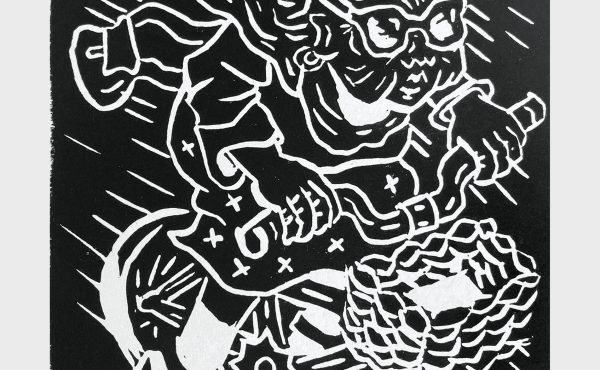
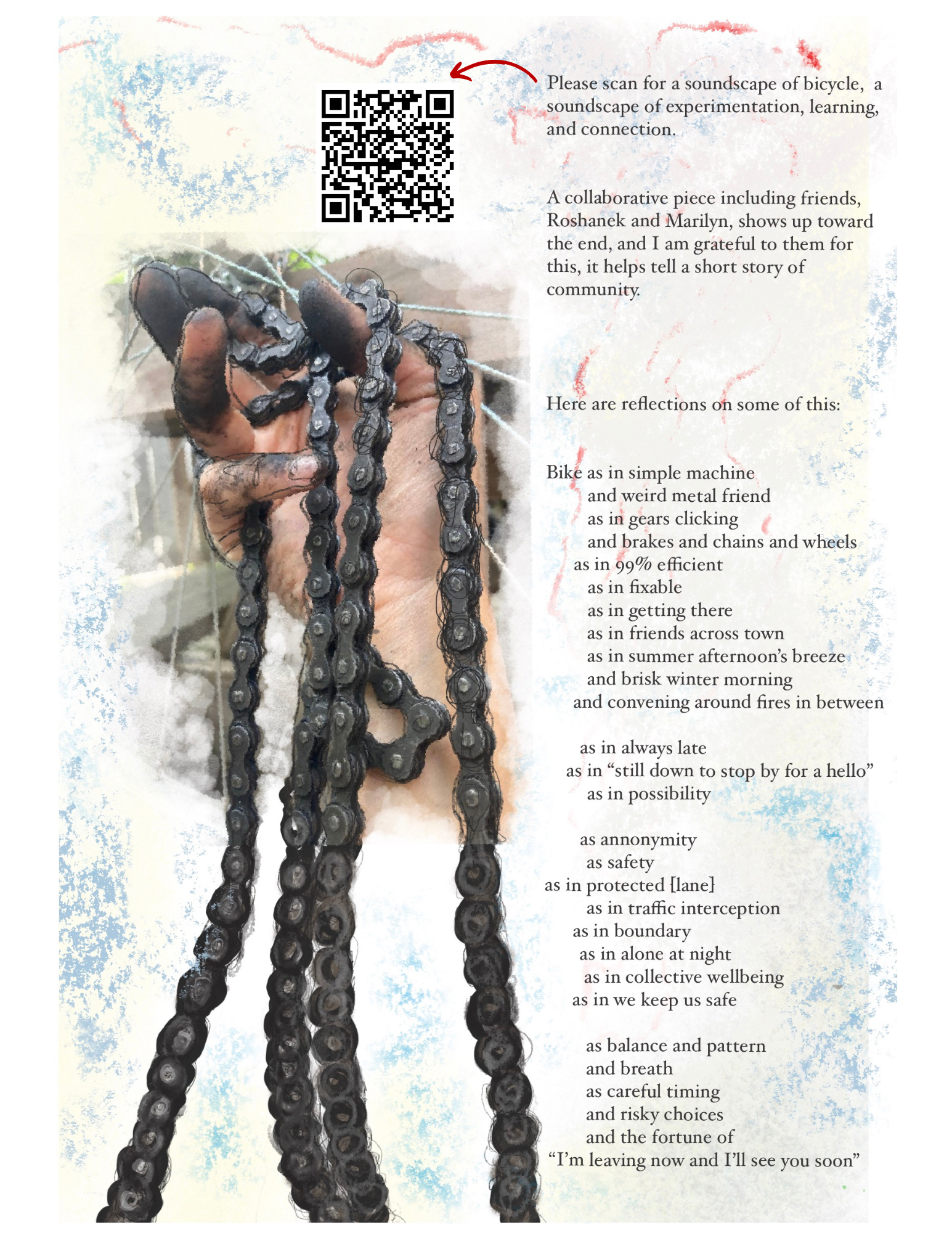
JN: There are written pieces, visual illustrations, linocut, and even sound. Someone made a soundscape and put in a QR code. We just left it open for our contributors to express themselves however they want. And we’ve obviously got such incredible pieces that I wouldn’t have dreamed of asking for. I’m really happy that we left it open. Even the design of the actual theme: Sylver developed the zine’s artistic theme.
SI: Sylver, the zine mentions your interest in amplifying untold stories as an artist. How do you depict the narratives of these cyclists and bring their stories to life?
SS: My practice is usually based on a lot of feelings. So, what I did was read through the participant pieces or just visualize them. Some of the pieces were literal, like Yasmine’s piece as sound & connective tissue, and I played off of and mirrored what their art was, and I just depicted and drew that. But there were pieces like Imagine a Toronto, and I had to consider what it would look like. So, I think about it, feel through it, and draw something that would depict the person’s piece.
RW: I want to highlight how instrumental Sylver was in the creative process — from the colours to the bike chain that moves throughout the zine. Sylver led sessions to discuss what Jess and I had envisioned, which she captured beautifully in visual form. She essentially captured the essence of our conversations into the zine — even down to the topography to create Journey Lines.
SI: Were there some commonalities that arose from the different contributors?
JN: One theme that I’ve been thinking so much about is safety and especially the way that we keep each other safe. It’s actually explicitly said in multiple pieces. The Untitled Piece by MZ explores Abolitionist Pride in opposition to mainstream corporatized Pride parades, bike marshalling, and keeping protesters safe by placing a bike between traffic and protesters.
Yasmine’s piece also includes the line, “We keep ourselves safe.” I know that Yasmine was also thinking about bike marshalling and even just the ways that we ride our bikes to show up for each other. It’s also interesting that there is a piece about a significant experience with violence, about being assaulted on a bike. Also, this person’s child was put in an unsafe position, and cops got involved, and obviously, the cops didn’t keep the artists safe.
What I keep coming back to is that sometimes the narrative on safety and cycling is about road safety and helmets. Safety came up in a way that isn’t talked about in mainstream stories about bicycling in Toronto, likely because of the identities of the artists: queer, trans, and BIPOC communities in Toronto are disproportionately targets of state and police violence and therefore systemic change is needed to ensure our safety.
SS: A theme that I also noticed is taking up space. I’m outside the biking community, and I don’t bike. But I noticed that a lot of the pieces were just about making space for us on the road or even in the streets. I also think that even the zine itself was kind of a space for those people to take up space and have their art shared.
RW: There was a particular contribution where the contributor felt that the police were their first line of safety. This aptly highlighted the important complexity around the relationship different communities have with the police regarding perceptions of safety.
We also invited contributors to share space online with each other. We thought about how we could best navigate and support the conversation around the contribution I mentioned, as there are abundant critiques and politics around the police in our spaces — but there was no need. The contribution I mentioned was shared, and the amount of care and kindness shown towards this person was beautiful. Every single person rallied around them to make sure they knew they were seen, cared for, and safe in this group. I was thrown at this radical kindness.
SI: It’s interesting how frequently the theme of safety emerges and how BIPOC folks grappling with that.
RW: Stories and storytelling is life — that personal element is so important to how we learn and connect with different people. For example, I love the piece that you wrote in 2020. When I read it, I wasn’t part of the cycling community. That piece helped me understand that some people also see what I see about how the cycling community exists, how people move, and how they have different experiences. The zine is a reflection of just bringing more of those stories — even a story makes an impact on one person, that is worth it.
JW: Another theme from the zine was how great it is to be part of this community because there’s so much opportunity for cross-movement solidarity. In contrast, when you exist in the cycling advocacy space, it’s often all about one thing — bike lanes.
Cycling justice can include newcomers and immigrant rights, labour movements, human rights movements, etc. Mainstream stories about cycling don’t quite have those intersections yet.
SI: It makes me think of the Audre Lorde quote: “There’s no single issue, struggle, because we don’t live single lives” and some of cycling anthropologist and researcher Adonia Lugo’s work on race and cycling and where she talks about how sometimes people’s first experiences with some degree of marginalization especially what some have referred to as the middle-aged-man-in-Lycra (M.A.M.L) type is on a bicycle because in other areas of their life they’re often so privileged, which informs their approach to advocacy.
JN: I love Adonia Lugo’s work.
SI: How can the broader cycling community ally with QTBIPOC folks who cycle?
RW: Allyship is really important to me. There have been many instances where I’ve had to rely on a white man to deliver my message because it wouldn’t have been heard coming from me directly.
As documented in Jess’ research, cycling advocacy spaces are primarily white, male, and middle-class. I personally don’t want to enter these spaces, but of course understand the value of this work. Because of this, allyship is crucial — it allows the work to continue even when I’m not in the room. I’m grateful to have a now-good friend that has demonstrated to me that this can work.
JN: I was talking to somebody who did an art piece for the zine. When I showed up for a protest against Ford’s bill to remove bike lanes in Toronto, I looked around and thought, “there are enough people out here who are spending their energy on these protests.” This isn’t immediate for me right now; there are other pressing ways I’d like to organize and put my energy into especially during the genocide on Gaza and our government’s complacency in it.
Based on my PhD project, this seems to be the case for many QTBIPOC who choose to put their energy into organizing around the liberation of Black and Indigenous peoples worldwide. Maybe another way to put it is, when we direct our energy to ensuring the safe movement of communities oppressed by state violence and Western imperialism, this inherently makes it safer for QTBIPOC who disproportionately face intersecting systems of violence.
SI: How can people support the project or get a copy of the zine?
JN: As of now, Another Story Bookshop on Roncesvalles and Queen Books on Queen East are selling copies. There is also a digital version of the zine, and an order form for a print version.
Images courtesy of Journey Lines.