It takes courage to take on a dynasty, but Chloe Brown has courage – and spirit – to burn.
An original thinker, Brown has run for mayor twice, coming in third in 2022. Now, the former director of Solidarity in Numbers Co-op is tackling Etobicoke North (Ward 1), the stronghold of the Ford clan. Currently, the ward’s councillor is Vincent Crisanti, a staunch Ford supporter who has been councillor in that part of the city on and off over 20 years.
Brown, 35, is a former policy analyst at the Future Skills Centre. She is passionate about transforming the complexities of public administration into tangible community benefits. And she espouses a true love for the community in which she grew up. Spacing sat down with the candidate to understand her desire to run in Ward 1.
Spacing: You are running on a platform of affordability. Where would you begin?
Chloe Brown: There’s a lot of underused and vacant lands in North Etobicoke, so adding more people to the tax base is one way to start addressing affordability. How do you do that? Building housing. Right now, one of the largest undeveloped tracts is the Woodbine Casino [north of Woodbine Racetrack]. It’s 684 acres, and there’s a 25-year residential project in the works, as they’ve just completed the secondary plan. They’re supposed to be mid-rises, affordable. It’s supposed to have 20,000 residents.
I’d begin by putting public assets to work for public good—not private profit. My approach is rooted in what’s called Community Wealth Building, and it starts with concrete, local action: Set aside city-owned land and a portion of public contracts for cooperatives and social enterprises that provide living wages to non-executive workers. Rezone aging malls into community hubs that cluster essential services under one roof. Partner with labour unions to build mid-rise housing and co-ops, not just condos. And pilot a shared-services grocery store model to lower food costs and stabilize local supply.
Spacing: What’s happening at Humber College’s north Etobicoke campus?
CB: Seven thousand people were recently laid off!
Humber has been slow to translate its institutional presence into tangible community benefit. It’s a major anchor in Etobicoke North, yet we’re not seeing the kind of workforce pipelines, local hiring commitments, or partnership opportunities that a college of its size should be delivering.
Humber’s layoffs are a crisis and an opportunity. I’d use social procurement to attach community benefit agreements to city contracts—requiring developers on major Etobicoke projects to hire Humber students and faculty, among other ideas.
Spacing: You grew up near Islington and Finch. What was it like then?
CB: I grew up at 2765 Islington—right across from a community centre, beside the Humber River Trail, and strip plazas. I would bike everywhere. My building was a true mix of immigrants and locals. I spent most of my time at Gord and Irene Risk Community Centre, Albion Library and pool, and the Woodbine Fantasy Fair. But what really made it work was affordability and access. The grocery run was Knob Hill Farms at Weston and the 401, Galati’s, and No Frills. Woodbine Mall gave us department stores like The Bay and a place to go for entertainment. Weston Road itself was—and still is—a vibrant main street. As a kid, I had everything I needed.
But when I went downtown, everything changed. Subways, museums, galleries, Electric Circus, big events—it hypnotized me and made me want to live downtown. And that’s the problem. We’ve built a city where all the energy, investment, and opportunity flows downtown, while places like Etobicoke North stay frozen in time.
Spacing: You’ve been outspoken about the current political climate, saying, “I want to drag Doug Ford into the ground.”
CB: Doug Ford got his start in local politics. It’s really important that we take responsibility for the bad actor that we’re allowing to govern the province. If [you] want us to stop Doug, it’s about putting attention back in North Etobicoke. A lot of advocacy groups I’ve worked with in the downtown core seem to not understand that we have the same desires in Ward 1, and we would be willing to work with you if you were willing to come up north of Bloor.
Spacing: So you are saying everything north of Eglinton is forgotten.
CB: It’s treated like a no man’s land. Doug Ford fundamentally understands that as long as he can position himself as a good guy against City Hall neglect, he will always win. If we want to get rid of Doug Ford at the premier level, we have to get residents in the local neighbourhood feeling empowered.
Spacing: You want to fight against Ford’s encroachment on the City of Toronto?
CB: To be honest, this neighbourhood is Conservative – for 30 years. While I am hopeful, I am fighting against one of the largest machines in Ontario politics.
Spacing: Tell us about canvassing in competition with Crisanti.
CB: There’s mixed reactions. Because voter turnout is low, some don’t know his name. Those that are connected to politics or community organizing say he’ll be hard to beat because he’s finally hired enough staff to be responsive. BUT they’re encouraged to see how many young candidates and volunteers there are.
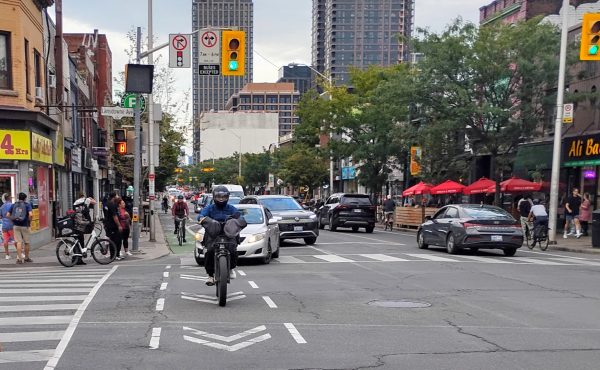
Something I’ve heard from a lot of residents at the door: they feel stigmatized by downtown. Like the conversation around bike lanes. People are cyclists up here too. Where are the cyclist groups coming up to North Etobicoke to make a stand? The loss of bike lanes doesn’t affect downtown Toronto only. The housing crisis doesn’t affect downtown only. Vincent Crisanti, the incumbent, was absent for 332 council votes since the last general election. Crisanti should resign. He has no vision, no plan for poverty reduction, and no strategy to advance prosperity in Etobicoke North –– his voting record makes that clear. He’s been absent for more than one in every five decisions that determine access to funding, programming, training, and operational support for this ward.
His absenteeism mirrors Doug Ford’s approach at Queen’s Park—where the legislature sat just 51 days in 2025. By contrast, even councillors I disagree with politically—like Stephen Holyday—have perfect attendance and show up to fight for their communities. Living in the ward isn’t enough. Proximity without presence, and presence without a plan, delivers nothing for the people who need it most.
Spacing: Ward 1 gained 5,937 voters since 2022, more than Crisanti’s 3,406 winning margin. Did that influence your decision?
CB: No. I’m running because Ward 1 is my home—where I grew up and where I’ve watched neighbours step up time and again in the absence of real political leadership. I’m tired of parties treating this community like a voting bank while ignoring their basic duty to govern with integrity and govern democratically. For me, service isn’t a slogan—it’s how I show up. As I approach 40, I want to look back and know I gave everything I had to lift up the people I care about.
Spacing: What inroads have you made in Etobicoke North that give you a fighting chance?
CB: I’ve already done the work—without holding office. I authored the Community Benefit Agreement for the Woodbine Casino redevelopment with the Toronto Youth Cabinet. As Phase 2 moves forward, my hands-on experience in granting, public tendering, benefit agreements, and workforce development puts me ahead of an incumbent who has been reactive at best.
Beyond that, my policy work with George Brown College and TMU connected me directly to key organizations and initiatives—including the federal Future Skills Centre and provincial programs that recruit and train skilled trades workers. These aren’t just résumé lines; they’re relationships and frameworks I can activate immediately to deliver for Etobicoke North.
Spacing: You’ve said, “If I get elected, I’m going to build bike lanes outside Ford’s office.” Another line: “Asking a politician to set their own term, is like asking a toddler to set their own bedtime.” Opponents could use that against you.
CB: I see myself as candid. I speak plainly about the patterns of behaviour that are eroding public trust in democracy, and I offer straightforward solutions. I’m not interested in fitting into my opponents’ idea of what a politician should sound like, because that status quo is exactly what got us here. I know I’m not perfect, and I own that. But the myth of the flawless, all-knowing leader is part of the problem. My willingness to be imperfect isn’t a liability—it’s what makes me accessible to people who are tired of soundbites and hungry for substance. I’d rather be real than rehearsed. If opponents want to weaponize my honesty, that’s their choice.
Spacing: Do you think there is a change-up fuelling progressive hope? Given the rise of Zorhan Mamdani, I’m curious what you think.
CB: What Mamdani has accomplished in New York is nothing short of remarkable, and it’s a powerful signal that voters are hungry for something different. That said, we have to be careful about drawing direct parallels between New York and Toronto—they operate within very different political ecosystems.
My hope lies in the public itself. More and more, people are getting crystal clear about what they want: genuine democratic governance, an economy that rewards social good over sociopathic greed, and a society that prioritizes caring for community ahead of concentrating capital in the hands of a small number of people, companies, or market sectors. That shift in public consciousness is real, and it’s far more durable than any single election cycle.
Spacing: What is one thing Toronto residents could do to stop being part of this picture you’ve painted and take a step in the right direction?
CB: Step out of your comfort zone. Be a tourist in your own city. I’m always surprised when I tell people I’m running in North Etobicoke, and so they’re shocked that it’s a part of Toronto. Be a tourist in your own city. Give people you don’t know more respect. Being a tourist is a humbling experience because you have to lean on the locals and their local knowledge.
I wish more Torontonians would gain the courage to come up and actually just see what we have out here. There’s delicious food outside of the downtown core. There’s arts programming. There’s everything that you think is exclusive to the downtown core. If you’re willing to give Chloe Brown a chance, give all of the people I grew up around a chance too, because that is the only way anyone can feel potential.
photo by Janice Reid
Sue Grimbly is a freelance editor and writer.