
I spent some time in the past couple of weeks in London and Paris, and there’s an emerging point of contrast between these two alpha-cities that has become impossible to ignore. Similar in size, population and density, both are extremely well served by rapid transit. And like many ancient river cities, they have gnarly street networks.
London’s traffic is still terrible despite years of central area congestion charges and massive investments in transit.
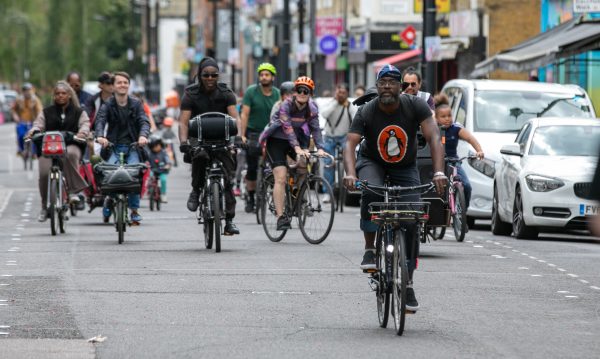
In Paris, except for the tourist zones near Notre Dame and the Louvre, traffic just…flows. There are still lots of cars and trucks, but they move easily, despite the fact that the City has replaced hundreds of kilometres of vehicle lanes with an extensive network of dedicated bike and bus lanes, and swapped out countless street parking spaces for bike parking racks.
Wait. Strike the “despite” in the previous sentence. Paris’ traffic is so uncomplicated because of the City’s enormous recent investment in bike mobility (€250 million for its 2021-2026 cycling plan). Bikes are literally everywhere, both in and out of mixed traffic. Velib, Paris’ bikeshare, competes with private firms in a lively market for rentals. You don’t see any road rage because, well, if you’re in a car, you’re not waiting.
In London, by contrast, there are new-ish dedicated bike lanes, and lots of lines on the asphalt. But the mobility transformation that occurred in Paris since the pandemic didn’t happen in London. Hence, unending snarls, gridlock and anger.
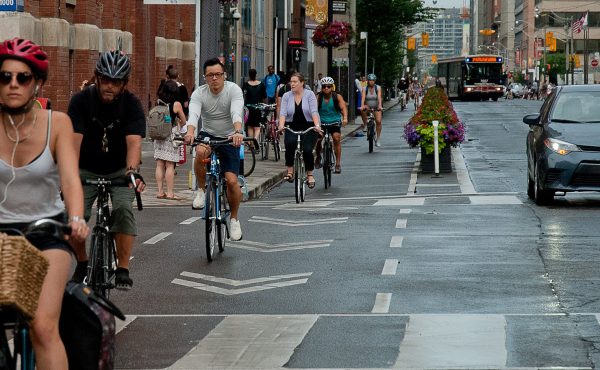
Here in Toronto, of course, we are hurtling back toward the stone age — a regression that formally began yesterday, with the Ford government’s uniquely disqualifying move to begin uprooting the Bloor/University/Yonge bike lane network. (A large demonstration by cyclists prevented construction crews from commencing the work.)
The obvious contrast is infuriating, not least because Toronto taxpayers at some point will pay tens of millions to put back all the cycling infrastructure the province is now removing, at tremendous expense and dislocation, and with no justification whatsoever.
Justice Grant Huscroft, who wrote the Ontario Court of Appeal ruling that shot down CycleTO’s bid to defend bike lanes against Ford’s culture war, articulated the perplexing wrong-headedness in the thinking that informed the campaign. “Common sense,” he wrote, suggests that “increasing the number of lanes available for motor vehicles must, at least to some extent, and for some period of time, be capable of contributing to reducing traffic congestion.”
It doesn’t!
“Common sense” says nothing of the sort. The truth is precisely the opposite, as every urban planner familiar with the phenomena of induced demand has known for decades, and as Paris’ bold move proves (dare I say) beyond a reasonable doubt.
While CycleTO yesterday announced it is seeking leave to appeal to the Supreme Court, the City, for now, has no choice but to move beyond litigation. After all, whoever prevails in this dreary mayoral election will, or should be, thinking about how to manage the near-term mess Ford has wrought. Certainly, the city’s congestion will only get worse, especially now that cyclists will be again competing for space in the demolition derby of mixed traffic.
A consequence I haven’t seen canvassed so far in the campaign has to do with the now cloudy future of Bike Share. In recent years, the number of users has soared to almost eight million rides as of 2025, as cyclists take advantage of the growing number of docks.
Mapping generated from Toronto’s open data portals suggests that almost half the users rely on the lanes now being removed. What happens if those numbers begin to fall, as seems likely? Does the next mayor roll back Bike Share to reflect declining demand, turn to council for more funding, or, search out other business models?
In fact, the City recently released an RFP looking for “industry insights regarding potential future operating models, service delivery approaches, technologies, performance measures, commercial structures, and risk allocation considerations for Bike Share Toronto.”
Also: what happens with future planning for cycling infrastructure? We know the Tories gave themselves a veto when it comes to proposed new bike lanes, so it’s safe to assume that City staff will tread ever so gingerly, knowing they’ll get little by way of political cover from a council that’s disinclined to take on Queen’s Park publicly.
My argument is that the City, for the duration of this nightmare, needs to turn its attention away from supply side policies (infrastructure) and focus more on demand-side moves. Meaning, look for every opportunity to make Bike Share more financially attractive to users, e.g., by bundling Bike Share and transit passes, and even potentially opening up the market to private firms, such as Lime. Yet the City also needs to significantly step up the replacement of arterial on-street parking spots with permanent bike racks and accelerate the deployment of more docking infrastructure.
As for the provisional cyclepaths not on Ford’s hit list, the next mayor must accelerate the transformation of these lanes into permanent ones instead of retaining the concrete-curb-and- bollard versions that only exist here, telegraphing their impermanence to culture warriors.
Finally, this fiasco — which has revealed to the world just how backwards we’ve become — marks, in my view, a moment of reckoning for on-street arterial parking. For way too long, the City and members of council have been in the thrall of business improvement areas that are hardly the progressive urban actors they once appeared to be. (A case in point: the Queensway BIA that lobbied Tory MPPs and the premier for the anti-bike lane legislation.)
Metered street parking is, without peer, the least productive use of road allowance. Yet the City and council are terrified of replacing these luxuries, or at least most of them, with amenities that contribute constructively to the urban economy.
Especially along the Yonge/Bloor/Danforth corridors with abundant Green P lots created by the cut-and-cover subway, there’s no reason busy arterials should have on-street parking in this day and age. It’s long past time for council to devise a strategy to phase them out as a means of preparing for the day when a more progressive government arrives at Queen’s Park.
Point is, the removal of the bike lanes is a disaster, but the crisis won’t last forever. In the interim, the City and council must figure out how to defend what remains while doing everything in its power to boost demand. Supply will return once the political insanity passes.