Cassandra Alves, Sarah Luca, Wesley Reibeling, and Celia Beketa are members of the Jane’s Walk steering committee.
There exists a paradox in city life. Toronto’s population has been increasing, bringing rapid development, rising density, and more people than ever before. But — do more people lead to more connections?
In its 2023 Vital Signs report, The Power of Us, the Toronto Foundation identified loneliness and social disconnection as among the city’s most urgent challenges, calling it a “quiet epidemic.” “Toronto the Good is Toronto the Lonely” reveals that 37% of residents — roughly 925,000 people — feel lonely at least three or four days a week. These numbers give voice to a fundamental vulnerability felt across our communities: we are facing a crisis of connection.
This is not unique to Toronto – it’s a global phenomenon. In 2025, the Copenhagen-based urban innovation hub BLOXHUB explored this issue in The Paradox of Proximity. Drawing on case studies and interviews from cities around the world, including Toronto, the report shows that across many cities, even though we’re living closer to each other, we are feeling more isolated. Similarly, the World Health Organization’s 2025 Commission on Social Connection estimates that roughly one in six people worldwide — about 16% of the population — experience loneliness, and that this contributes to more than 871,000 deaths annually.
But if these numbers paint a sobering picture, Jane Jacobs shows us a hopeful path forward. In The Death and Life of Great American Cities, Jacobs describes city life as the “ballet of the sidewalk,” a constantly evolving choreography of everyday encounters where cities become living, breathing ecosystems that influence, and are influenced by, those living in them. Democracy happens on the streets and the sidewalks, shaped by the experiences of diverse communities sharing spaces.
After Jane Jacobs’ passing in Toronto in 2006, her friends and family created the Jane’s Walk festival to honour her legacy. Now in its 19th year, Jane’s Walk, taking place annually on the first weekend of May, has grown into a global movement, with thousands of volunteer-led walking conversations having been hosted in over 500 cities, across more than 46 countries and six continents.
The ethos of Jane’s Walk is simple — people gathering to walk and talk about their neighbourhoods. No podiums, no gatekeepers, no required expertise. Anyone can lead a walk. At a time when it feels like public discourse is increasingly polarized and mediated through screens, Jane’s Walk offers a different way to engage, one rooted in empathy and lived experience. The festival asks us to slow down and pay attention to each other.
This year’s Jane’s Walk festival theme, “Our Streets, Our Stories,” arrives at a moment when many are searching for a way back to belonging. It is an invitation to reclaim public space by sharing, questioning, and seeing the city through the perspectives of those who live and shape it.
In cities like Toronto, where rapid growth and development can sometimes outpace community connection, these collective experiences are essential. They remind us that a neighbourhood is not just a collection of buildings, it is a network of interconnected relationships where democracy goes beyond ballot boxes and catchy slogans. It is an ongoing practice: sharing space, listening together, and negotiating the differences that make us unique. By walking together and exchanging stories of history, struggle, joy, and change, we build empathy and open up new perspectives.
Walking itself is significant — it is accessible, informal, and open-ended. Conversations emerge naturally and people can join or leave at any time. Jane’s Walk is not a solution to urban loneliness or civic disengagement, but it is a start. It suggests that connection is possible and that even our smallest stories have value.
But what about beyond the festival weekend? What would it take to make our public spaces — parks, sidewalks, and streets — places where we do not just cross paths with, but actually engage with people different than us? How might intentional investment change not just how a city looks, but how it feels? How do we build cities where we feel like we belong? What are we willing to do to get there?
With an election approaching, investing in communities is crucial. We see glimmers of this in projects like PlazaPOPS and Toronto Greeters where streets become spaces of dialogue, not just a way to get from one place to another. If cities are where democracy lives, then shaping them is a fundamental civic act. Choosing to walk, listen, and share stories becomes a way of rebuilding connection — and that may be the most important infrastructure of all.
Jane’s Walk 2026 takes place May 1st to May 3rd. Explore a diversity of volunteer-led walks featuring passionate local storytellers, community partners, non-profit organizations, grassroots and resident groups, the City of Toronto, and residents who generously share their stories to celebrate our neighbourhoods. Visit our website for our updated list of walks: janeswalkfestivalto.com/walks
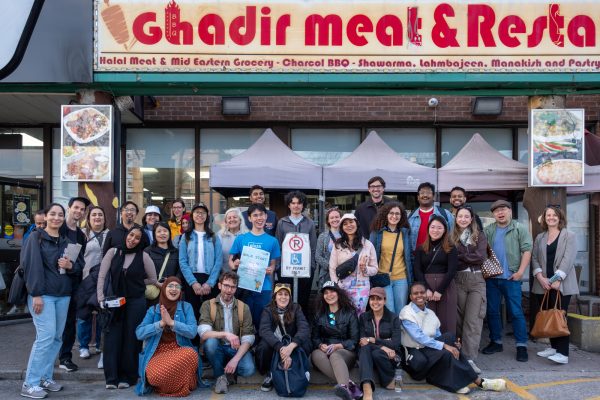
Photo by Tooba Tariq