This spring, at Bloomberg CityLab in Madrid, social prescribing reached the agenda of the world’s largest cities summit for the first time. It was a breakout session rather than a main-stage event, but it was a meaningful one: I was there, in front of a room of mayors and city builders, making the case that connecting people to culture and community is a serious, data-backed tool against loneliness, polarization, and chronic disease. For a practice still proving itself to mayors and budgets, a place on that agenda is a signal that this is becoming mainstream municipal business.
Social prescribing connects people to non-medical sources of health and wellbeing: nature, arts, movement, community, each other. It is having a bit of a global breakout moment. And what I have learned watching social prescribing find its way to the global stage over the past few years is that a social prescription, to truly build wellbeing and belonging, needs two parts that cities consistently get half-right. It needs a place to stay, which urbanists know well. It also needs an invitation, and that part gets far less attention.
I learned this first at home, underneath an expressway. The Bentway, the civic space built beneath the Gardiner, is Toronto’s own piece of reclaimed infrastructure: a place to stay in the shadow of a place for just passing through. My work there with research partners asked a simple question: does a well-designed public space produce connection? We found that the space matters, but also that the space alone is not enough. People felt belonging and wellbeing only when they were explicitly invited in by a named program, a direct message, or a person, and only when there was somewhere to actually sit and stay once they arrived. That is one reason it stung so much when the City proposed to charge for access to The Bentway during this summer’s FIFA fan festival: it felt like a carefully built invitation being revoked from anyone who couldn’t pay.
I carried that two-part lesson into two other cities this spring.
In New York, where I have been living this year as Canada’s Harkness Fellow, I mentored a group of High Line Fellows: high-school-aged young people who are paid to spend one afternoon every week engaging with public space and civic life. The High Line is another reclaimed space for passing through, now turned into an elevated garden park. But the fellows told me that many of their own families, including families living in the High Line’s neighbourhoods, do not feel the park is really for them. The fellows named what had changed that for themselves, and what made the park their medicine: someone offered them time, gave them mentorship, and paid a meaningful wage for their labour. They had been invited in, and the invitation came with resources.
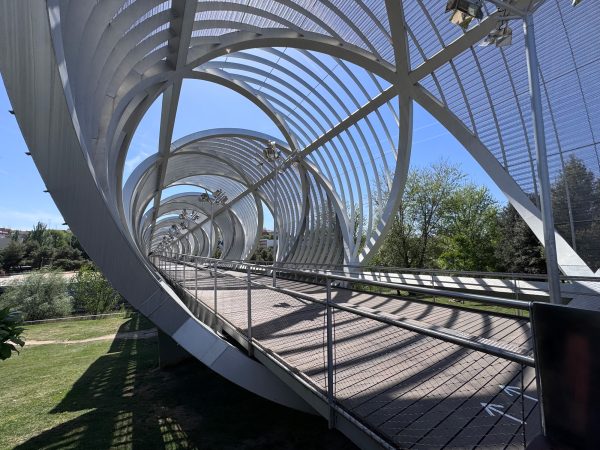
And in Madrid, beyond the conference hall, I walked the Madrid Río, another place to stay reclaimed from a place for passing through. For decades a ring-road expressway ran along the Manzanares River, walling off the waterway much as the Don Valley Parkway (DVP) walls off the Don. Then Madrid made a big decision: to bury the motorway and reclaim the river and its banks. It took years, an enormous public budget, and a sustained municipal will, and today it is a thriving public park programmed for staying, with cultural activities, markets, and a water-feature “beach” that gives land-locked citizens a hot-summer place to stay.
Back in Toronto, the need for meaningful, equitable invitation into public spaces has been reinforced by ongoing work led by my colleague Dr. Nadha Hassen with Park People. Not everyone feels welcome in our parks and public spaces, even when they are designed to be welcoming. What makes the difference is programming and a genuine invitation, designed by and for the people who use these spaces.
Global cities are getting better at the architecture: at burying the road, opening the river, making a room beneath a highway. We are less practised at the art and science of invitation: paying people for their presence, giving them time and mentorship, sending the message that this place has a seat with their name on it. We still tend to see city-building and health as if they were entirely separate activities: urbanists reclaim the space, and the health system treats the loneliness and the chronic disease that the space could have helped prevent.
Social prescribing is one of the few practices that really brings the two together. It is an invitation, a way of walking a person across a threshold they would not otherwise cross — by a link worker, a peer, a paid young fellow who knows the neighbourhood — so they find, on the other side, somewhere to stay. This is the kind of work that turns a city of neighbourhoods into a city of active neighbouring.
Imagine if every major public project in Toronto arrived with an invitation budget attached: money for the link workers, the youth fellows, the programming and outreach that turn a built place into a space of belonging and care. We already know how to do this: The Bentway is the proof, and so are those already doing social prescribing across the city, from hospitals to community health centres. What we need is to treat the invitation as core infrastructure rather than a nice addition once the ribbon is cut.
The forces that frighten us right now can feel enormous and untouchable: climate, geopolitics, even our national government’s retreat from social infrastructure in favour of the physical kind. But cities still belong to us, at a scale where something we can shape still feels within reach. So here is what I told that room in Madrid: with leadership from city hall and genuine responsiveness to everyday people – the kind the FIFA fan fest episode this spring tested – Toronto can teach the world not just how to reclaim a space, but how to invite people to stay.
Photo by Kate Mulligan