
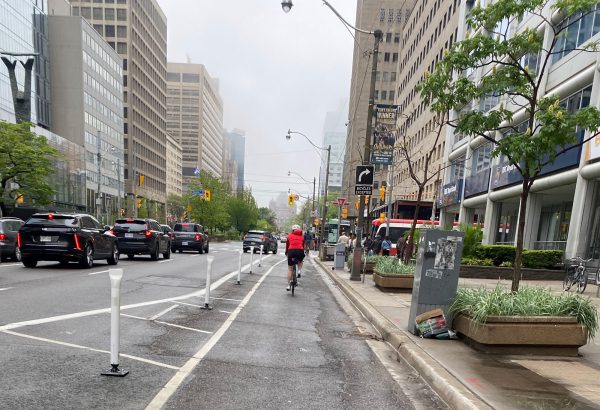
Over the past year, I have written multiple times about how misinformation and selective framing continue shaping Toronto’s transportation debates. In previous Spacing op-eds including Pedaling Inaccuracies and Stop Framing Bike Infrastructure as the Problem, I examined how emotionally charged narratives around cycling infrastructure are often amplified without the broader context needed to understand what is actually happening on our streets.
ABC Toronto describes itself as “a not-for-profit organization of concerned citizens who believe Toronto must become a highly livable city that is the envy of the world” The organization says it advocates for solutions around congestion, affordability, competitiveness, and community safety.
In a recent video criticizing the University Avenue cycle tracks, ABC Toronto frames the corridor as “the most important hospital corridor in Toronto” and questions why bike lanes were installed there at all. The video strongly implies that cycling infrastructure is interfering with emergency response and asks why the City would conduct a “traffic experiment” near major hospitals.
It is an emotionally effective argument. Ambulances. Hospitals. Loved ones in crisis. Every second counts.
But emotional framing is not the same thing as evidence. Because once you move beyond the rhetoric and examine the history of the corridor, the transportation design itself, and the publicly available data around emergency response times, the argument begins to fall apart.
Let’s walk through the claims one by one.
“This isn’t just any regular street. This is the most important hospital corridor in Toronto.”
That part is true.
University Avenue is one of Toronto’s most significant healthcare corridors, home to multiple major healthcare, education and innovation centres, including Mount Sinai Hospital, SickKids | The Hospital for Sick Children, MaRS Discovery District, and University Health Network’s Princess Margaret Cancer Centre, Toronto General Hospital and Toronto Rehab – University Centre
But that context is also precisely why the corridor was redesigned during the pandemic to support more than just private vehicle movement.
In 2020, temporary cycle tracks were installed along University Avenue and Queen’s Park Crescent as part of ActiveTO to improve multi-modal access for essential workers travelling to hospitals and workplaces along the corridor. According to the City of Toronto, the route was specifically intended to provide “multi-modal capacity along the Line 1 subway and as a connection for essential workers to the four hospitals along the corridor.”
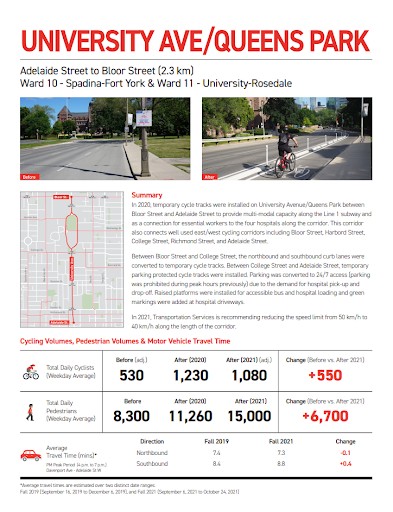
The corridor also connects major east-west cycling routes including Bloor, Harbord, College, Richmond, and Adelaide, making it one of the most important north-south links in the downtown cycling network.
Framing the street exclusively as a corridor for cars and ambulances leaves out how thousands of healthcare workers, patients and students actually access the area every day.
“What did the city do? They put bike lanes on it.”
This framing suggests the lanes were introduced recklessly or without planning.
That isn’t what happened.
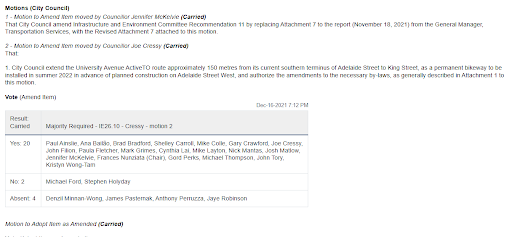
The University Avenue cycle tracks were introduced during COVID-19 under ActiveTO and later made permanent by City Council in December 2021 following staff review, consultation, and infrastructure upgrades. (IE26.10 – Cycling Network Plan – 2021 Cycling Infrastructure Installation – Fourth Quarter Update and the Future of the 2020 ActiveTO Cycling Network Projects)
The redesign maintained multiple vehicle lanes in each direction, preserved hospital loading access, introduced accessible boarding platforms, added green safety markings at hospital driveways, and converted some parking areas to 24/7 access specifically to support hospital pick-up and drop-off activity. (ActiveTO – Corridor 3: University Avenue/Queens Park – Avenue Road to Adelaide Street (2.3km))
The route was also identified as a priority major city-wide cycling corridor in Toronto’s Cycling Network Plan.
This was not simply “putting bike lanes on a hospital street.” It was a broader redesign of a major corridor intended to support multiple forms of movement safely and efficiently.
“When your loved one is in an ambulance you want every second to count.”
Of course every second matters during a medical emergency. But serious public policy cannot rely on emotional implication alone.
The argument being made here is not merely that traffic exists. It is implying that cycling infrastructure is contributing to delayed emergency care.
That is a claim that requires evidence. And the available evidence points elsewhere.
In June 2024, Toronto’s Auditor General released a report titled Toronto Paramedic Services – Rising Response Times Caused by Staffing Challenges and Pressures in the Healthcare System. The report identified hospital off-load delays, staffing shortages, increasing call volumes, and healthcare system pressures as the primary causes of worsening ambulance response times.
A 2025 City report, Toronto Paramedic Services: Multi-Year Staffing Plan, similarly found that paramedic wait times to transfer patients into emergency departments had increased by 11 per cent since 2019, while periods of “low ambulance availability” had increased by roughly 300 per cent compared to pre-pandemic conditions.
These are systemic healthcare pressures. Not bike lane pressures.
To date, no public evidence has been presented showing that the University Avenue cycle tracks are causing ambulance delays or worsening patient outcomes.
“With response times on the rise, the city needs to do a review, talk to paramedics and put patients first.”
The implication throughout the video is that bike lanes are interfering with emergency response operations. But public evidence supporting that claim has not been presented.
In reporting for CBC News, reporter Rochelle Raveendran examined similar claims made by Premier Doug Ford regarding Toronto bike lanes and emergency vehicle access. One of Ford’s claims stated:
“Talk to our first responders that are pulling their hair out, the fire trucks that can’t get across the road because there’s barriers or there’s bike lanes and they’re backed up. Talk to our police that are trying to get to a call or our paramedics. It’s an absolute disaster, it’s a nightmare.”
But according to the City of Toronto, emergency services themselves had not raised those concerns.
As reported by Raveendran, the City stated in an email to CBC Toronto:
“Emergency services are accustomed to manoeuvring through a variety of road conditions throughout the city on a daily basis and will continue to take the route that provides the fastest response based on the specific conditions at the time of dispatch.”
Raveendran also examined Ford’s specific comments about University Avenue:
“You go down on Hospital Row, University Avenue, paramedics are trying to get someone to the hospital as quickly as possible. They take out a lane of traffic, put bike lanes in there, it’s cut down to one, it’s jammed like crazy.”
Again, the City pushed back directly. According to CBC Toronto, City staff stated that emergency services had not raised issues regarding traffic conditions on University Avenue caused by the bike lanes.
The conversation changes when frustration about congestion becomes an accusation that cycling infrastructure is interfering with emergency medical care. If that claim is going to shape transportation policy, it should be supported by operational evidence from emergency services themselves, not just political rhetoric or emotionally charged assumptions.
“When alternatives like Bay and McCaul exist, there’s no reason to run a traffic experiment here.”
This misunderstands how transportation networks function.
University Avenue is currently the only protected and accessible north-south cycling corridor west of Yonge Street connecting Bloor to Richmond and Adelaide.The route was intentionally designed to connect major east-west corridors including Bloor, Harbord, College, Richmond, and Adelaide while also serving the hospitals, Queen’s Park, the University of Toronto, and downtown employment districts. According to the City of Toronto, the corridor was identified as a priority Major City-Wide Cycling Corridor within the Cycling Network Plan.
Bay Street and McCaul Street are not equivalent substitutes.
Neither corridor offers the same level of protection, accessibility, continuity, or direct hospital access as University Avenue. Cycling infrastructure functions as a network, not as isolated fragments. Telling riders, including healthcare workers, students, patients, and commuters, to simply “use another street” ignores how people actually move through dense urban environments.
The Province’s own evidence during the recent Bill 212 court challenge further complicated the idea that cyclists can simply be diverted onto nearby secondary streets. In Cycle Toronto et al. v. Attorney General of Ontario, Justice Paul Schabas noted there was “uncontradicted evidence that there are very limited alternatives to the target bike lanes,” directly challenging one of the central assumptions behind bike lane removal arguments.
The ruling also referenced provincial briefing materials acknowledging that removing bike lanes “may not have the desired goal of reducing congestion.” Justice Schabas further noted evidence showing that restoring lanes for cars would likely increase safety risks for cyclists while failing to meaningfully improve long-term traffic conditions..
Those findings cut directly against a recurring narrative in Toronto’s transportation debates: that removing cycling infrastructure automatically improves mobility for everyone else.
The evidence increasingly suggests the opposite. Congestion in Toronto is primarily driven by the overwhelming number of private vehicles competing for limited street space, while safe and connected cycling infrastructure gives people additional ways to move through the city without adding another car to already congested roads.
And on a corridor as important as University Avenue, that multimodal flexibility was not an afterthought. It was part of the original design rationale from the beginning.
“There’s no reason…”
There was a reason.
The corridor was redesigned during a global pandemic to support essential workers, improve multimodal access to hospitals, close major gaps in the cycling network, and create safer conditions along one of Toronto’s busiest downtown routes.
Toronto City Council reviewed the project and voted to make it permanent in 2021.
Notably, Councillor Brad Bradford voted in favour of extending the route south to King Street.
That does not mean the project should be beyond criticism. No infrastructure project should be.
But if bike lanes are now being framed as threats to emergency care, the public deserves evidence supporting that claim.
Right now, the available evidence points somewhere else entirely.
Toronto’s worsening ambulance response times are overwhelmingly linked to healthcare system pressures, hospital off-load delays, staffing shortages, and broader congestion across the city.
Reducing that conversation to “bike lanes versus ambulances” may produce compelling political messaging, but it does little to address the actual causes of the problem.
And if we genuinely care about getting patients to hospitals faster, those are probably the problems worth focusing on first.
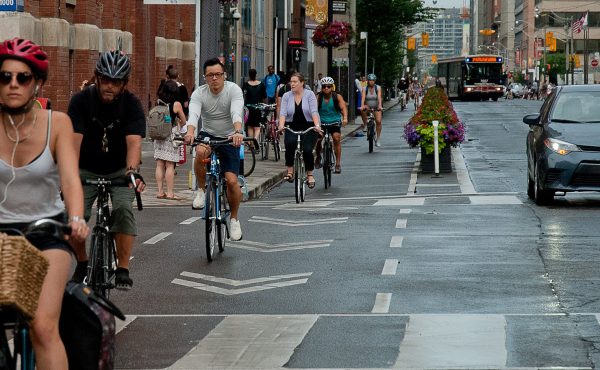
Photo by Lanrick Bennett

3 comments
I’d add that McCaul is not at all a good cycling street due to the very narrow space between the parked cars and the streetcar tracks. You have a choice between getting doored and being brought down by the tracks.
Thinking car parking should be removed from University Avenue. Parking poses a greater risk to all that use the avenue.
Great piece. I would add that the hospitals have supported the University Ave bike lanes. See for example the May 2020 letter from the President & CEO of Sinai Health in support of protected bike lanes on Hospital Row (University Ave), and citing a 2017 staff survey in which 63% of Sinai Health staff said they cycled to work and 80% said they would like to see protected bike lanes: https://www.toronto.ca/legdocs/mmis/2020/cc/comm/communicationfile-102809.pdf