
This is the continuation of Jet Dreams on Toronto Island (Part 1).
The chief obstacle to expanding Billy Bishop Toronto City Airport is geography – the tiny size of the airport and its location on an island unconnected by a fixed link to the mainland. If there were ever a collision between two jets, the ferry lacks the capacity to get enough first-responders and their vehicles to Toronto Island to rapidly evacuate the injured to trauma hospitals. Ice-buildup has in the past shut down the ferry. Yes, there is a pedestrian tunnel, but you can’t drive a fire truck or ambulance through it.
Billy Bishop occupies 85 hectares (210 acres), just a third the area of Midway Airport in Chicago, which Doug Ford uses as his comparison for promoting jets. The premier neglects to mention that Midway is 14 km inland from Lake Michigan. The more apt comparison is Meigs Field, Chicago’s former airport on Lake Michigan, which Chicago Mayor Richard M. Daley bulldozed in 2003, converting the land to a waterfront park.
The 2015 Oliver Wyman study commissioned for Air Canada concluded that there is not enough space between the current air terminal and the runway at Billy Bishop to dock jets. Consequently, the new runway would have to be located further south and new hangars and infrastructure would have to be located at the southern end of the airport lands to accommodate the hoped-for user increase from two million to 10 million passengers per year.
This particular move could eliminate Hanlan’s Point ferry dock and much of Hanlan’s Point Beach. it may also explain why Ontario Bill 110, the Building Billy Bishop Airport Act, cryptically lists property information numbers (PINs) of blocks of land to be expropriated that include all of the Toronto Islands. To date, Ford and his government have not released a plan for the airport expansion, nor explained why all this parkland is targeted for potential expropriation in the legislation. Ford and his ministers have also issued contradictory statements about the future of Little Norway Park on the mainland.
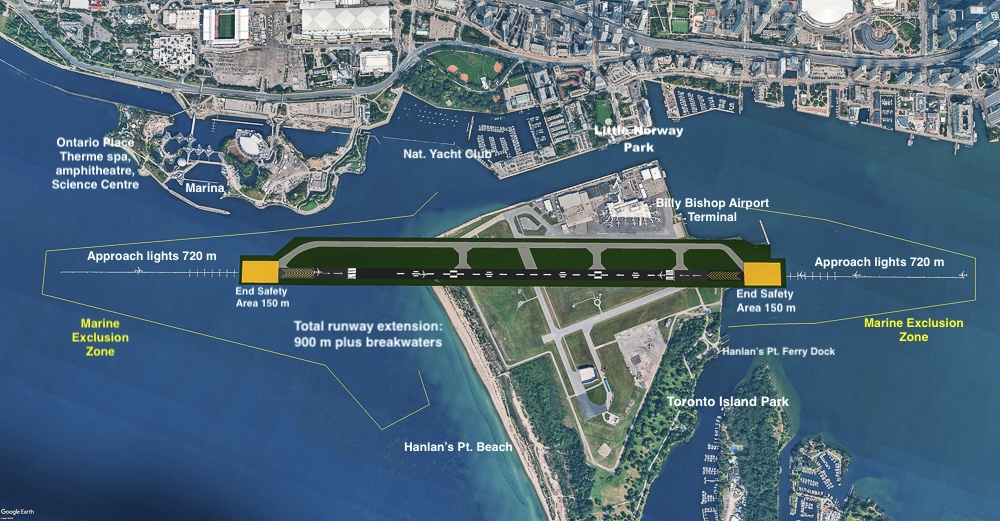
The Oliver Wyman study recommends building a tunnel under the runway to avoid a LaGuardia-type collision, such as the one earlier this spring involving an Air Canada jet and a firetruck. Given that the island airport is barely above the water table and located on what was a series of sandbars, a vehicle tunnel and runway expansion would be extremely expensive. To accommodate jets, approach landing lights would have to be installed in Toronto Harbour, extending east for 720 metres and on the western side of Toronto Island to Ontario Place. The lights and the huge marine exclusion zone around them will severely impact the navigation of ferries and pleasure craft.
A secret environmental assessment found that allowing jets will increase air pollution, raising the risk of heart disease, lung cancer and respiratory tract tumours for residents living near the airport. The Toronto Port Authority (TPA) commissioned AECOM Canada Ltd. to conduct the EA in 2017, but it only became public on March 11, 2026 as the result of a freedom of information request from No Jets T.O. (The TPA also withheld from the public an environmental assessment of options for runway end safety areas, an aviation safety standard mandated by Transport Canada to prevent aircraft from overshooting runways.)
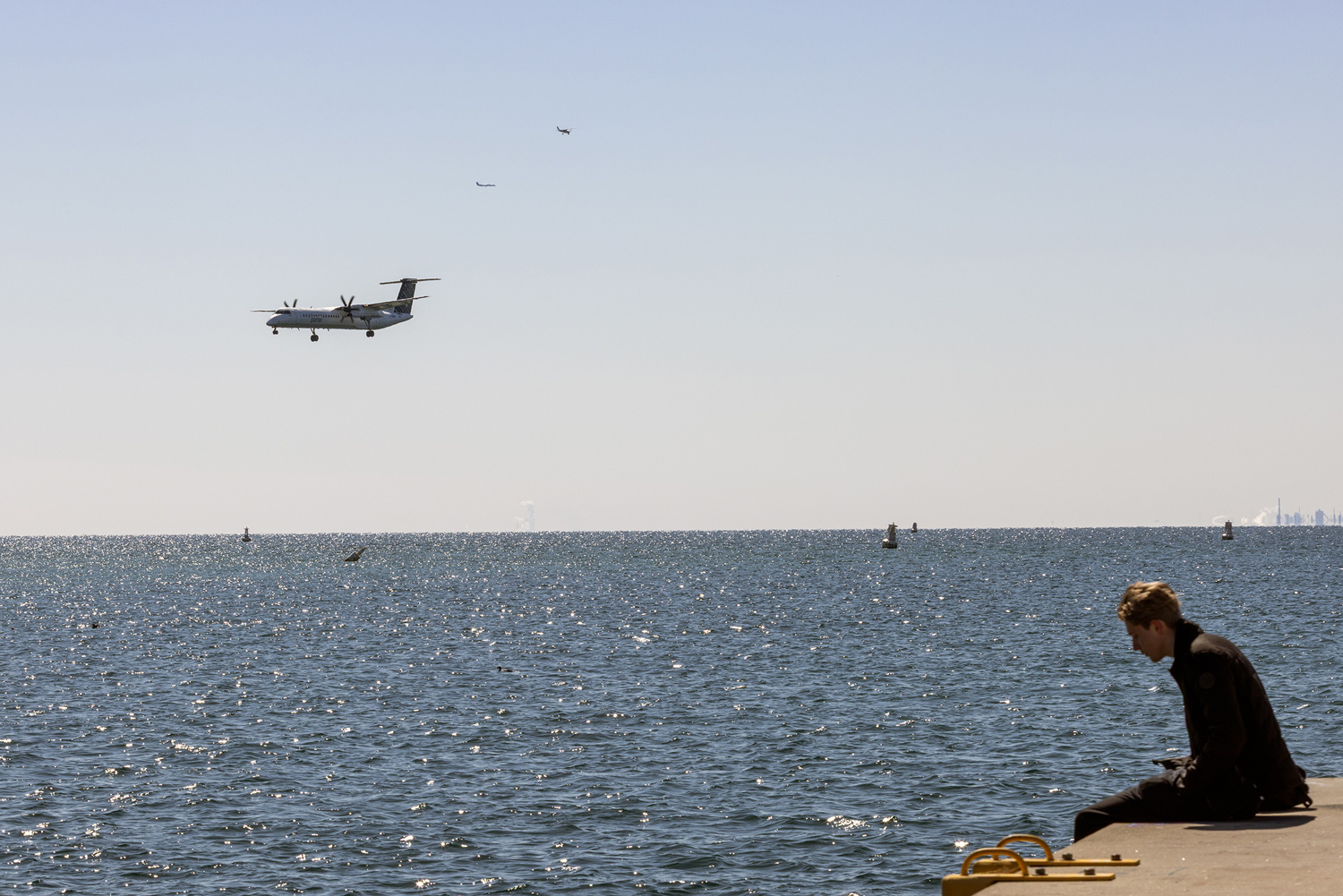
The study found that increased sound levels may lower property values and interfere with residents’ sleep. While a new generation of regional jets may be quieter than conventional jets, its performance will be mitigated by the increased number of flights as well as these jets’ longer and lower approaches and takeoffs.
The report concluded that extending the runway will reduce water circulation through the Western Channel, raising pollution levels and harming aquatic life. The report noted that adding a large volume of fill into Lake Ontario will destroy fish habitat and spawning beds and reduce the volume of nutrients fish feed on. Most townships in Ontario make it illegal to dump fill into lakes because it only takes one contaminated load to add toxic chemicals into a freshwater lake. Even with the installation of jet blast walls at both the ends and the sides of the extended runways, the report warned that jet exhaust blast poses a high risk of capsizing canoes, paddleboards and kayaks in Toronto Harbour.
Billy Bishop Airport is not a “gold mine” on Toronto’s waterfront, as Ford would have it. The real gold mine is Toronto’s extraordinary geography.
Toronto’s protected harbour and necklace of offshore islands attracts visitors and delights Torontonians. National Geographic, Michelin, and Trip Advisor all rate the ferry excursion to Toronto Islands as one of the top ten things to do when visiting Toronto. National Geographic further describes the islands as “a pastoral archipelago” and highlights the quaint cottages and lush gardens on Ward’s and Algonquin, the only two inhabited islands.
While Ford describes Billy Bishop Airport as a “gold mine” to provide access to Toronto for business travellers and tourists, he hasn’t acknowledged that the parks along Toronto’s waterfront, the harbour, and offshore islands are among its top attractions for both visitors and local residents. According to former Toronto mayor David Crombie, who led the Royal Commission on the Future of the Toronto Waterfront (1988-1992), Toronto’s waterfront parks attract 18 million visitors annually and contribute $13 billion per year to Ontario’s gross domestic product (GDP).
Expanding Toronto Island Airport for jets will do irrevocable damage to this geographical treasure, which all three orders of government have invested millions of taxpayer dollars in restoring, most recently through re-naturalizing the mouth of the Don River and thus allowing wetlands to filter and clean the river’s discharge into the harbour.
By advocating for jets at Billy Bishop Airport, the Government of Ontario is undercutting recent investments in developing parks along the Toronto waterfront and promoting new housing. All levels of government invested $2.5 billion to naturalize the mouth of the Don River and reduce the risk of flooding so new land is available for housing and parks. What’s more, on March 30, 2026, the federal government, Province of Ontario, and City of Toronto agreed to provide $1 billion each to build the Waterfront East light rail transit line to connect Union Station to the new communities to be built in the Portlands.
The TPA is contesting the City of Toronto’s plans to build 40-60-storey apartment towers on Ookwemin Minising (formerly Villiers Island) at the Ontario Land Tribunal because it contends that building higher than 30 storeys will interfere with the flight paths of jets landing and taking off from Billy Bishop Airport.
Disallowing apartment towers higher than 30 storeys will reduce the density of the new neighbourhoods, making each unit more expensive. This move contradicts Ford’s and Prime Minister Mark Carney’s agenda to build more affordable housing in Toronto. Waterfront Toronto, a federal-provincial-municipal non-profit agency, was created in 2001 to coordinate the revitalization of the city’s waterfront. The Ford government and the TPA have refused to coordinate new developments with that agency, resulting in haphazard and contradictory planning and design.
Unlike Doug Ford, most Torontonians don’t own a cottage. The beaches, picnic tables, boardwalks, and cafés on Toronto Islands offer families a chance to escape the city heat at the height of summer and enjoy the cottage experience only a 15-minute ferry ride from downtown.
I have canoed through the Toronto Islands archipelago, and marvelled at the blue herons patiently fishing and the majestic willows overhanging the quiet waterways. A few years ago, my wife and I stayed at a bed and breakfast on Algonquin Island and watched the sunset over the Toronto skyline from a picnic table on the shore. Afterwards, we heard music wafting through the trees, and wandered over to the Island Café, a community-owned restaurant, for a folk concert. In the morning our host, an artist, dropped off a basket of freshly baked muffins, berries and yoghurt for breakfast. It was an enchanting experience only 15 minutes by water from Canada’s largest metropolis.
I asked Doug Ford’s spokesperson if the premier has ever visited the Toronto Islands. She did not respond.
Ian Darragh was a former editor-in-chief, Canadian Geographic magazine, and feature writer for National Geographic.


7 comments
Thank you for all of the amazing information. It is so valuable for those of us who are getting involved, to stop Ford’s absurd plans.
Phenomenal writing and well constructed arguments. Unfortunately, given that Ford, his government, and the lobby he seems to be servicing are corrupt to the bone, no amount of pointing out how bad an airport extention on the waterfront will be for the city and its residents is going to chance his mind. The federal government needs to grow a spine and defend its own policies and put a stop to the extension idea once and for all.
Premier Ford said that Billy Bishop Airport is “the jewel in the crown of Toronto’s waterfront”.
Nothing could be further from the truth. Our waterfront is the jewel in Toronto’s crown.
From the magnificent Biidaasige Park to the Toronto Islands, our waterfront is a precious resource that must not be squandered by expanded runways and disruptive jet traffic. We’ve already lost so much with the desecration of Ontario Place.
The expansion of Billy Bishop Airport is not a re-construction but a destruction project. Its impact on the environment, on future housing initiatives, as well as on the oasis of the Toronto Islands, spells disaster for the waterfront. It is hard to imagine that one of the most treasured sites of Toronto, the beach on Hanlan’s point, may no longer exist. This article and other writing on the subject need to be given a lot of publicity, so that the extension of the airport can be stopped before it is too late.
The information in this article is invaluable and its arguments are very clear. The expansion of Billy Bishop Airport is not a re-construction but a destruction project. Its impact on the environment, on future housing initiatives, as well as on the oasis of the Toronto Islands, spells disaster for the waterfront. It is hard to imagine that one of the most treasured sites of Toronto, the beach on Hanlan’s point, may no longer exist. This article and other writing on the subject need to be given a lot of publicity, so that the extension of the airport can be stopped before it is too late.
Never has there ever bern anyone so determined to destroy Toronto and the province. He thinks all he does is brilliant . It doesn’t matter Dougie. Enough is enough. Release the phone records so the truth can be revealed to all of your corruption and deceit.
Imagine if we had parkland going all the way through the Toronto Islands. This would be a gold-mine for both residents and tourists. People could either take a ferry or walk through the underground tunnel to get to the islands. This could rival Central Park in New York City or the English Garden in Munich, Germany.
Improved access to and from Pearson International Airport will help get people to and from downtown Toronto and other parts of the Toronto area more easily.