Read part 1 of this conversation.
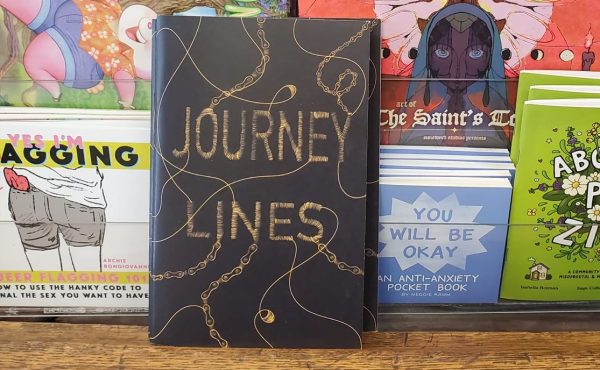
Sabat Ismail (SI) met with Rachel Wang, Sylver Sterling, and Jess Nachman, creators and editors of the Journey Lines zine, to discuss the zine and its launch. The zine explores the art, experiences, and stories of queer trans black people of colour (QTBIPOC) cyclists in their own words.
Rachel Wang (RW) (she/her) is an environmental consultant and founding Executive Director of the Bike Brigade. Her work centres art and culture as pathways for collective resistance and visions of collaborative survival beyond systems of oppression.
Sylver Sterling (SS) (she/her) is an artist and designer with 9 years of experience creating for communities, movements, and people who care. Her work lives at the intersection of design and storytelling, always rooted in emotion, clarity, and intention.
Jess Nachman (JN) (they/them) is a queer, Asian, anti-Zionist Jewish graduate student and mobility justice researcher. Jess organizes with Climate Justice Toronto and Sport Scholars for Justice in Palestine.
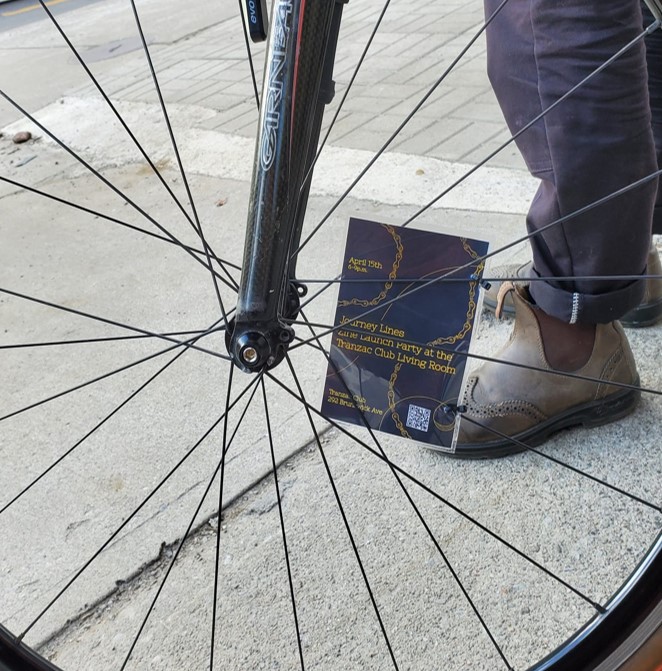
SI: What audience did you create the zine for?
RW: We spent quite a bit of time journaling, reflecting, and talking through this. One common thread was not creating something for white consumption — it would be for us and our communities. This informed the zine approach: when we write, we’re not writing for mass consumption or entertainment. We don’t have to write about suffering, which as Jess said, is almost celebrated; we can write about the mundane, the joy and whatever what we want.
Nikita’s piece What your bike says about you is particularly interesting because it was her lens on cycling as a person of colour commuting in the city. She doesn’t have a bike, so she uses Bike Share and therefore doesn’t see herself as a “real cyclist”. So, the fact that she felt seen enough to submit something for the Journey Lines bike zine is something I cherish.
SI: Rachel, your work has explored arts and culture drive community change. How do you see this zine contributing to this?
RW: I think what makes art so powerful for community change is that it creates space for people to see themselves and each other differently. When you read policy documents or advocacy reports, you get data and recommendations, but you don’t necessarily feel the humanity behind it. Art lets people share their full selves in ways that can’t be reduced to talking points. With Journey Lines, we weren’t trying to convince anyone of anything — we were creating a container for our communities to express their experiences on their own terms.
When people feel that sense of belonging, they start building from there — organizing, showing up for each other, imagining new futures together. That’s the cultural shift, and it can start with a simple story.
SI: I also wanted to know whether your background in the Bike Brigade and community organizing informed this project.
RW: The Bike Brigade is made up of relatively privileged people — we have time to volunteer during the workday, we’re able-bodied, and we usually have access to a bike. The demographic reflects the broader cycling community in Toronto, though it’s a subset of folks who are particularly interested in solidarity-building and care work in the city.
This zine is a unique space for me because we were reaching a different community than the Bike Brigade typically does, but the approach to building solidarity was the same.
SI: What do you think are the distinctions of how QTBIPOC folks view cycling?
JN: I can’t say one overarching perspective, but it’s a way to get to the places that bring us joy, build community, or just have a way to get to where you need to be.
SI: In the introduction to the zine, you mentioned and critiqued the typical archetype of a cyclist in the broader cultural imagination, and you touched on their different relationships to taking up space. Perhaps a kind of spatial entitlement, can you elaborate on what you touched on, and the different experiences of QTBIPOC cyclists in taking up space on a bicycle?
JN: Sabat, your work also touches on this, but this is often the experience of all QTBIPOC, that class inequality has resulted in BIPOC and queer and trans folks having limited access to resources, including bicycling, especially growing up, whereas you see a lot of middle-to-upper-class kids getting to learn how to cycle when they’re younger and have access to biking.
Access to safe cycling as an equity issue is well-researched: it is connected to mobility injustice in which ableism, racism, gendered violence, and class-based inequality dictates who is able to move safely and who are targets of violence. So, communities like QTBIPOC may have to work twice as hard to access cycling.
RW: I don’t know if I have a direct answer, but it made me think of two particularly alienating experiences interacting with cis-het white male cyclists that illustrated the stark contrast in how we take up space. There was this guy cycling in a manner that broke a bylaw; the police confronted him and he escalated it into a confrontation. His demeanour emphasized that he deserved to ride how he was and take up space. I was shocked by how safe he felt in that interaction and how empowered and emboldened he was — I could never imagine doing the same.
The second instance was seeing a well-known cycling advocate that made a post disparaging cycling couriers, emphasizing his perception that they “ruin” bike lanes (after all their hard advocacy work) and, while emphasizing that bike lanes are not for these cyclists, who are primarily people of colour.
SI: You mention couriers, increasingly, there’s been a lot of stigma around bike couriers, and as you allude to, it’s racialized because a lot of them are people of colour, and immigrant men. I was just wondering if you could talk about this stigma and also the challenges of visibility and the visibility for people of colour while cycling, and how that’s experienced in a different way than white folks, because of the image of the M.A.M.L.
RW: It’s shocking to see how public perception and just the cultural shift around it have changed. Since COVID, bike couriers went from hero to zero — from being completely celebrated for bringing us our food as essential providers and on the front lines to being treated like a nuisance. They’re on the sidewalks, they’re on the road, yet they’re still doing the same thing.
It’s fascinating because it’s just cultural; behaviour informed by social norms of the day. Reflecting on moments in different Asian countries, I saw how societies approach cycling. It’s the norm to go from point A to point B on a bike, on safe infrastructure, for any age. To see how quickly culture can shift is scary, but it’s also an opportunity — to work within the system and humanize that experience to change it, because we’ve seen these shifts can happen overnight.
JN: In thinking about your question around bike couriers and how the white nation state that is Canada functions and the lines that have been drawn between who is seen as essentially “other” to Canada.
It’s a shift that Rachel was talking about, the culture of seeing Uber couriers as heroes to being nuisances that need to get out of “our lanes.” That these couriers are supposedly ruining the bike lanes that “we” have worked hard for clearly denotes a line between who is seen as belonging and who isn’t.
In the book Bicycle Justice, there’s a chapter that is set in the United States about migrant delivery cyclists, and this whole anxiety over migrant delivery cyclists entering wealthy white neighbourhoods, because the moment that they trespass into white private property, they’re seen as threatening and contaminating that space.
This xenophobic rhetoric is similarly present in the idea that migrant cycling couriers using Toronto bike lanes are “taking over our streets.” Bike lanes are supposed to be public space, and “our” streets imply a type of property ownership over land that is colonial in its nature.
SI: It’s also a very significant shift, mirroring some of those things happening at the national level regarding the stigmatization of immigrants. But I also see what you’re saying about how it is an opportunity there, the cultural shift in perspectives can also shift positively here, that social possibility, even if it seems distant right now. In the zine’s introduction, you also mention that cars are a symptom of deeper forms of violence. Can you elaborate more on this perspective?
JN: here’s a culture of car dominance in North America, which feels like an entitlement to public space at the expense of vulnerable bodies in the streets, such as cyclists and pedestrians — but that’s also a huge generalization. Many people need to drive cars, and I’m not implying that driving is bad..The history of cars however, especially in North American cities, is however rooted in capitalism — cars are a way for us to get to our jobs and transport capital more quickly. Not to mention, the automotive industry’s relationship with the billion-dollar fossil fuel industry.
SI: What motivated you to include the anonymized contributions and the different ways that you allowed people to contribute?
JN: We actually didn’t have an explicit conversation, except asking folks how they want what they want shared. It was simply: “What’s your signature?” and “Do you want any handles shared?”
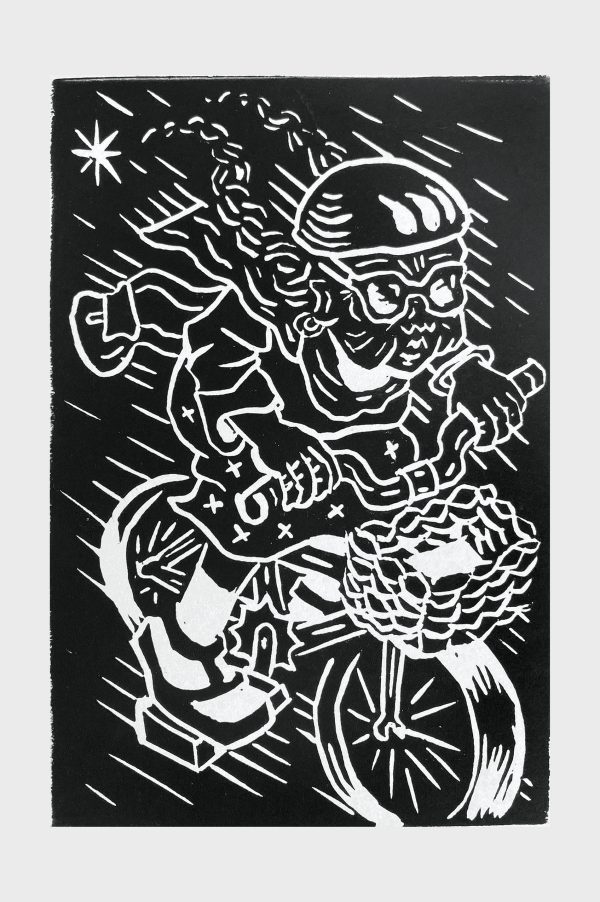
For example, Dani T’s piece Rad Grandma, maybe at face value, it doesn’t look like a political piece, right? Yet Tiff, one of the event moderators and zine contributors, interpreted the Rad Grandma piece as incredibly political.
Through engaging with Dani’s piece, Tiff said, “I want to see that grandma more,” or “Why don’t we have more places for that grandma to ride a bike?”
Art and its interpretation can be so political, especially when read by other QTBIPOC. Art is such an amazing medium to express what we want out of the world in ways that aren’t stifled by institutions.
Still, some pieces weren’t political at all: not every piece was about activism, frustration, or suffering, because that’s the point: there are fun art pieces and exploratory pieces of people just exploring their thoughts and feelings about cycling.
Journey Lines is available at Another Story Bookshop on Roncesvalles and Queen Books on Queen East. There is also a digital version of the zine, and an order form for a print version.