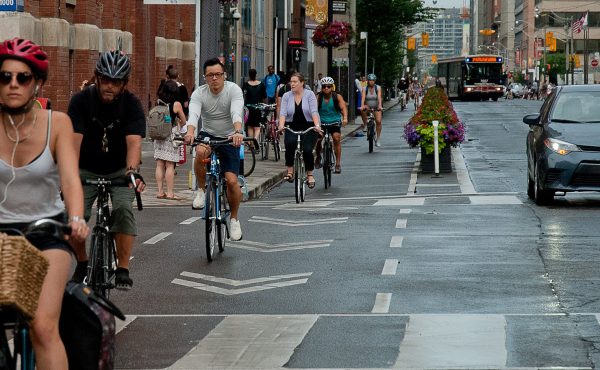

After the Ontario Court of Appeal (ONCA) shot down CycleTO’s legally innovative charter challenge that sought to stop Doug Ford’s attack on the city’s bike lanes, Queen’s Park wasted little time before issuing a request for proposals in early September. The government has asked contractors to submit bids on the “project” by the end of November. CycleTO, meanwhile, has not yet said whether it plans to seek leave to appeal the ONCA decision to the Supreme Court.
Spacing last week obtained copies of the RFP documents. They include — contrary to the premier’s anti-Trump rhetoric — a form enabling U.S. firms to participate. The contract, to be concluded by the end of 2028, will be tendered and overseen by the Ontario ministry of transportation. Judging by the way the RFP has been scoped, the winning bid will reveal the extent to which the minister, Prabmeet Sarkaria, and Ford, have put their fingers on the scale.
According to the “intent” of the RFP [screen shot], “[t]he proposed design is expected to reinstate motor vehicle lanes and where feasible, provide bike facilities with modification made as needed to ensure road user safety, lane continuity, impacts to adjacent infrastructure, and other relevant factors.”
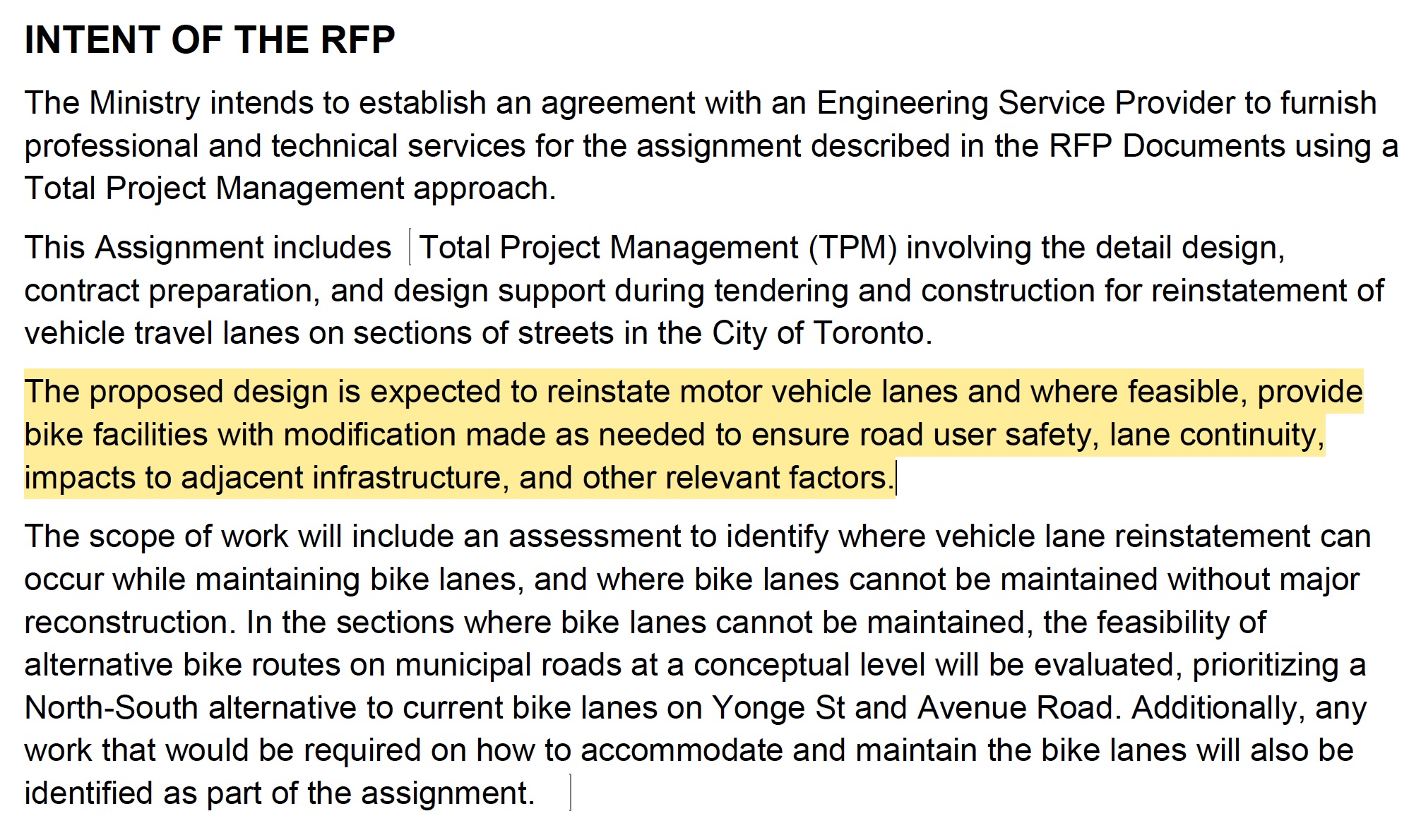
The project, the document continues, “will include an assessment to identify where vehicle lane reinstatement can occur while maintaining bike lanes, and where bike lanes cannot be maintained without major reconstruction.” How that assessment is conducted, the RFP doesn’t say. Nor does it offer any details about the fate of the street parking spaces all along the impacted routes.
The construction will affect the entire Bloor bike lane that extends from Royal York Road to Castle Frank Drive, as well as Yonge Street from Hayden to Millwood, University Avenue from College to Heenan Place, Queen’s Park and Queen’s Park Circle from College to Bloor, and Avenue Road north to Davenport. The RFP does not mention Danforth.
Based on the description of the scope of work, there’s no question that this will be a highly disruptive and expensive undertaking. Besides the bike lane removals, the RFP wants bidders to provide plans to “remove or relocate” islands, medians and gutters and “incorporate congestion relief measures at all major intersections to improve traffic flow, such as traffic signal adjustments (i.e. signal timing, signal phases), geometric adjustments at intersections, repurposing lanes, lane re-configuration, operational adjustments within the curb-to-curb platform, etc.”
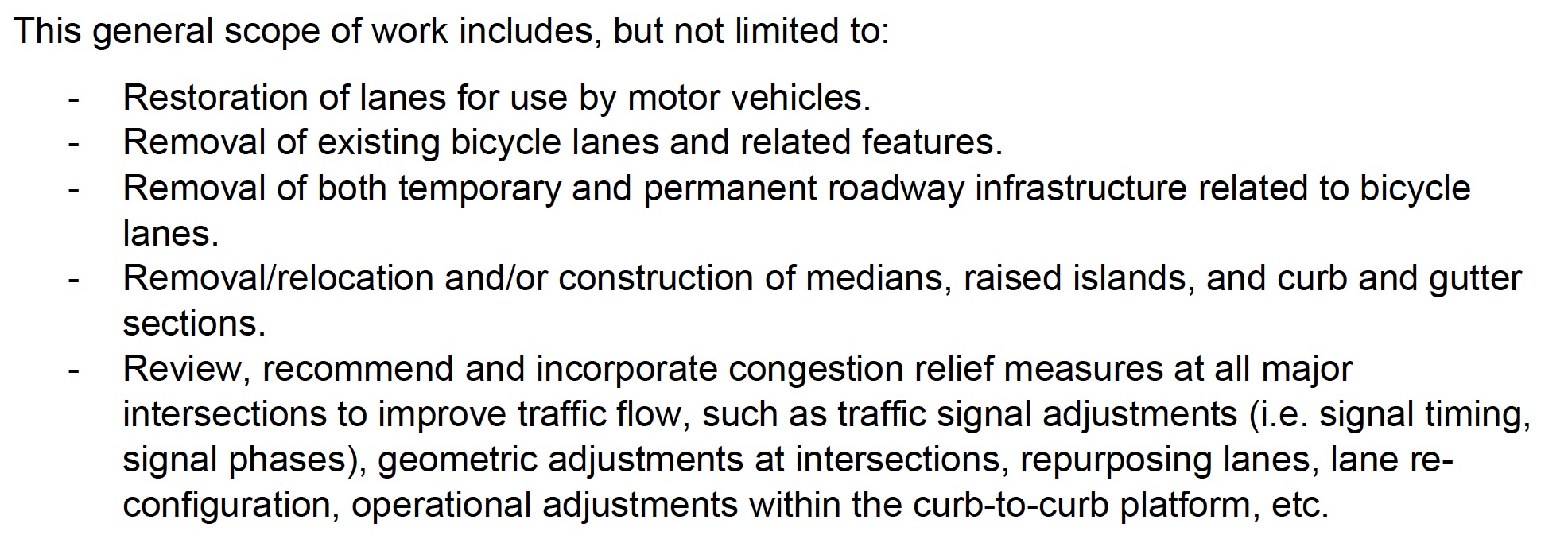
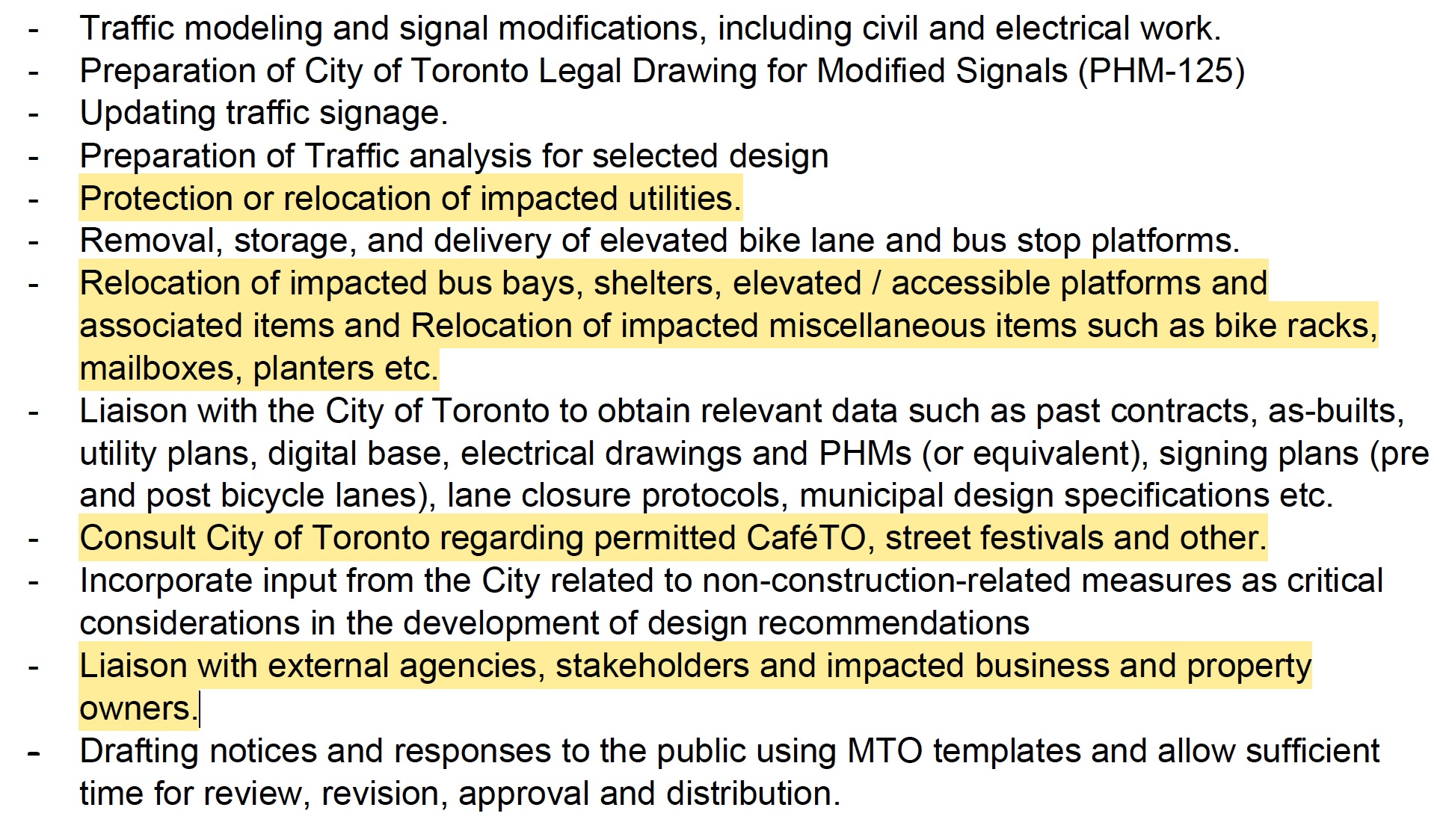
Evidently, the construction will be extensive, and involve moving underground utilities (typically a hefty expense), as well as bus bays, bike racks, accessible platforms and even mailboxes. MTO also says it will “consult” with the city regarding CafeTO locations and street festivals. The process envisions the contractor connecting with external agencies, stakeholders, property owners and “impacted businesses,” but not, of course, the cyclists and delivery people who use that infrastructure and will be most directly “impacted.”
The whole contract, finally, will be divided into the phases, with the tendering for each one due to be submitted to MTO on April 1, 2027, December 1, 2027, and June 1, 2028. The government has left it up to the bidders to propose their own staging.
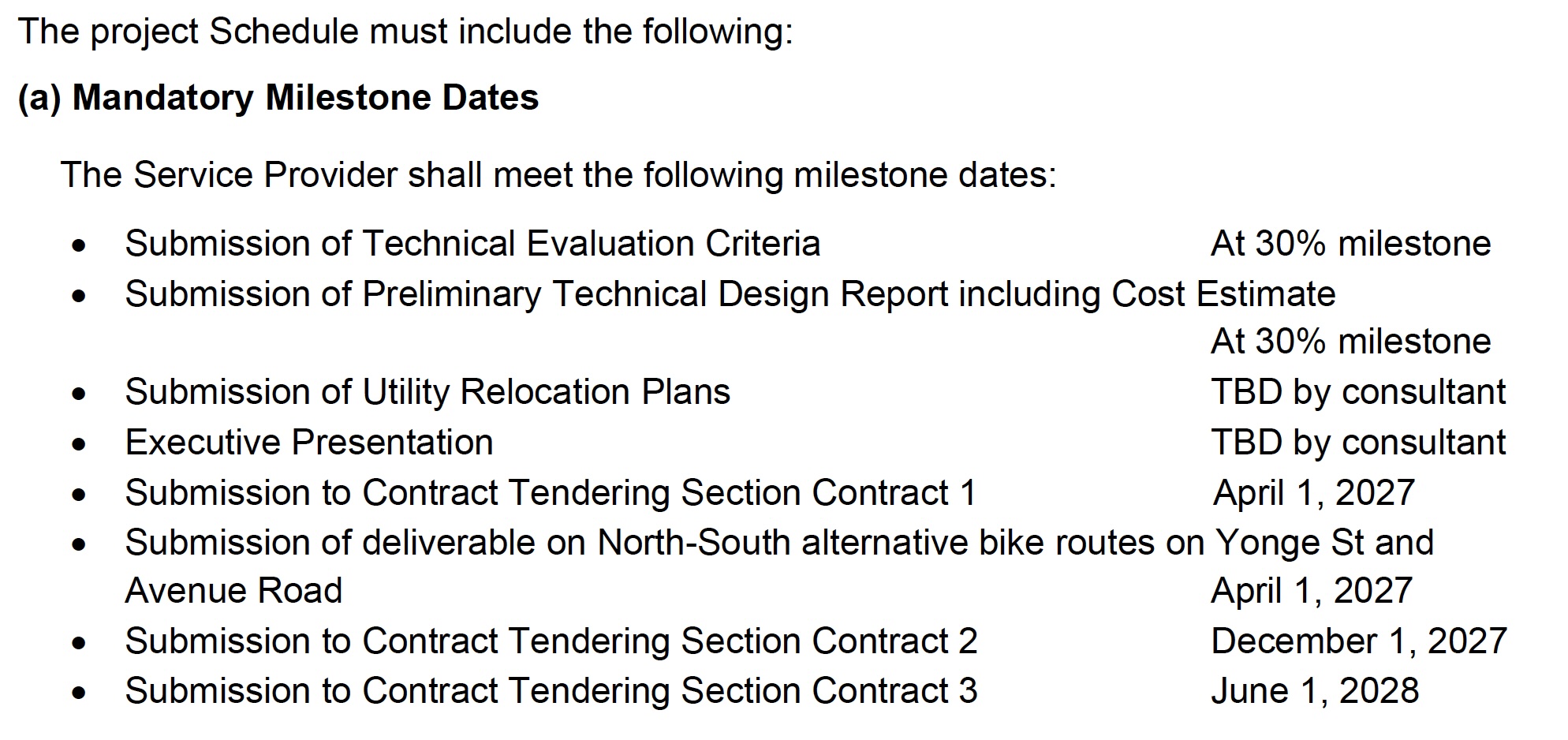
The most absurd deadline lands, appropriately enough, on April Fool’s Day, which is when bidders have to tee up proposals for “alternative” north-south bike routes to Yonge and Avenue Road, as if there’s anyone around who doesn’t already know that the only such streets near either arterial are Mount Pleasant, Beford, and Russell Hill roads.
It’s clear from reading the 110-page document that this project will not be a quick and dirty job. The government has set out an exhaustive range of technical standards and time-tables, and it’s not at all difficult to imagine that none of this will be complete according to schedule laid out in the RFP.
After all, the University Ave. bike lanes, and a portion of the Bloor lanes between Avenue Road and Spadina, were built during the pandemic, when traffic was way down. There’s lots of traffic now, and what the government is doing, ironically, is condemning all the users of those roads — vehicles, delivery trucks, cyclists, pedestrians, etc. — to at least a year of lane closures and detours. And for what?
The question, to my mind, is how all the baked in tensions in this idiotic exercise play out. The firms that vie for these kinds of civil engineering projects have to get over all sorts of technical bars, but the award will ultimately go to the lowest cost bidder.
Removing temporary concrete curbs and the flexible bollards, such as those found west of Bathurst, won’t involve a lot of work. But eliminating all the elevated purpose-built lanes and medians means digging up the street and mucking around with sub-surface utilities, which is expensive and slow, and involves coordination with agencies like Toronto Hydro and Enbridge.
Will contractors aiming to ante up the lowest bid be tempted to find ways to avoid those big costs by taking up the RFP’s allowances for retaining lanes where “feasible”? Or do they game out the politics of this tender, and gamble on the assumption that Sarkaria and Ford’s officials will automatically reject such proposals, even if they are the least expensive.
I can’t find any evidence on the documents we obtained that MTO has engaged a fairness monitor — as is done with large Infrastructure Ontario projects — to ensure the whole process is on the up and up, so we’ll probably never know how the winner was chosen.
What is certain, however, is that a vast sum of our money will be wasted, countless Torontonians will find themselves profoundly inconvenienced for extended periods, and, eventually, a cyclist will get struck by a car. But at least the congestion will be worse.