Whether it’s buck-a-beer, easier access to alcohol, or tunnelling under Highway 401, Doug Ford has proven himself to be a master of distraction, diverting attention from his government’s failures and scandals. His threats to rip out bike lanes are merely one scene in the same political theatre.
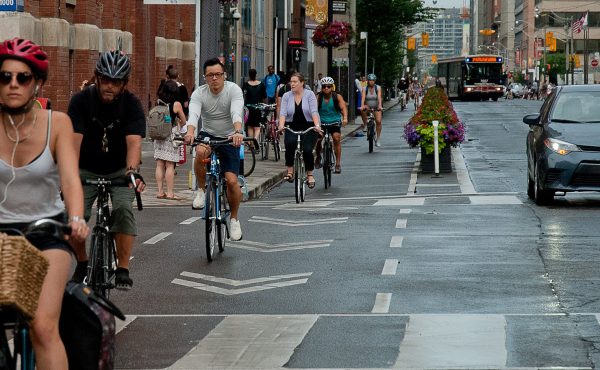
Debates about bike lanes inflame passions, albeit in different ways across the province. In cities like Toronto bike lanes have come to be accepted as necessary road infrastructure for commuters, shoppers, and visitors. In other parts of Ontario, where cycling may still be seen as recreation, opposition remains strong. As provincial leader, Ford had an opportunity to educate — but bike lanes serve him better as a wedge issue. When residents who cycle react angrily to his threats, Ford can pretend to play the motorist’s champion. Ford wins. We all lose.
Ford’s claim that removing 19 kilometres of bike lanes — on Toronto’s 5,600km road network — will solve the region’s multi-billion congestion problem is fanciful. Even removing all bike lanes would affect less than 5% of Toronto’s roads, with no impact on routinely clogged Gardiner, Allen, and DVP expressways, or local segments of Highways 400, 401, and 427. But threatening to remove bike lanes is easier than explaining the inefficiency of single-occupant cars.
No family has gotten more electoral mileage out of the bicycle than the Fords. When Doug’s brother Rob became Toronto’s mayor in 2010, his ‘War on the Car’ rhetoric played a leading role in his success, with bike lanes as the villain. If bike lanes were actually removed today, the premier would lose his scapegoat. How would he then explain worsening motor traffic congestion – an outcome that’s virtually assured given a growing population and his measures to induce driving by making it cheaper: eliminating vehicle registration fees, reducing gas taxes, and banning speed cameras.
If the premier merely used bike lanes as a distraction, predicting his actions — and planning a response — would be fairly straight-forward. But much like Donald Trump, Ford appears to treat every past slight, including his rejection by voters in the 2014 Toronto mayoralty race, as requiring retribution. How else to explain Ford’s dismissal of the compromise offered by Mayor Olivia Chow that would restore car lanes on Bloor Street while keeping bike lanes – lanes that city council had approved in a 21-1 vote. Petty vindictiveness is not a leadership quality.
Round and round we go, where we end nobody knows. We are beginning to look like character actors or extras in political theatre directed by Ford’s whims.
The way forward is for Ford’s opponents to write their own script.
First, the defence of Toronto bike lanes has to be seen as part of a broader struggle that encompasses the chill Ford imposed on new bike lanes across Ontario. More important still is to reframe the debate to focus on efficient, affordable, clean transportation centred on walking, cycling, and transit. Professional, community, faith, and business organizations that may not be interested in cycling, can nonetheless be drawn into the debate by concerns for fairness, economics, health, and vibrant neighbourhoods.
Second, the Liberals and NDP must be urged to stand up for better transportation, instead of merely lamenting Ford’s meddling in municipal affairs. Leadership also has to be more than telling people what they want to hear. Speak facts to fiction: Cyclists are traffic. We won’t solve the congestion problem without getting more people out of cars. City councillors alone shouldn’t have to be the standard-bearers of good policy.
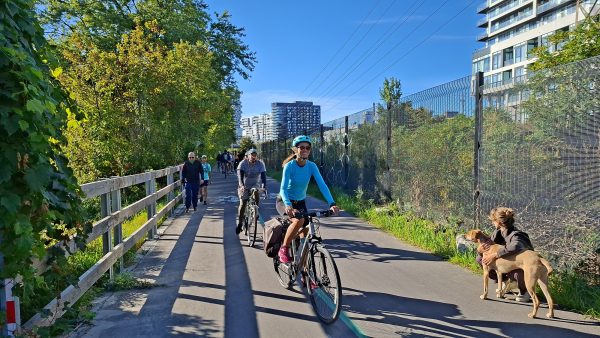
Third, to bypass Ford we have to seize opportunities, instead of simply biding our time until his departure. Improved GO bus service and bus-only lanes are cost-effective, quickly-implemented transit improvements. Cycling infrastructure can still be built out along wide rights of way or by connecting disjointed trails, including Toronto’s unfinished 75km “Loop Trail.” And all roads can be made safer by tackling the troubling proliferation of pickup trucks.
Finally, while social media has isolated many people in online tribes, we need to re-engage in a larger community that values evidence-based decision-making, the environment, and integrity in politics.
Albert Koehl is an environmental lawyer, Executive Director of Community Bikeways, and author of Wheeling through Toronto, A History of the Bicycle and Its Riders.
Photo courtesy of Rob Zaichowski