
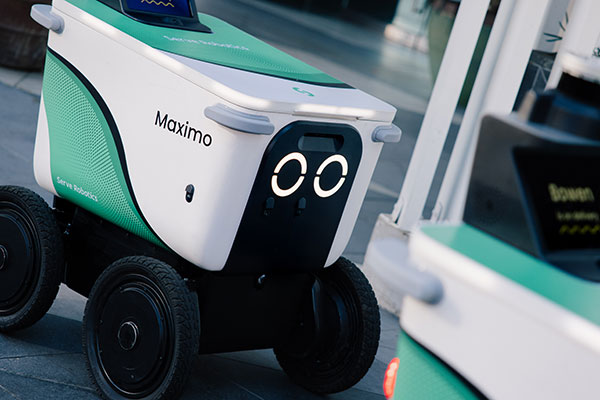

A small cube-shaped robot rolls carefully along a crowded sidewalk, weaving between patio tables, cyclists, utility poles, and pedestrians carrying groceries or pushing strollers. Soon, scenes like this may become part of everyday life in Vancouver.
City council recently approved a six-month pilot program that would allow autonomous delivery robots to begin operating in parts of Kitsilano and downtown this fall. Supporters describe the machines as innovative, efficient, and environmentally friendly. Critics warn about accessibility, safety, and labour impacts.
But beneath the debate over food delivery lies a much larger urban question. This is not really a story about robots. It is a story about sidewalks.
For most of modern urban history, sidewalks have been understood primarily as civic infrastructure: spaces for walking, gathering, social interaction, accessibility, protest, waiting, wandering, and public life. They were never simply transportation corridors. They were among the few parts of the city designed fundamentally around people rather than machines.
But sidewalks have never been entirely neutral spaces either. They have long reflected larger political and socio-economic conditions within cities. In wealthier neighbourhoods, sidewalks are often wider, smoother, greener, and better maintained. In poorer or historically marginalized areas, they are more likely to be cracked, obstructed, poorly lit, inaccessible, or missing altogether. Decisions about sidewalk maintenance, accessibility, snow clearing, tree canopy, curb ramps, and pedestrian safety often reveal whose movement cities prioritize — and whose movement they do not.
In this sense, sidewalks have always been contested spaces: shaped by tensions between commerce and public life, movement and gathering, accessibility and exclusion, public use and private encroachment. And over the past two decades, however, sidewalks have quietly begun changing in new ways.
Cafe patios expanded into pedestrian space. Ride-hailing transformed curb behaviour. E-scooters, app-based delivery, bike-share stations, and mounting loading demands increasingly pushed sidewalks toward functioning less as civic space and more as logistical infrastructure—delivery robots are simply the latest layer in that transformation.
The language surrounding the pilot program reveals this shift clearly. Proponents repeatedly describe the robots as a “last-mile delivery” solution. The phrase comes not from urban design or public-space planning, but from logistics and supply-chain management. It refers to the final segment of a delivery route between a distribution point and the customer.
That distinction matters.
When neighbourhood space is framed primarily through the lens of logistical efficiency, sidewalks gradually shift from places of civic life into components of an optimized distribution network.
Importantly, this transformation is not simply technological. It is also economic. Delivery robots are emerging within a highly competitive logistical economy that rewards faster circulation, lower labour costs, greater convenience, and reduced friction in the movement of goods. The issue is not merely that new technologies exist, but that cities increasingly adapt themselves to the pressures and priorities those systems generate.
One of the most striking aspects of the robot debate is how harmless the machines initially appear. They are small, electric, and framed as environmentally responsible alternatives to car trips. Their supporters are not entirely wrong. But technological transitions rarely remain confined to the technologies themselves; they gradually reshape behaviours, priorities, and infrastructure.
In the 20th century, streets were gradually redesigned around the automobile. Traffic engineering, lane widths, signal timing, parking requirements, setbacks, and road hierarchies all evolved around the logic of vehicular movement. Over time, cities reorganized themselves around the needs of cars. The question now is whether sidewalks are beginning to reorganize around automated logistics systems.
The answer may seem obvious: these are only small delivery robots. Yet many urban transformations begin through seemingly modest pilot projects. Ride-hailing, app-based delivery services, and e-scooters all entered cities incrementally before becoming deeply embedded in everyday urban life.
Pilot programs are often presented as temporary experiments, but they also normalize emerging technologies. Once a system becomes visible and routine, debate shifts from whether it belongs in the city to how the city should accommodate it. Ride-hailing and app-based delivery followed this pattern: by the time regulations emerged, the infrastructure and behaviours surrounding them were already embedded in everyday urban life.
That shift is already visible in Vancouver. Councillors supporting the pilot framed the program partly through the language of innovation adoption, arguing that Vancouver should avoid repeating past delays around ride-hailing and e-scooters. Embedded within this argument is a broader assumption that cities must continuously adapt to emerging private technologies to remain modern, competitive, and forward-looking.
But cities are not merely technological marketplaces. They also shared civic environments with competing public interests.
This is where the concerns raised by accessibility advocates become especially important. Critics of the pilot noted that delivery robots in other cities have created conflicts with pedestrians, curb cuts, and people with mobility or visual impairments. These concerns are not peripheral operational details. They expose an underlying reality about many North American cities: sidewalks are already under pressure.
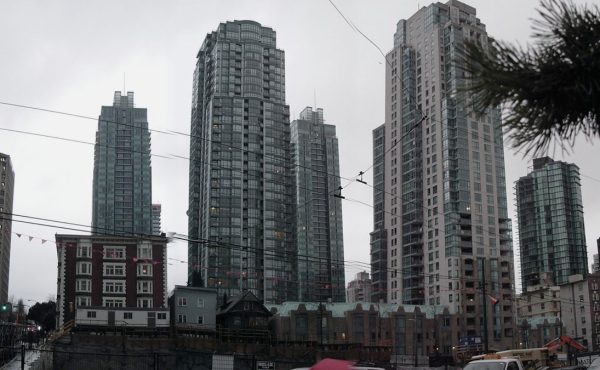
In dense neighbourhoods like Kitsilano and downtown Vancouver, pedestrian space is often constrained by patios, utility poles, transit stops, signage, street trees, bike infrastructure, and heavy foot traffic. Even relatively small interruptions can create disproportionate impacts for wheelchair users, parents with strollers, seniors, or people navigating with limited vision.
There is an irony here. Many cities still struggle to provide consistently accessible sidewalks for people, yet are increasingly being asked to accommodate autonomous commercial machines within those same spaces.
The labour implications reveal another layer of the transformation underway.
Food delivery work itself emerged through the platform economy, which transformed many traditional employment arrangements into precarious gig labour managed through apps and algorithms. Autonomous delivery systems now threaten to partially automate the very workforce created by the first wave of platform disruption.
Traditional delivery labour gave way to gig work. which may now give way to automation. The robots, therefore, do not enter a neutral labour environment. They enter an already precarious urban economy organized around convenience and accelerated consumption.
Importantly, the benefits of this system are also unevenly distributed. While some residents gain convenience, others absorb the costs through precarious labour conditions, unequal infrastructure, or reduced access to public space. Technological efficiency, in other words, does not necessarily translate into broader urban equity.
The robots are therefore not simply novel gadgets moving through the city, but symptoms of a broader economic system organized around accelerated circulation, lower labour costs, and increasingly frictionless consumption.
None of this means Vancouver should categorically reject new technologies. Cities evolve. Innovation matters. Electrified and lower-emission delivery systems may indeed help reduce car dependency. The robots themselves are not inherently dystopian. But the deeper issue is whether cities are still consciously deciding what public space is for.
Once sidewalks begin functioning primarily as logistical corridors, the meaning of the sidewalk itself changes.
The small delivery robots proposed for Vancouver may ultimately prove successful, limited, or temporary. But they reveal something larger already underway in cities across North America: the gradual transformation of urban public space into infrastructure optimized for frictionless circulation, delivery, efficiency, and platform-mediated consumption.
In the 20th century, cities quietly reshaped themselves around the movement and storage of cars—a transformation driven not only by technology, but by broader economic systems that rewarded speed, mobility, and consumption. The environmental and social consequences of that shift were only fully understood much later.
The question now is whether sidewalks will gradually reorganize around the movement of goods. And if they do, we may eventually discover that—much like the car—the debate was never really about robots, but about how economic systems quietly transform the public spaces through which urban life unfolds.
***
Related Spacing Vancouver pieces:
**
Erick Villagomez is the Editor-in-Chief at Spacing Vancouver and teaches at UBC’s School of Community and Regional Planning. He is also the author of The Laws of Settlements: 54 Laws Underlying Settlements Across Scale and Culture.

One comment
Great perspective on how urban spaces are evolving to support modern logistics. A thoughtful reminder that successful cities must balance efficiency, accessibility, and livability for everyone.