

Prime Minister Mark Carney and Premier David Eby recently announced a plan to purchase vacant condominium units and convert them into affordable housing through a proposed rent-to-own program. Details remain unclear. We do not know how many units will be acquired, expected discounts, how financing will be structured, or how the rent-to-own model will work.
The announcement immediately sparked criticism. Some described it as a bailout for developers struggling to sell units in a cooling market. Others welcomed it as a pragmatic way to put existing housing stock to use.
Both reactions are understandable. But before debating whether governments should buy empty condominiums, we should pause to consider a more fundamental question: If Canada is facing a severe housing shortage, why are there thousands of completed homes available for governments to buy in the first place?
This is not rhetorical. It is an attempt to understand what is happening in our housing system—and why the answer keeps slipping out of reach.
For years, Canadians have been told that housing affordability is primarily a supply problem. There are not enough homes, so governments must make it easier to build them. Municipal approvals accelerated. Development charges reduced. Regulations streamlined. More housing, we were told, would improve affordability.
This narrative has shaped housing policy across the country. Provincial governments have introduced sweeping legislative reforms. Municipalities have rezoned large areas for higher densities. Public financing programs have expanded.
Government has increasingly aligned itself around one objective: maintaining a continuous pipeline of housing production.
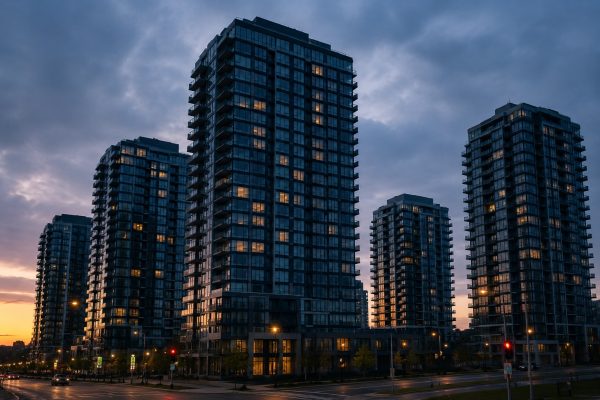
Yet, Canada Mortgage and Housing Corporation data show thousands of completed condominium units sitting vacant across British Columbia, including 4,376 in Metro Vancouver alone, a 76 percent increase from the previous year.
How can a province facing a housing shortage also have thousands of empty homes?
The answer is that housing need and housing demand are not the same thing. Many households need housing. That does not mean they can afford to buy what the market is producing. Markets do not respond to need. They respond to demand backed by purchasing power.
Andy Yan of Simon Fraser University estimates roughly one-third of Metro Vancouver’s unsold condominium inventory is priced above a million dollars. So, a shortage of affordable housing can coexist with a surplus of unaffordable housing.
The problem may not simply be supply but a mismatch between what is being built and what people can realistically pay—and a system that has consistently produced the former while calling it a solution to the latter.
The proposed purchases expose a deeper question: what, exactly, are governments trying to save?
The obvious answer is housing. But that word is doing a lot of work. In Metro Vancouver, housing is shelter, yes—but it is also a retirement strategy, investment vehicle, source of municipal revenue, major employer, and cornerstone of household wealth for a significant portion of the population. These functions overlap and are increasingly pulling in opposite directions.
Consider what government housing policy has actually looked like over the past several years: accelerated approvals, reduced regulatory barriers, expanded financing programs, deferred development charges, increased municipal borrowing capacity, tax exemptions for certain projects, and now the direct purchase of completed inventory.
Individually, these interventions appear unrelated. Together, they describe something more than a housing strategy. They describe a sustained effort to keep the development system running—to ensure that the pipeline of land acquisition, construction financing, pre-sales, and completions does not seize up.
This represents a subtle but important evolution in housing policy. Historically, governments framed major housing interventions in terms of broader economic goals—particularly employment stimulus and the need to sustain construction activity during downturns—rather than solely as efforts to support housing consumption through social housing programs, rental assistance, mortgage insurance, and first-time buyer incentives. Increasingly, however, they are intervening to support housing production itself.
The objective is no longer simply housing access. It is also to ensure that the institutions and financial structures responsible for producing housing remain viable.
Earlier this year, the B.C. government cancelled the Community Housing Fund, which supported non-market housing and had thousands of units in planning or construction. Months later, those same governments are prepared to commit public resources to purchasing unsold market condominiums. That reveals which pressures governments respond to most urgently.
The development sector employs many people and generates substantial municipal revenues. Its distress registers quickly in employment figures and economic indicators.
Non-market housing, by contrast, produces no comparable signal when it goes unbuilt. The people who needed those units simply don’t get housed—a harm that is real but diffuse, politically visible only once it becomes a crisis.
These conditions did not happen by accident. They reflect decades in which housing’s investment function—as an asset and store of wealth—came to dominate its role as shelter. Not through any single decision, but through thousands of incremental ones: zoning, financing, tax policy, and political choices about whose interests prevailed.
The empty condominiums are the most legible symptom of that process.
For years, policymakers celebrated rising construction as evidence that the housing system was responding to scarcity. The unsold inventory suggests the system was responding to something else—not unmet housing need, but investor demand, speculation, cheap credit, and expectations of future appreciation. When those conditions weakened, thousands of units became difficult to sell, even as housing needs remained acute.
The most recent details make the proposal more interesting. Acquiring completed homes at a substantial discount could be far cheaper than building equivalent units—and, if governments can do so, there may be a compelling public-interest case. But that judgment depends on answers governments have not yet provided: who they are trying to house, at what income levels, and how affordability will be protected over time.
These are not technical details to be worked out later. They are the policy itself.
Programs are easy to announce. Without the principles that establish who is being served, on what terms, and toward what end, it is impossible to know whether this initiative is intended to expand affordable homeownership, stabilize housing production, or respond to the latest market disruption.
What we have today are programs without a clearly articulated policy.
The deeper question is no longer simply whether governments should purchase unsold condominiums. It is whether maintaining a continuous pipeline of housing production has quietly become a housing policy objective in its own right.
The empty condominiums are not the story. The system that created them is.
***
A version of this article was originally published in the Vancouver Sun.
**
Related Spacing Vancouver pieces:
- Entitled to Flip
- The (Ur)banality of Evil
- The Coriolis Effect (3-part series)
- The Pro Forma Problem
- Defining “Viability”…and Who Decides What Counts?
- The Trifecta of Control: Stealth. Speed. Complexity.
*
Erick Villagomez is the Editor-in-Chief at Spacing Vancouver and teaches at UBC’s School of Community and Regional Planning. He is also the author of The Laws of Settlements: 54 Laws Underlying Settlements Across Scale and Culture.
2 comments
My compliments on a well written piece regarding a crucial issue of our times.
I reside in San Diego California, a place that seems to be a primary target of our State government’s continuous legislative proposals to “solve the housing crisis”.
You have certainly described our situation. This seems to be a Western world problem that is being dealt with by the same failing policies regardless of location.
The problem is considered to be one-dimensional – that “housing affordability is primarily a supply problem”, and that if we fix the supply, the affordability will take care of itself, supply and demand.
But as you have well noted, there is a difference between demand and need, the terms are not interchangeable, most notably in who their goals benefit
Twisting the primary purpose of housing from shelter to investment instrument is what has produced the skyrocketing housing prices,
We have learned nothing from our past.
The savings and loan crisis of the 1980s and 1990 should have taught us something, but instead only led to further excesses that imploded in the 2008 sub-prime mortgage crisis. From which we have continued to learn nothing.
In almost all stages of the developments that have led to where we are today, the primary concern of the governments has not been to address the housing needs of its citizens, but rather to serve to demands of the money-making interests involved.
The system is indeed the story and the problem.
Hi Robert,
Thank you for your kind words. I’m happy you found meaningful parallels with your home city. It’s definitely an issue that extends beyond Vancouver and Canada.
E