
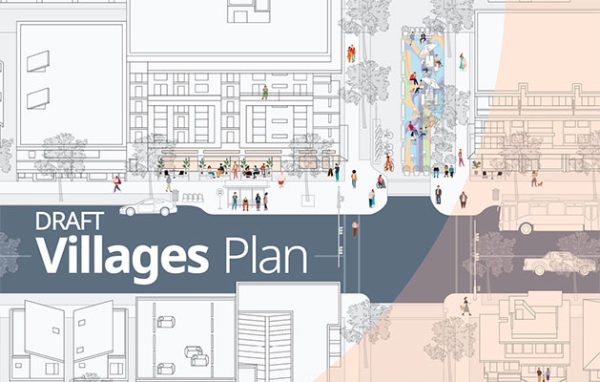

If you’ve heard people talking about Vancouver’s proposed Villages Plan and wondered what all the fuss is about, you’re not alone.
The idea sounds simple enough. The City wants to create 17 “village” areas across Vancouver—small neighbourhood hubs where people can live close to shops, services, restaurants, parks, and other everyday amenities. The goal is to make it easier for people to meet many of their daily needs within a short walk, bike ride, or roll from home.
Most people would agree that sounds like a good thing. Walkable neighbourhoods are popular. Local businesses are popular. More housing options are popular. The Villages Plan is built around all three ideas.
So why is it generating so much debate?
The answer is not that people oppose walkable neighbourhoods. In fact, many of the plan’s critics support the same goals as the City. The disagreement is largely about how those goals should be achieved and what unintended consequences might result.
The City’s argument is straightforward. Vancouver continues to grow, housing remains expensive, and many parts of the city are still dominated by detached housing. The Villages Plan is intended to allow more homes in these areas while creating local commercial hubs that residents can walk to.
Under the proposal, areas around 17 selected intersections—about 13,000 lots—would be pre-zoned for a range of new housing types. Some sites would allow townhouses and multiplexes. Others would allow apartment buildings up to six storeys.
Unlike traditional planning processes, where a property owner applies for rezoning and the proposal is reviewed on a site-by-site basis, pre-zoning establishes the permitted density and building form in advance. Over time, the City hopes that more people living near local shops and services will help create vibrant, complete communities.
Supporters argue this creates certainty and speeds up housing delivery. Critics worry it removes opportunities for neighbourhood-specific planning and public review.
One of the most common concerns is whether Vancouver is focusing on the right places. Many of the city’s existing neighbourhood shopping streets are already struggling. Dunbar Street, for example, has one of the highest retail vacancy rates on Vancouver’s west side. Point Grey Village faces similar challenges. Critics ask why the City is creating new commercial nodes when some of the commercial streets it already has are finding it difficult to attract customers and businesses.
The City’s position is that new housing density around village centres will eventually provide the customer base needed to support local retail. Opponents worry that new retail space will arrive long before the customers needed to sustain it and may end up competing with existing businesses that are already under pressure.
Ultimately, whether the new retail succeeds, and to what degree it affects existing retail, will depend on many factors—timing, market conditions, the pace of residential development—that are genuinely hard to predict.
Another concern relates to housing choices. The Villages Plan is often presented as a way to expand options, and in many parts of the city, it may. However, approximately 750 properties closest to proposed village intersections have been identified by the City as future commercial expansion areas intended to accommodate retail growth as villages develop.
Critics argue that this effectively channels those properties toward four- to six-storey mixed-use redevelopment with retail at grade, limiting other forms of redevelopment such as multiplexes, townhouses, and laneway houses. Critics also note that some homeowners in these areas may face restrictions on future additions or redevelopment options that would otherwise be available elsewhere.
The City notes that no one is required to redevelop and that existing homes can remain. But critics point to a practical concern: when land is zoned exclusively for its highest-density use, the market tends to price it accordingly. A property designated solely for a six-storey mixed-use building may come to be valued primarily as land awaiting assembly rather than as a home, with consequences for property taxes, maintenance incentives, and the real choices available to the people who live there.
Critics also point to what can happen when properties are widely understood to be awaiting future redevelopment. In some parts of Vancouver, such as portions of Oak Street and Cambie Street, homes designated for eventual assembly have experienced deferred maintenance as owners wait for redevelopment opportunities that may take years to materialize. Critics worry that if large numbers of properties are designated for future mixed-use redevelopment, some village areas could experience similar periods of uncertainty and neglect.
Questions have also been raised about the pace of the process. What was originally envisioned as a 50-to-100-year planning horizon has been accelerated into a proposal heading to a single public hearing this July, with the full 329-page plan released less than seven weeks before.
Supporters argue that the housing crisis requires urgency and that the city cannot afford to spend years deliberating every change. Critics counter that a proposal affecting thousands of properties and hundreds of blocks deserves more time for public review. The disagreement is not necessarily about whether change should happen, but about how quickly it should happen and how much genuine public input should shape it along the way.
Some residents have also questioned why direct notification appears to have been limited primarily to properties designated for future commercial expansion, rather than including neighbouring properties that could be significantly affected by future redevelopment. For these residents, the concern is not simply what is being proposed, but who is being informed about it.
Referring to Vancouver Plan document from which the Village idea began, residents have also suggested that area plans will be created in advance of zoning. This has brought up questions about whether the Village Plan is an area plan or a zoning change.
The issue of speculation is another source of debate. Some residents and planning professionals worry that broad pre-zoning will increase land values and encourage speculation, particularly in areas where property prices are currently lower. Others argue the opposite—that by allowing redevelopment across a larger area of the city, speculative pressure will be distributed rather than concentrated in a handful of locations.
Even among experienced planners, there is no clear consensus, and the City’s own position—that broad pre-zoning will limit rather than encourage speculation—is not universally shared.
Beneath all of these concerns lies a deeper question about how communities are built. Many critics are not arguing against growth. Rather, they are arguing for a different way of planning it. Instead of creating new village centres between existing commercial streets, they believe growth should be concentrated around neighbourhood centres and high streets that already exist—places with schools, libraries, transit connections, community organizations, and established local businesses. In their view, successful communities are not created simply by adding housing. They are built through a combination of homes, services, public spaces, institutions, and the relationships that develop around them.
This is where the debate begins to shift. At its core, the disagreement may not really be about density at all. Most people involved in the discussion accept that Vancouver will continue to grow and that new housing is needed. Instead, the debate is increasingly about the difference between planning for density and planning for community.
Planning for density asks how many homes can fit in a neighbourhood. Planning for community asks how those homes connect to schools, parks, libraries, businesses, transit, public spaces, and the existing social fabric. Density can be measured in units and floor space. Community is measured in relationships, belonging, and quality of life. One focuses on accommodating growth. The other focuses on how growth becomes part of a living neighbourhood.
Where does this leave us?
The Villages Plan may ultimately prove successful, unsuccessful, or somewhere in between. What is clear is that the debate is more complicated than a simple battle between people who support growth and people who oppose it. Most participants agree that Vancouver needs housing. Most support walkable neighbourhoods. Most want thriving local businesses.
The disagreement is about how to achieve those goals.
As Vancouver considers changes that could shape neighbourhoods for decades to come, perhaps the most important question is not simply how much growth the city needs. It is what kind of communities that growth is meant to create…because while density can be approved through zoning, communities are built over time.
***
Related Spacing Vancouver pieces:
- Entitled to Flip
- The (Ur)banality of Evil
- The Coriolis Effect (3-part series)
- The Pro Forma Problem
- Defining “Viability”…and Who Decides What Counts?
- The Trifecta of Control: Stealth. Speed. Complexity.
**
Erick Villagomez is the Editor-in-Chief at Spacing Vancouver and teaches at UBC’s School of Community and Regional Planning. He is also the author of The Laws of Settlements: 54 Laws Underlying Settlements Across Scale and Culture.

One comment
Your macro overview and objections are well thought out and are extremely valid. The City’s Planning Department is totally out of touch with the city’s residents and is selfishly pursuing an out of control ‘Manifest Destiny’ mandate of accelerated growth and property speculation which will make Vancouver increasingly more and more unaffordable for average residents. A return to ‘Local Area Planning’ processes and realistic growth targets puts residents and not developers and real estate speculators at the top of decision making objectives in our neighbourhoods.