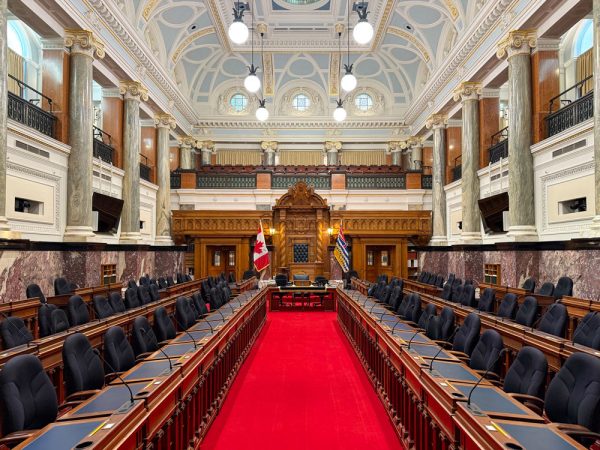

David Eby already had what most politicians spend their careers trying to acquire. He was premier of British Columbia. His party held a majority in the legislature, albeit by the narrowest possible margin. And with roughly two years left before the next scheduled election, he had something else politicians rarely enjoy: time. On September 22, he called an election anyway, asking voters to return to the polls on October 24.
The narrow majority is the government’s strongest defence, and it deserves a fair hearing. In April, the government retreated from its plan to suspend parts of its Indigenous rights legislation after an NDP MLA told Eby she could not support it. Eby had declared the legislation a matter of confidence, meaning the government could fall if it lost the vote.
But that weakness was partly of his own making. Eby staked the government on that vote, and he had earlier used the possibility of an early election to pressure his caucus. A premier whose hold on power has weakened has reason to want a stronger one. But a narrow majority is not a deadlock, and a crisis partly of one’s own making does not automatically justify an election.
Eby’s public argument focused on an external threat: Donald Trump’s trade policies and the need for a fresh mandate to protect B.C.’s economy. His other reason was more candid. The opposition was divided, and that division, he said, made him want to “call this election and take advantage“.
The advantage was difficult to miss. The official opposition had no permanent leader. Hamish Telford, a political science professor at the University of the Fraser Valley, said calling an election under those circumstances breaks a long-standing understanding in Canadian politics. The vote would also take place one week after B.C.’s municipal elections, despite local leaders’ requests to avoid the overlap.
The political opportunity was apparent. So were the questions it raised about democratic fairness.
This tension extends well beyond one premier. Governments need security to govern: enough time, support and authority to carry out their promises. Citizens need a different kind of security: the assurance that government power remains limited, accountable and capable of being taken away. A healthy democracy needs both. The difficulty begins when governments use their existing power to improve their chances of keeping it.
Which raises the question: when is power enough?
From inside government, a majority looks different than it does from outside. Every vote, poll, caucus disagreement, and unexpected crisis is a reminder that today’s authority may disappear tomorrow. Politicians can hold power without ever feeling secure in it.
Psychology offers part of the explanation: people fear losing what they have more than they value gaining the equivalent, and that fear can push them toward risk. But it has limits in Eby’s case. His polling had recently improved, and his opponents were divided. He faced uncertainty in the legislature but saw opportunity at the ballot box. Insecurity helps explain why politicians keep seeking more power. Opportunity helps explain why Eby chose this moment.
Both can be true, but they are not the same.
Governments enter office to accomplish things, and to accomplish them they must stay in office. The danger comes when that relationship reverses and staying in power becomes the goal. A government may sincerely believe its policies are essential and that losing office would put them at risk. From there, winning another election can begin to look like a public duty rather than a political advantage. The belief may be entirely genuine. That is what makes it hard to challenge. When a government sees its own interests as the public’s, it can start to see limits on its power as an obstacle to doing good.
Take Eby’s argument about Trump’s trade policies. The threat is real, and it emerged after the 2024 election, so voters haven’t judged the government’s response. A major change in circumstances can justify seeking a new mandate. But the threat is not new. It has shaped policy for well over a year, and Eby’s government has kept governing throughout. It also isn’t clear what a new mandate would allow the government to do that it cannot do now. A promise to protect B.C.’s economy is broad enough to cover almost any policy, making it difficult to know what additional authority voters are being asked to grant. Political observers have already questioned whether voters will accept the explanation.
Governments can choose when to call an election. They cannot control what voters think about being asked. Voters may resent the interruption or conclude the election is unnecessary, turning a contest over who should govern into a debate over why it was called at all.
The concern also goes beyond voter reaction. An opposition without a permanent leader has less time to organize and make its case. Municipal candidates, already campaigning, must compete with a provincial election for attention, volunteers and public discussion. Neither circumstance prevents a fair election. But both raise the question of whether the government weighed the wider democratic process or only the timing that suited it best.
Early elections are not inherently illegitimate. A government that loses the legislature’s confidence may have little choice but to return to voters, and a major new policy direction may justify seeking public approval first. But there is a difference between asking voters to settle a question that needs answering and asking them to improve a government’s political position.
Political insecurity is usually seen as a politician’s problem. In a democracy, it is also a design feature.
The two kinds of security are not necessarily opposed: stable governments deliver reliable services and make long-term decisions, and citizens benefit. The tension arises when a government’s efforts to strengthen its position weaken the safeguards that protect the public. Elections, legislatures, a free press, and opposition parties make governing slower and less predictable. That is part of their purpose. They keep political authority answerable to people other than those exercising it.
Yet that discomfort tempts people to escape it. A narrow majority wants a larger one. A government facing opposition wants fewer obstacles. A government under scrutiny wants more control over its message. Each desire seems reasonable alone. Together, they form a pursuit of security with no natural stopping point.
Having the legal power to call an election is not the same as having a convincing democratic reason to do so. B.C.’s fixed-election-date law was introduced in part to limit governments’ ability to choose dates for partisan advantage. The power to call an early election remains, but that does not make every use of it equally justified.
Consider Eby’s reasons in that light. The Trump threat is serious but does not clearly require an election now. The divided opposition better explains the timing, and an opportunity to gain seats is not a public need. The case for this early election is unconvincing, even though it is legally permitted.
Winning an election does not give politicians ownership of the authority they receive, or entitle them to every advantage the law allows. Legitimacy also depends on how governments exercise power between elections, including their willingness to respect limits that may be politically inconvenient. Governments will always argue for loosening those limits: larger majorities bring stability, faster decisions deliver results. Sometimes they are reasonable. But efficiency cannot answer every question about political power. The rules and conventions that constrain governments are part of what makes them accountable.
So, when is power enough?
Never, perhaps. Every majority can be made larger. Every mandate eventually expires. The more important question is not whether politicians ever feel secure, but how they respond to the fact that they cannot.
Democracy works because those who govern can lose the authority they hold. That possibility gives elections meaning and ensures citizens retain the final say. Effective government requires stability, continuity and confidence. But there is a difference between enough security to govern and enough security to govern without meaningful challenge. That difference is the whole matter.
A democratic leader’s measure is not how much power they win or keep, but how willingly they accept the uncertainty that comes with it. Power isn’t something politicians are supposed to secure for themselves. It is something the public lends them, with the right to take it back.
***
Erick Villagomez is the Editor-in-Chief at Spacing Vancouver and teaches at UBC’s School of Community and Regional Planning. He is also the author of The Laws of Settlements: 54 Laws Underlying Settlements Across Scale and Culture. This series is part of an ongoing effort to make urban governance and city-building more accessible to a broader public audience.