
Recently, a family member told me about a survey they participated in concerning municipal taxation. The questions gradually worked toward a familiar dilemma: would they prefer to freeze their property taxes, even if it meant reducing municipal services, or pay more to maintain those services?
They chose the tax freeze.
Their reasoning was simple. Their child had grown older and no longer needed many of the services their family had once relied on, particularly community centre camps and recreational programs. Those services had been enormously useful at one stage of their lives. Now, they were less relevant.
I found the answer interesting, not because it was unreasonable, but because of how the question was framed. Our relationship with the city changes throughout our lives, and property taxes don’t establish a direct link between what we contribute and what we receive. A choice between freezing taxes and cutting services makes it easy to answer from where we stand today.
It’s also the choice election promises often invite. Consider how ABC Vancouver has again promised a zero property tax increase for 2027. But what does that actually mean for the everyday workings of a city?
What Exactly Is Frozen?
A zero property tax increase sounds straightforward. Last year’s taxes remain this year’s taxes. For households facing rising costs, that can be attractive. But municipal taxation is more complicated than it appears, and individual bills can shift with assessments even when the overall levy doesn’t.
Vancouver’s 2026 budget shows what a freeze looks like in practice. In November 2025, City Council approved a $2.39 billion operating budget with no increase in the municipal property tax rate. The City reported that balancing it required identifying $120 million in savings and new revenue opportunities while maintaining selected frontline services and continuing planned infrastructure investment.
Yet total operating revenue was budgeted to increase by approximately $50 million compared with 2025. Property tax revenue itself was expected to grow by $9.3 million, while revenues from programs, parking and bylaw fines were also expected to increase. A frozen tax rate, in other words, did not mean frozen municipal revenues.
Nor did it mean frozen bills. Property taxes account for approximately 56% of Vancouver’s operating revenue, according to a recent report by the University of Toronto’s Institute on Municipal Finance and Governance (IMFG). The remainder comes from utility charges, service fees, parking revenues and other sources.
In 2026, average utility charges rose 4.2%, roughly $107 annually for a single-family home, which the City attributed to ageing infrastructure replacement and higher regional water and sewer levies.
The City’s July 2026 financial sustainability report also identified $40 million in additional budgeted non-property-tax revenue compared with 2023. Annual contributions from the Property Endowment Fund to the operating budget had grown from $9 million in 2022 to $23 million in 2026.
So, a zero property tax increase describes only one part of the city’s finances. It doesn’t tell us whether costs have increased, decreased, or simply shifted elsewhere. Understanding a freeze means distinguishing recurring savings, alternative revenues, service reductions, and deferred costs.
The City Doesn’t Stop Getting More Expensive
Vancouver must pay for policing, fire protection, parks, libraries, community centres, transportation infrastructure and numerous other services. Collective agreements establish wage obligations. Even maintaining the same level of service can require additional expenditure.
Municipal spending deserves scrutiny, too. Vancouver’s inflation-adjusted operating expenditures grew by an average of 2.2% annually between 2010 and 2024, compared with population growth of 1.4%. This raises questions about expenditure growth, although the figures alone cannot establish whether it reflected inefficiency, changing service standards, or growing responsibilities.
A zero property tax increase doesn’t eliminate these pressures. It requires the city to accommodate them through some combination of operational efficiencies, expenditure reductions, alternative revenues or changes to its financial plans.
These approaches are not interchangeable.
A library that purchases supplies more economically has achieved an efficiency. One that closes an additional day each week has reduced its service. A city that coordinates road reconstruction with underground utility replacement may save money. One that postpones necessary maintenance may simply transfer costs into the future.
All can produce immediate savings. Their longer-term consequences are very different.
The Hidden Cost of the City
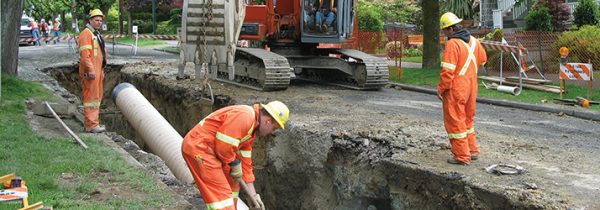
Some of the most consequential municipal expenditures are also among the least visible. Consider the water main beneath your street. Most residents rarely think about it. They turn on a tap and expect clean water. Yet like roads, sewers, fire halls and community centres, these systems require continuous investment and eventual replacement.
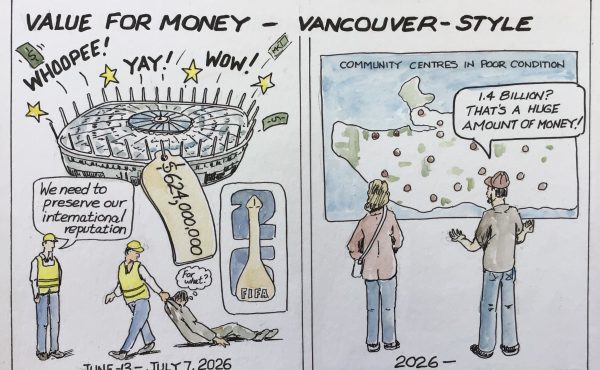
The scale of the challenge is considerable. According to Vancouver’s 2027–2030 Capital Plan, maintaining the city’s existing infrastructure in good condition requires an estimated $800 million annually. Property taxes and utility fees provide about $300 million, leaving an estimated annual funding gap of $500 million. The City’s Auditor General also found that 72% of its recreation facilities were in poor or very poor condition.
Preventive maintenance is often less expensive than emergency repairs, but it’s easy to overlook politically. Residents notice a new community centre or renovated park. They’re less likely to celebrate the replacement of an underground sewer pipe, even when it is essential to their neighbourhood’s continued functioning.
A tax freeze may coexist with continued infrastructure investment, or it may involve deferring some of it. The headline tax figure can’t tell us which.
The same plan shows who is paying. Development contributions are expected to account for 21% of capital funding, down from 27% in the preceding plan, while contributions from other governments and partners fall from 14% to 6%. The City’s own share rises from 59% to 73%, supported partly by increased borrowing, which carries costs into the future.
And building is only the start. A new community centre requires staff, electricity, cleaning, programming, maintenance and eventual replacement. The cost of constructing a public facility is only the beginning of its financial commitment.
Who Pays When We Don’t?
Not everyone pays for municipal services in the same way, and not everyone benefits from them equally at any particular moment. Homeowners receive property tax bills directly. Renters generally contribute indirectly through housing costs, although tax changes don’t translate automatically into rent changes.
Households also have different capacities to absorb additional costs. The IMFG report cites household incomes of $63,200 for renters compared with $100,000 for owners in Vancouver. Higher taxes or fees may affect households differently, just as reductions in public services may have greater consequences for those unable to afford private alternatives.
How the City responds matters: funding a service through general taxation spreads its cost broadly, while relying more heavily on user fees shifts that cost toward the people who use it.
That doesn’t mean every service must be maintained indefinitely or every expenditure is justified. Governments must regularly reconsider priorities. But evaluating municipal services exclusively through our immediate personal needs can obscure their broader public purpose.
Beyond Election Promises
ABC Vancouver’s platform pairs the freeze with eliminating residential parking permit fees and paid parking at beaches and community centres, alongside investments in infrastructure and public facilities. Eliminating a fee reduces costs for those who pay it, but also removes municipal revenue. Renewing public facilities requires capital investment and creates ongoing operating obligations.
The City’s June 2026 Budget Outlook anticipates utility fee increases of approximately 6–7% annually over the following five years, alongside increases of 4–5% for services funded through cost-recovery fees. These are projections rather than approved future rates, but they illustrate the financial pressures facing the next council.
The question is how these commitments fit together.
How much of the proposed savings would be recurring? Which alternative revenues would replace forgone taxes and fees? Would existing service levels be maintained? And what would the financial implications be over several years rather than a single budget cycle?
These questions apply to any municipal government proposing to hold taxes constant, just as questions about affordability and spending priorities apply to governments proposing increases. A tax increase doesn’t guarantee improved services. A tax freeze doesn’t necessarily mean reduced services. Both must be understood in relation to what the city collects, how effectively it spends that money and the obligations it carries into the future.
The City We Share
When I think back to my family member’s survey response, what interests me most isn’t the choice they made. It’s the way the question encouraged them to think about the city. Asked to choose between higher taxes and reduced services, they understandably considered their household’s present circumstances.
But cities operate across a much longer timeline than individual households.
Children grow up. Families move. Neighbourhoods change. Public facilities serve successive generations whose needs differ, and every generation inherits both the benefits and financial obligations of decisions made before it.
A zero property tax increase is therefore more than a number on an annual tax notice. It’s one part of a larger set of decisions about public services, infrastructure, financial responsibility, and the future of the city. Understanding those decisions doesn’t require everyone to agree about how much tax they should pay.
It requires recognizing that the city we pay for is much larger than the portion of it we happen to use.
***
Related Spacing Vancouver articles:
- City Primer — Part 1: What Is Municipal Government?
- City Primer — Part 4: Why Cities Are Always Short of Money
- City Primer — Part 6: Why Civic Literacy Matters
**
Erick Villagomez is the Editor-in-Chief at Spacing Vancouver and teaches at UBC’s School of Community and Regional Planning. He is also the author of The Laws of Settlements: 54 Laws Underlying Settlements Across Scale and Culture. This series is part of an ongoing effort to make urban governance and city-building more accessible to a broader public audience.