
EDITOR’S NOTE: Spacing is pleased to again partner with Heritage Toronto on their ongoing Building Storeys exhibit at the Gladstone Hotel that has been extended until April 25. A collaborative effort by Heritage Toronto and members of the photography groups the Shadow Collective and the DK Photo Group, Building Storeys is a visual documentation and anecdotal exhibit of the city’s heritage building and sites. This is the second in a series of posts on Spacing Toronto connected to the exhibit, and is by Wayne Reeves.
The recent furore over a developer’s attack on a “John M. Lyle” house near Casa Loma highlights one argument used to preserve buildings: a structure is worth keeping because it’s associated with a major architect. Minor buildings rise in value because they teach us about the working range of important designers like Lyle.
Rather more interesting are those cases where minor architects design great buildings. Toronto’s pre-eminent example is Thomas Canfield Pomphrey and the R.C. Harris Water Treatment Plant. Who was he, and how did he get such an iconic commission?
As befits a minor personality, no golden archive of letters, journals and photos has been found. Pomphrey’s military service file contains the basics: born, November 29, 1882; birthplace, Wishaw, Scotland; height, five feet six-and-a-half inches; complexion, dark; eyes, blue; hair, black; religion, Presbyterian; marital status, single; died, March 8, 1966.
The son of a stationer/printer, Pomphrey grew up 20 miles southeast of Glasgow and studied at the elite Hamilton Academy. By 1900, he was apprenticed to architect Alexander Cullen in Motherwell and attended classes at the Glasgow School of Art. Highly respected, Cullen had a prosperous practice which included many public commissions, including hospitals, schools, court houses, police and fire stations, libraries and municipal offices.

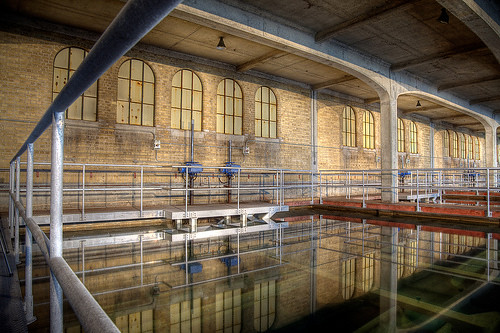
Inside RC Harris – present day (top and above photo by Timothy Neesam)
Pomphrey left Cullen’s office in April 1906 and sailed for Canada. In Toronto, he served as draughtsman for Sproatt & Rolph, John M. Lyle and Darling & Pearson between 1906 and 1915. These were among the city’s finest architectural firms, responsible for the Royal Alexandra Theatre, Union Station, Ontario Hydro buildings and numerous banks. Pomphrey was further exposed to Beaux-Arts design principles while working for New York’s Clinton & Russell in 1909-12. His annual salary in 1915 amounted to $1,500, earned by working for himself and Darling & Pearson.
A loyal British subject, Pomphrey volunteered to serve in the Great War. He was part of the active militia in January 1915 and enlisted in the 48th Highlanders three months later. Appointed acting corporal that August, he joined the 14th Battalion of the Canadian Expeditionary Force in the trenches of France in November 1915. Perhaps questioning his own leadership skills in the face of battle, Pomphrey “reverted to the ranks” and became a private at his own request in March 1916.
During an attack near Ypres in June 1916, an enemy shell fragment tore through Pomphrey’s right armpit, severing arteries and exposing nerves. His right hand was also broken. He spent the next year on a tour of hospitals in France, Scotland and England. For a professional who needed the use of both arms, the outlook was grim. A March 1917 report summed up the problem: “Shoulder, 25% limitation in elevation. Elbow, 45 deg. limitation in rotation. Wrist, 35% of active and passive movements. Hand, only very slight movement possible, at metacarpo-phalangeal joints. Other joints are held stiff in semi-flexion. Glove anaesthesia in hand.”
Pomphrey was invalided to Canada in June 1917 and returned to civilian life in Toronto. An out-patient at the Central Military Convalescent Hospital, he boarded at a house on Tranby Avenue in the Annex – an arrangement that began in 1914 and continued through at least 1945. Despite having lost the ability to use one arm and hand, he resumed his role as a draughtsman for Darling & Pearson in 1917. In May 1918, Corporal Pomphrey was finally discharged from the army. Though physically unfit for war service, his character and conduct were pronounced “very good.”
Nearing forty, Pomphrey made a critical career move. In 1920, he became staff architect for the newly formed Toronto engineering partnership of Gore, Nasmith & Storrie. Engineers William Gore and William Storrie were renowned for their work in water supply and sewage treatment; bacteriologist George Nasmith had been decorated for designing mobile water purification units for the CEF and the British Army. Nasmith, at Ypres in 1915 when the Germans used poison gas on the Allies, must especially have empathized with Pomphrey’s condition.
While Pomphrey’s appointment appeared to be a promotion, working for engineers brought new challenges. Not only did architects rarely receive credit for their work in engineering journals, they also ignored the architectural value of utilitarian public works in their own publications. Pomphrey was top dog at his new firm, but had slid down the professional hierarchy.
Engineering work was, in fact, not enough for the Scot. In 1924, the firm of Ferguson & Pomphrey won the City of Toronto’s competition for a Great War cenotaph. Their pylon, erected a year later in front of Old City Hall, was a triumph for underlings. It was also bittersweet for Pomphrey. When the results were announced, William Ferguson got the lead credit and his photo in the Toronto Daily Star. (Like Pomphrey, Ferguson was from Lanarkshire, a CEF veteran, and had worked for Lyle and Darling & Pearson.)
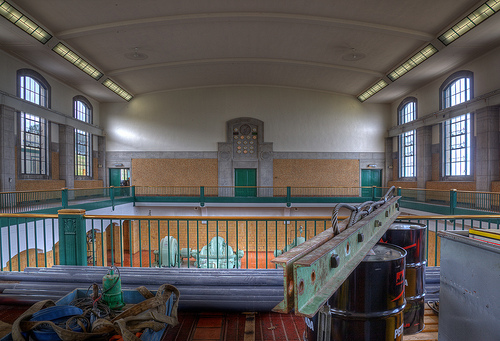
Inside RC Harris – present day (photo by Olena Sullivan)
The cenotaph would have been encountered on a daily basis by Roland Caldwell Harris, Toronto’s Commissioner of Works. Since 1913, R.C. Harris had envisioned duplicating the water supply system to meet rising demand and eliminate the prospect of water shortages or disease if any one element of the system failed. The Toronto Water Works Extension would double the city’s filtration, pumping and storage capacity and enhance water distribution. The city’s second filtration plant was planned for Victoria Park. There, Harris called for “handsome buildings, which, in conjunction with the park section and the beach, will constitute one of the most beautiful areas in Toronto.”
Progress remained slow even after City Council finally approved proceeding with the TWWE in 1927 and Gore, Nasmith & Storrie were appointed consulting engineers. Harris was in an irritable mood in February 1928 after reviewing preliminary drawings for the Victoria Park plant. “The buildings as shown on the perspective sketch appear to me to be plain and unattractive,” he told William Storrie, ordering the firm to spend more time on architectural detailing.
Harris may have just been concerned that the project was not measuring up to his long-stalled civic vision and that it would be a disappointment to Torontonians. Or, perhaps knowing that Toronto was to host the American Water Works Association’s conference in 1929, he wanted confirmation that the delegates would take away an unforgettable image of the city’s aspirations.
In any event, Pomphrey returned to his drafting table to mull over Harris’s rebuke. At that point, his stock had no where to go but up. The June 1928 pay log for the TWWE identified him simply as an “engineering assistant.” His billing rate was $10.50 per day, a fraction of the $100 charged by his bosses, Gore and Storrie.
Pomphrey’s revised design for the Victoria Park plant was unveiled in 1929. The rendered ink-and-wash drawing of the filter/administration building and terrace became the emblem for the $14 million TWWE, accompanying all articles about the project until the plant was actually constructed. Pomphrey’s role, however, was never mentioned.
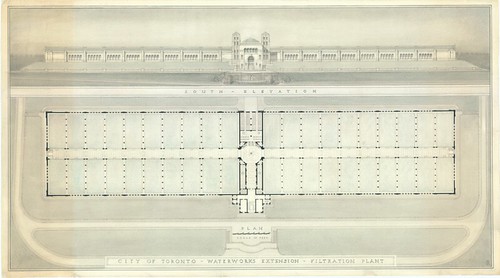
T.C. Pomphrey’s design for the filter/administration building and the terrace at Victoria Park, 1929. The “rooms” are filter basins, each capable of purifying 5 million gallons of water per day. In the drawing’s lower right-hand corner are the initials “TCP.” Image courtesy of CH2M HILL Canada Limited.
Writing in the Contract Record and Engineering Review in June 1929, William Gore summed up the plant’s design: “The architectural appearance of the building, which will be of reinforced concrete faced with buff brick and coursed stone, should be pleasing, lending itself to the unique nature of the site above a cliff overlooking Lake Ontario. The grounds will be suitably laid out and planted, and provided with a protection wall and promenade at the water’s edge. The principal floors of the buildings will be laid to designs in terrazzo and a sparing use will be made of decorative marble in the main corridors and central octagonal hall. In the latter will be provided master gauges, clocks and signalling apparatus carried upon a neatly designed pedestal.”
Now assured of Pomphrey’s abilities, the Commissioner of Works became his patron as the project moved into detailed design and then construction. In 1931, Harris insisted that the Scot’s signature appear on everything architectural in the contract drawings. (Perhaps not coincidently, Pomphrey was admitted to the Ontario Association of Architects that year.) In 1933, Harris informed the City Architect, K.S. Gillies, that Pomphrey – not Gillies’ inspectors – would make decisions on materials, details and interpreting specifications. It was a delegation of authority Harris never extended to his consulting engineers.
Throughout the late 1920s and into the ’30s, Pomphrey assisted Gore, Nasmith & Storrie (later Gore & Storrie, now CH2M HILL) on water supply projects across Ontario, with major works undertaken in Ottawa, Hamilton and Niagara Falls. He even ventured into Alberta to design the Glenmore Dam & Filtration Plant in Calgary. Still, the Toronto Water Works Extension occupied the bulk of his time.
The first TWWE project bearing Pomphrey’s imprint was the portal and valve house at the new St. Clair Reservoir (1929-31). At Victoria Park, construction of the central block and west wing of the filter/administration building and the terrace occurred in 1932-35; the pumping station and the service building followed in 1935-37, though delays in fitting out the buildings meant the plant didn’t become operational until November 1941. Pomphrey also drew up plans for an elevated water tank at St. Clair in 1933 (the only TWWE project not implemented), and designed the surge tanks built at John Street (1935, now demolished) and along The Queensway (1940-41).
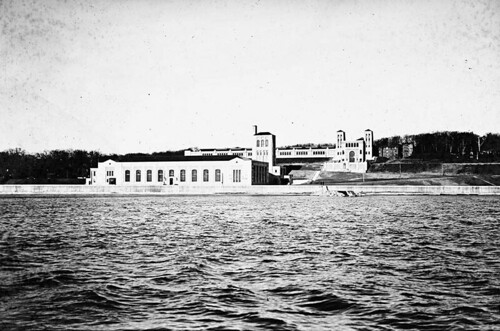
The Victoria Park filtration plant, 1936. The pumping station is in the foreground, hiding most of the service building save for its alum tower. In the background are the terrace and the filter/administration building; the east wing would be added in the 1950s, doubling the plant’s treatment capacity to 200 million gallons of water a day. The plant took R.C. Harris’s name after his death in 1945. Image courtesy of Toronto Water.
Pomphrey never saw his final TWWE project – the Parkdale Pumping Station – through to construction. Approaching his sixty-fifth birthday, he resigned from Gore & Storrie in 1947 and returned to Scotland. The station, designed in 1938, would not rise until 1952-54.
Largely ignored by the architectural fraternity and uncredited by his engineering masters, the cloak of obscurity closed around Pomphrey once he left Toronto. He likely never saw the east wing added to the Victoria Park plant in 1955-56, completing Harris’s dream for the site. Pomphrey’s death in Glasgow in 1966 wasn’t noted in any Canadian newspaper or technical journal. Even the public image of the plant declined. A 1974 guidebook by the Toronto Chapter of Architects described the buildings as “disasters both inside and out, [with] not even the end-of-tour enticement that a candy factory or a brewery can offer.”
Pomphrey’s identity and city-building contributions were rescued by Michael Ondaatje in his 1987 novel, In the Skin of a Lion. Ondaatje had Pomphrey – “the strange one from England” – accompany Harris on an inspection of the unfinished Bloor Viaduct in April 1917. “Harris spoke of his plans to this five-foot-tall Englishman, struggling his way into Pomphrey’s brain. Before the real city could be seen it had to be imagined, the way rumours and tall tales were a kind of charting.” While the details are all wrong, the greater theme of setting out a vision that others bring into being rings true.
In the novel’s climax, Patrick Lewis confronts Harris inside the Victoria Park plant and threatens to blow it up. The fictional Harris tells the fictional Lewis: “You’re as much of the [city] fabric as the aldermen and the millionaires. But you’re among the dwarfs of enterprise who never get accepted or acknowledged.” These are words the real Harris could have spoken to the real Pomphrey, forever the second-tier architect. Yet in demanding the highest quality for Toronto’s public works, it was Harris who unleashed T.C. Pomphrey’s creative potential and modestly elevated the Scot’s status amongst his fellow professionals.
Wayne Reeves, Chief Curator for City of Toronto Museum Services, authored a 1997 heritage study of the Harris plant that is now being updated with Toronto Water staff and the site’s public advisory committee. He appreciates the help provided by Steven Mannell and Robert Hill for this blog.