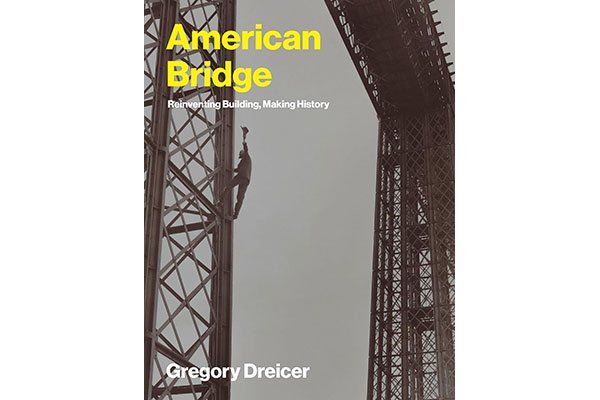

Author: Gregory Dreicer (MIT Press, 2026)
We tend to think of infrastructure as something we build. Concrete, steel, timber—assembled into roads, towers, and bridges that quietly organize our lives. But what if infrastructure is not only physical? What if it is also narrative—constructed, repeated, and reinforced until it becomes indistinguishable from fact?
Gregory Dreicer’s American Bridge: Reinventing Building, Making History begins from this unsettling premise. It is not, despite appearances, a book about bridges. Or rather, it is a book about bridges in the same way that a mirror is about reflection. The object is there, but what matters is what it reveals.
At the centre of Dreicer’s account is the nineteenth-century lattice bridge, patented by Ithiel Town in 1820—a structure composed of small, repeatable parts assembled into a seemingly improbable whole. Histories of engineering have long treated such innovations as steps in a linear progression: wood to iron, craft to industry, simplicity to complexity. But Dreicer refuses this narrative. He asks a more difficult question: not how bridges evolved, but how we came to believe that they did.
The answer, he argues, lies in what he calls “evolutionism”—a storytelling device that arranges technologies into neat, forward-moving sequences, imbuing them with inevitability and direction. These stories feel scientific, even objective, but they are anything but. They are narratives that prioritize continuity over rupture, nation over network, and progress over ambiguity. In doing so, they obscure the messy, collaborative, and often contradictory processes through which technologies actually emerge.
This is where American Bridge becomes something more than a history of technology. It becomes a critique of how knowledge itself is constructed. Dreicer shows how historians, engineers, and institutions have collectively reinforced these narratives—often unintentionally—by privileging visible artifacts over invisible processes. The bridge, as an object, becomes easier to document than the systems of labour, organization, and exchange that produced it. The result is a historical record that is materially rich but conceptually thin.
The lattice bridge disrupts this record. Its significance lies not in its form, but in its logic. It reimagines building as a process of assembly rather than craft, distributing labour across standardized parts and reducing dependence on specialized skill. In this sense, it anticipates industrialization—not through the factory, but through the construction site. Dreicer goes so far as to suggest that this transformation rivals the Ford Model T in its impact, though it has been largely forgotten in canonical accounts of industrial history.
But if the lattice bridge is so consequential, why has it remained peripheral?
Dreicer’s answer is as provocative as it is convincing, because it does not fit the story we prefer to tell. It is neither heroic nor singular. It does not belong to a single inventor or nation. It resists authorship. And perhaps most importantly, it foregrounds process—something far more difficult to narrate than object.
This critique extends beyond evolutionism to nationalism. The very term “American bridge,” Dreicer notes, is less a technical classification than a narrative construction—one that assigns identity to an artifact in order to stabilize its meaning. Yet the history he reconstructs reveals a far more fluid reality: one of transnational exchanges, itinerant engineers, and shared techniques that defy clear boundaries. “Places don’t invent,” he reminds us. “People do.”
For readers attuned to contemporary debates in planning and urbanism, these arguments will feel uncomfortably familiar. We continue to rely on simplified narratives—of supply and demand, growth and progress, innovation and inevitability—to explain complex systems. These narratives do not merely describe reality; they shape it. They determine what counts as evidence, what remains invisible, and what forms of intervention are considered possible.
In this sense, American Bridge resonates far beyond its historical scope. It offers a way of thinking about infrastructure not as a fixed system, but as an ongoing negotiation between material and meaning. The bridges we build, Dreicer suggests, are inseparable from the stories we tell about them. Both function most effectively when they remain unseen. Both become visible only when they fail.
If there is a limitation to the book, it lies in its distance from the present. Dreicer stops short of fully connecting his analysis to contemporary conditions, leaving readers to draw their own parallels. Yet this absence may also be its strength. By resisting the temptation to prescribe, the book maintains a critical openness that invites reflection rather than resolution.
That openness is not always easy to navigate. American Bridge is dense… at times demanding and unapologetically theoretical. It asks its reader to question not only what they know, but how they know it. For those expecting a conventional history of engineering, this may prove disorienting. For others, it is precisely the point.
Like the bridges it examines, the book operates as a kind of crossing—between disciplines, between narratives, between ways of seeing. It asks us to reconsider what lies beneath the structures we take for granted, and to recognize that the most consequential infrastructures are often the ones we cannot see.
The question Dreicer ultimately poses is a simple one: can we change the story?
It is a question that extends well beyond bridges—and one that feels increasingly difficult to ignore.
***
For more information about American Bridge, visit the MIT Press website.
**
Erick Villagomez is the Editor-in-Chief at Spacing Vancouver and teaches at UBC’s School of Community and Regional Planning.